Patrick, GUGP's 2015 Guide Dog Puppy

Patrick, GUGP's 2015 Guide Dog Puppy
GUGP Website
Showing posts with label service dog handlers. Show all posts

16 February 2016

Dobermans are service dogs, too!

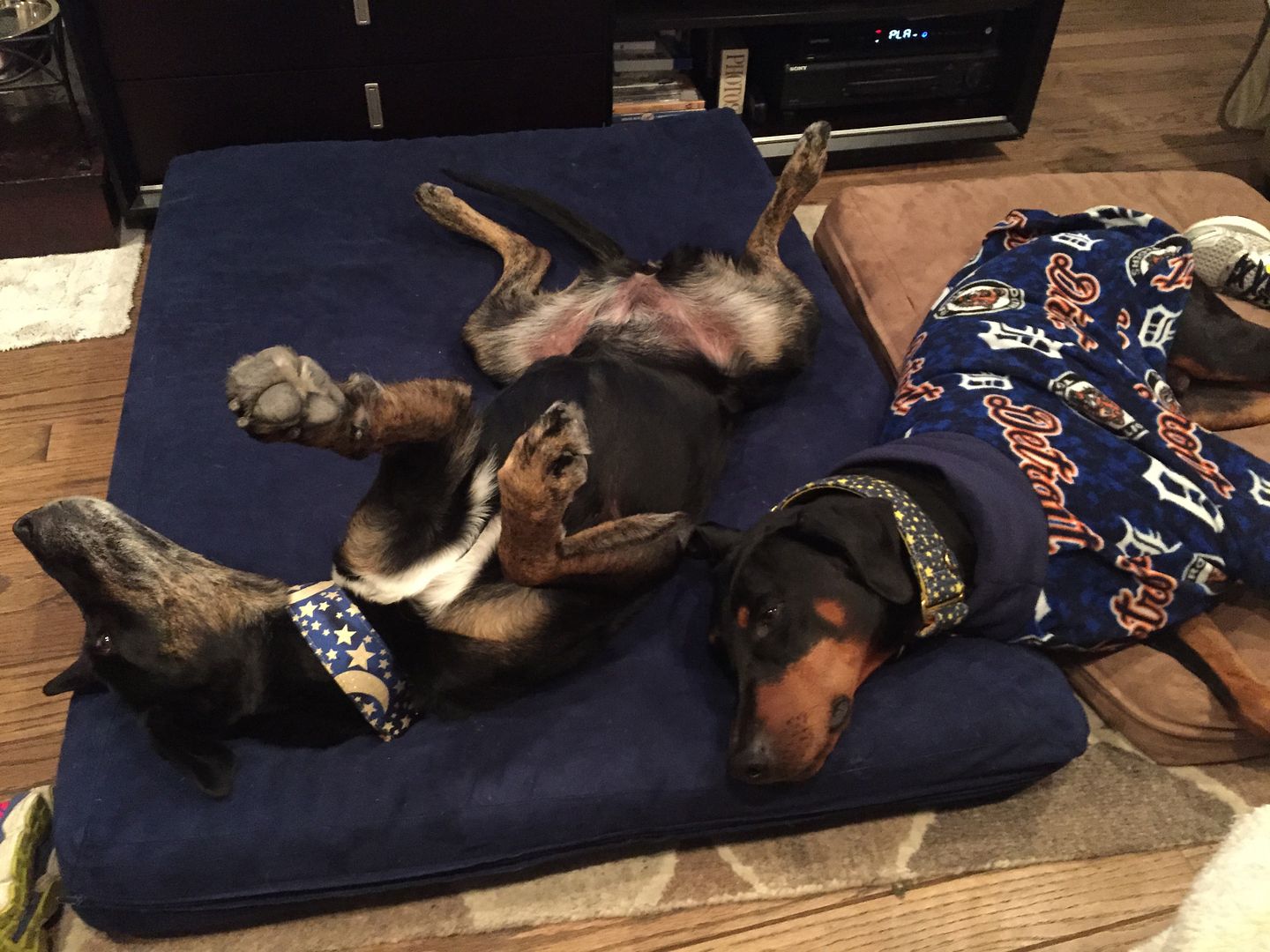
As you might have guessed, my service dog, Kaline, is a Doberman. It's not a breed that is commonly used in the service dog world, although they are gaining some popularity. Working a Doberman can sometimes be a bit different than working a Lab or Golden.

Happily for me, Kaline generally does not get questioned as to his legitimacy due to his breed. We do get a ton of comments along the lines of: "I didn't know THEY used Dobermans as service dogs!" (No word yet on the identity of the mysterious "they.") The one major access challenge we've had as a team, oddly, was because of his custom-made, very professional-looking mobility harness. Apparently it looked like some sort of extreme control device. (Pro-tip: If you try to control a dog's movements with a mobility harness, you will fail. Spectacularly.)
Kaline in his big mobility harness.
Most of the public seems conditioned to think that dogs of a certain (read: medium to large) size wearing service dog gear are "real." This has worked out nicely for me with Juno, a big black mutt who does look a little Labby, and with Kaline. You will get a little more scrutiny with an uncommon breed, as far as behavior goes, but it's generally not extreme. Obviously this is not so handy for handlers of small service dogs, who regardless of breed or impeccable behavior, seem to be viewed largely with suspicion.

If you love taking advantage of photo opportunities, Dobermans will certainly help you there. Kaline, anyway, is a huge ham. He absolutely loves to pose for photos. Where some dogs (read: Juno) require high-value bribery like string cheese to put their ears up nicely for a picture, all Kaline needs to see is that camera. Once, while he was having an off-duty romp at a beach, Kaline galloped past a guy with a massive camera who was getting pictures of the scene. Kaline screeched to a stop, made a U-turn, and began cavorting in front of the camera, much to the photographer's delight. While I don't usually like to be in photos myself, I love few things more than taking photos of Kaline looking handsome.
This was a completely irresistible photo-op.
The big issue Kaline's breed can cause is some bizarre questions and assumptions from members of the public. If I had a dollar for every time someone tried to begin a conversation by asking, "Does he bite?" Kaline's collar collection would be twice the size it is now. This should go without saying but: 1) all creatures with teeth have the capability to bite, and 2) any dog who is likely to bite without provocation should not, and generally is not, working as a service dog.

Many children will ask if he's a police dog, which I find completely adorable. Less than adorable is when parents, though usually not on a regular basis, use Kaline's breed to frighten their children away from him. While I appreciate parents who educate their kids about why they shouldn't pet working dogs, it's quite unnecessary to tell the children that if they go up to Kaline he will bite them. Kaline's major failing with kids is he really loves to kiss them. And given that he's at face level with small children, sometimes that can surprise and startle them; this is why he only gets to greet kids taller than he is.
"Of course I would love to pose on this rock!"
And then there are what I like to call the storytellers. Every service dog handler can tell you about the innumerable times someone has interrupted an errand to tell them, "My dog at home looks just like yours! Only a different breed, size, color, and gender. ... She died last night." When you have a Doberman, or other perceived "scary" breed, you get a special kind of storyteller. These are the people who, after they've asked permission to pet your Doberman, will launch into a long and intensely uncomfortable story about how they, or their sister's boyfriend's second cousin once removed, was horribly mauled by a Doberman. That's when you smile and nod—and wish you could just disappear.

You might wonder why Dobermans are so uncommon, given how fantastic they can be as working dogs. Being taller than most Labs and Goldens, they can be a better choice for people who need mobility. They tend to be very in-tune with their handlers' emotions, a plus as long as you can keep that from becoming serious separation anxiety or overprotectiveness. They're incredibly snuggly and delightfully low-maintenance when it comes to grooming. They're also fun to train and quite intelligent, if not so very biddable as Labs and Goldens.
A love of snuggling means Kaline is great at deep-pressure therapy.
However, Dobes tend not to be the best choice for first-time owner-trainers or handlers. They're much more likely to give you the "Make me, why don't you" face than a Lab or a Golden. They can also become overprotective if their handler isn't careful to curb those tendencies. They are a guarding breed, after all, and if the handler allows it, a Doberman will take on the handling of a situation, which can end badly for everyone.

They're also well-known for health problems, despite the tireless work of ethical breeders. One of the major health issues that crops up in Dobermans, as well as the most devastating, is dilated cardiomyopathy (DCM), a heart disorder that is inevitably fatal. It generally crops up in older dogs, and there isn't yet a reliable genetic test for it. By the time a breeder learns that one of their dogs has the condition, the dog is likely to have been bred already.

Dobermans aren't the greatest candidates for service dog programs, in the sense that they tend to bond very strongly to their person, and may have major difficulties shifting that bond to a trainer or trainers, and then again to a new handler. While you can't go on autopilot with any dog and expect it to maintain its training without regular refreshers, doing this with a Doberman can be especially bad.

Then you have the diva aspect. Dobermans' shiny, beautiful coats are pretty much only for show. They get cold very easily, and aren't shy in the least about informing you about their distaste for the situation. If I take Kaline to a baseball game in Oakland in the summer, for example, and don't bring his various jackets and his cocoon-blankie, he will shiver dramatically, fix me with utterly miserable puppy dog eyes, and poke me every inning to see if it's finally time to go. Ask him to lie down on a marble floor without his mat, and he'll drop his head into your lap and stare at you mournfully: "But it's so cold on the floor. I couldn't possibly lie down here."
Kaline enjoying summertime at the ballpark.
There's also the fact that almost nothing pre-made will fit them. This works out pretty well for me, since I'm a complete gear-nut and have several friends who make high-quality custom harnesses and other equipment. Nonetheless, it does tend to get expensive, and it was quite sad when the PetJoy vest that I loved to use on Juno just would not fit Kaline, no matter how I adjusted it.
My favorite old vest. Alas.
The best part of working a Doberman, when it comes to the general public, is that you attract other Doberman people. I was somewhat prepared for this, having graduated from the University of Michigan. If you wear Michigan gear anywhere in the world, you will inevitably be greeted with cries of "Go Blue!" from perfect strangers who also went to Michigan (we're everywhere). It's very similar with a Doberman. Since Dobes are not terribly common, either as working dogs or pets, lovers of the breed tend to get delightfully enthusiastic when they see one out working as a service dog.
Sometimes we attract both fellow Wolverines and Doberman aficionados.
It's lovely being able to educate receptive people about the versatility and all-around greatness of the breed. Like any breed, they're not for every person. But many times, when someone who has been scared of Dobermans all their life sees one working calmly and quietly in public, that can be just the impetus they need to ask some questions and find out that Dobes aren't scary after all. Kaline, even though his breed as a whole is usually fairly aloof with strangers, loves getting to say hi to new friends, and is so sweet and goofy that he can usually change people's minds about his breed. There are few things more gratifying than opening someone's mind about Dobermans.
Kaline makes a new buddy.

Colt

09 February 2016

Why I call my service dog medical equipment


Medical equipment comes in many forms to help mitigate many types of disabilities. There are wheelchairs, insulin pumps, canes, oxygen tanks, and more. There are also dogs. Yes, those cute, cuddly, lovable creatures that many of us just ooh and ahh over. As a dog lover myself, I definitely get that big smile and sometimes the giggles as I see a cute pup or a breed I love walking down the street or playing with their owner in the park. However, there's a big difference between a pet dog and a service dog. The latter is, indeed, medical equipment.

When my service dog, Sulley, gears up and we head out that door, he is working. He's no longer just a dog. Really, he isn't a dog anymore. He's my highly trained and very much needed medical equipment. He is my monitor for my anxiety levels to let me know before it gets out of control. He is my guide when fibromyalgia leaves me in a heavy fog and I can't think or function well. He's my movement when my legs feel like they are on fire, or when I'm extremely fatigued from living with chronic pain. He's my hands when I drop something and I worry that bending down will mean vertigo and a possible fall. He becomes as much an extension of me as any other medical equipment does for another disabled individual. He serves a very important purpose: to keep me safe and able to live my life.  
Recently we took a trip to one of our favorite places, Disneyland! Sulley loves it because it means lots of work. The crowds, the noises, and other distractions can be very triggering and very difficult for me to deal with. Without Sulley, there's no chance I would be capable of going and enjoying as much of it as I do. There's another aspect of it, though, beyond the basic over-stimulation of the parks, that makes it tough for me as a disabled individual who uses medical equipment—particularly the kind that is furry with a beating heart.

"Oh my gosh! Quick, kids! Look at the doggie! Look, look, look! Say, 'Hi, doggie!' He's so cute!"

Now, some of you might not understand what the big deal is. A parent is simply helping her children to enjoy a moment of a very adorable dog passing by. They might not even be encouraging their kids to pet, though that does happen despite Sulley's multiple stop signs and "do not pet" patches affixed to his vest and harness. Fortunately, this is such a frequent occurrence that I can share a few things that have happened in the past.

1) Due to my panic disorder, I startle extremely easily. Loud screams, even of joy, can cause me to fall and hurt myself, cause a panic attack, cause me to have such a sudden burst—then decrease—of adrenaline that it leaves me very dizzy and fatigued.
2) These noises can distract my service dog from his job due to him needing to investigate the sound, even for a second, to determine what caused it. If he's in the middle of mobility work and needs to turn quickly to investigate a sound, that can put me in harm's way.

3) He could attempt to seek attention, as he is still a dog and has off days, which would require me to correct him.

In these situations, I do my best to make a short but educational statement to people while still moving on. Confrontation is very taxing on me and can trigger my anxiety, so by keeping it short and to the point, I hope to avoid any medical issues on my end. This, in turn, makes it so the cute dog they want to enjoy doesn't have to work harder after an anxiety attack from a confrontation.

"Do not distract my service dog. He's working."

My point here is clear, at least to me.

1) Do not distract my service dog. (This is a service dog who needs to focus.)

2) He's working. (This dog has a job.)
Sulley after retrieving a credit card on the floor and placing it back on the counter.
Sadly, this is all too often met with hostility. I'm called everything from "rude" to many various expletives. I'm yelled at because "we were just saying hi!" I'm told I shouldn't have a dog in public that can't be played with.

This particular trip, it dawned on me that there was something happening with these exchanges. They didn't see or hear "service dog." They saw and heard "service dog." No emphasis in the world would help them see past the word that meant "adorable fluffy plaything here for my entertainment." They couldn't see the harm in greeting, petting, calling a dog. Obviously, he's friendly and not a biter. What's the harm? They saw a dog. They didn't see medical equipment.

The remainder of the trip, I practiced. I do my best to practice responses to people so that my anxiety won't get in the way of what I want to say. The rest of the day and back at the hotel room, I practiced. I asked friends to randomly pop questions about my dog at me. I failed at responses over and over, and grinned when I would finally get one right. The next day, I felt a bit better. I felt nervous, but ready to deliver my new responses to the public when they intruded on my day.
Sulley doing deep pressure therapy to lessen a fibromyalgia flare or panic attack.
Sulley is no longer a service dog. He is, and always has been, my medical equipment.
I placed Sulley in the crate provided at the roller coaster and began to board. An employee ran over while I struggled into my seat, squealing about my cute dog and demanding to know his breed.

Deep breaths. You've got this. You practiced countless times.

"I don't feel comfortable discussing my medical equipment."

She looks confused. Please go away ...

"No, no. I mean your dog!"

More deep breaths. Stay calm, you've got this!

"No, you mean my medical equipment."

NAILED IT! Did you see that lightbulb come on?!

Just as the employee scowled a bit and rolled her eyes, there was a pause. I could see it click in her head. She never even thought that the dog, my dog, was medical equipment. It lit a fire in me. The rest of the day, I struggled through getting the proper words out. It began to get a bit easier. I began plotting new ways to say things. What to say if someone said something terrible back to me. It was brilliant!
I felt confident and self assured that I could handle these confrontations. More and more people throughout the day had their lights turned on. Even if it was just a teeny spark, it happened every single time. Something that never happened when I explained him as a service dog.

"Ma'am, keep your child away from my medical equipment."

"Sir, do not distract my medical equipment."

"Interfering with my medical equipment is a crime."

"I am not comfortable discussing my medical equipment." (Insert rude reply.) " ... And that is why I am not comfortable. Good day!"

On an ending note, I would like to point out that never once do I say "sorry" or "please." When it comes to my safety and that of my dedicated medical equipment, it is never, ever a request. I also will not apologize for not wanting to be grilled about my medical equipment, or having it played with or distracted. This does not make me rude. It makes the person forcing their way into my personal space, and interfering with Sulley, rude.

No one, disabled or otherwise, deserves to feel intruded upon or made into a spectacle. Remember that service dogs are medical equipment, and respect their and their handlers' space.


Kymi

05 January 2016

When not to crusade

One day, I was browsing through my newsfeed on Facebook, as per usual, when an interesting photo popped up. It was a peer of mine holding her dog in a locally owned arts and crafts store. I looked at the comments, and the most recent was one of her friends asking: “Wow, they let you bring him in the store?”

For some people, this would have alarm bells ringing in their head. Because somebody is obviously going to reply, “They asked me if he was a service dog, I said yes and that’s all I had to do,” or “Ha ha, yeah, I just say he’s a service dog and they can’t kick him out.” It’s a struggle many handlers have come across. “Fake” service dogs, or more accurately, pets that are portrayed as service dogs, are certainly a problem for service dog teams. I know of some teams where the service dog has had to either go through retraining or be retired from work entirely, due to an unfortunate encounter with a pet dog in a place where the pet should not have been.

Yes, it would be a real kick to the face for this peer of mine to have responded with affirmation that she had, in fact, misrepresented her pet as a SD. Considering we have had classes and outings together, before and after Velvet and I were a working team; I should have every right to go in tooth and nail, bombs away, right? How dare she do this to me, to other teams?

No. All I had seen was a photo and the poster had not responded with any indication that she had posed her companion dog as a service dog. In fact, my phone had a notification that there was an additional comment on the photo. Scrolling down, she had responded to the person asking how she took her dog into the store. Her response: “I asked the owner if it was okay if I brought him in.” Bingo! Some stores, as long as they are not violating health department codes, are pet friendly. I commented explaining how some non-pet stores can be pet-friendly, and was thanked for the explanation.

Now, imagine if I had gone in prepared to start a war over this. Feelings probably could have been hurt over my assumption. Rather than being known as a friend who would gently educate, I would be known as a trouble-maker who can’t enjoy a good photo of a cute dog in a dog-friendly store. Also, this person knows I am a service dog handler. What example would I be setting for her as one of her few, possibly only, friends who uses a service dog to mitigate a disability?

How long did it take to avoid potentially starting a fight? About five minutes. Unless a person is blatantly saying, “I’m just saying my pet is a service dog to get him into stores,” we cannot know the full story behind a picture. Many people are uneducated about the laws behind service dogs. How many handlers knew all of the laws before utilizing a service dog to improve their daily life?

I am not saying to sit every person down and start with the history of service dogs being utilized. You do not have to go out of your way to educate, especially when you have your own daily life schedule to attend to. All I am saying is, be kind and do not make assumptions. Proper education of service dog laws in America is desperately needed. Simple misunderstandings due to  lack of service dog education are experienced by different teams every day, such as a greeter saying “Dogs aren’t allowed in here,” or a child exclaiming, “I didn’t know they let dogs in here!” It doesn’t take an entire lecture to gently educate these simple misunderstandings.

With the emergence of social media, many people have assigned themselves the task of hunting down fakers. Do some people blatantly pose their pets as service dogs, knowing exactly what they are doing? Of course. There are also many other cases that could be the story which people do not know. What if the person has been advised by their health professional to get an emotional support animal and is not educated about the different between ESAs and service animals?  What if the individual does have a disability that could be mitigated by a service dog specifically trained to assist with the individual, but doesn’t know how to get started? Until the full story is posted, assumptions should not be made about a snapshot.

Many misunderstandings service dog users encounter with the public are not direct insults to the team, but simply a lack of education. This is why I am glad Growing Up Guide Pup is dedicating themselves to educating the general public in various ways. Aside from laws, Growing Up Guide Pup also showcases the adventures of puppy-raising, introducing readers to the various types of service dogs, and much more. Even as a service dog handler, I love reading the articles that are posted by guest bloggers and watching Matt and Amie’s vlogs of their puppy raising adventures. The website, videos, and social media tools utilized by GUGP are a vault of valuable educational tools.

Sara

02 December 2015

Service dog retirement

When a service dog retires, it's different from washing out or being career changed. A dog who retires had, at one point, everything required to be a service dog. A dog who washes out is in one way or another unable to be a service dog.
Some service dogs retire themselves. One day, you realize your dog isn’t quite as excited as she used to be about getting “dressed.” Or that he isn’t as enthusiastic about doing his tasks. Maybe he’s even reluctant to do certain things. It’s very important to remember that no one forces a service dog to work, and sometimes they just decide that they’re done.

Some dogs have to be retired—they still want to work, but they are no longer able to do their job safely and comfortably. This happened to my first service dog, Juno. At age five, she was diagnosed with sudden acquired retinal degenerative syndrome (SARDS). This genetic defect causes blindness. Her vision was restored by an experimental treatment for about two years, but then I noticed her vision deteriorating again. She couldn't navigate as well in the dark and got startled if touched suddenly on the left. Around that time she was also diagnosed with spinal arthritis.

She still wanted to work. In fact she still wants to work—despite the fact that she's almost nine now, and completely blind in her left eye. Anytime she knows I'm getting Kaline ready to go, she bounces around us and sometimes hands me her leash. 
Juno knows how to pull on the old heartstrings.
But it's no longer safe or appropriate for her to work in public. Her spinal arthritis means that mobility tasks like counterbalance or momentum pull are painful, even if she doesn't show it. Due to her visual impairment, she can't help me navigate a crowd or find an exit. She also can't see surprises coming and would constantly be getting startled. It's just not right to put her in that position. Dogs are very stoic and dedicated creatures, Juno especially so. Just because she still wants to work doesn't mean it's okay to let her. As the person in the partnership, it's my responsibility to make decisions that are in her long-term best interest, even if those decisions make both me and Juno unhappy in the short-term.

Just because Juno can’t work in public doesn’t mean she can’t help at home. Helping at home—her favorite tasks have always been retrieving and opening the fridge, both of which she is still very capable of doing—is a big deal for her. She loves it and it makes her feel useful. Also, it gives Kaline a bit of a break, since he isn’t as excited about doing those tasks.

For an owner-trainer like me, it’s much easier when you can retire your service dog gradually. It gives both of you time to get used to the idea, for one. It also gives you time to get used to your up-and-coming partner. Thanks to the experimental treatment, I was able to do this with Juno. I freely admit that there were days when I was just not up to taking the puppy in public and having to deal with being in trainer-mode every minute. On those days, it was wonderful to just put Kaline in his crate and head out with my fully trained girl, who knew exactly what she was supposed to be doing without being told (most of the time). And by the time Juno had to stop working completely, it wasn’t as much of a sudden change for her—or me.

When a service dog retires, there’s always the question of where they will go. Many handlers keep their retired dogs as pets. When this isn’t possible, the dog is rehomed. Some handlers don’t have the funds or the space to care for a pet dog; some are in situations where they aren’t permitted a pet, even a retired service dog. If the dog came from a program, often she will be offered back to her original puppy raisers. There are also long waiting lists of people waiting to adopt these retired service dogs.

In Juno’s case, she’s in what I like to call joint custody. Kaline and I have our own apartment, which does not allow pets, so Juno officially lives with my parents. This is a win for everyone (with the possible exception of Kaline, who is filled with unrequited love for his big “sister”). 
Kaline and I still spend a lot of time hanging out with Juno.

Juno is still with me nearly all day during the week, since she is my trusty sidekick for walking my packs of dogs. 
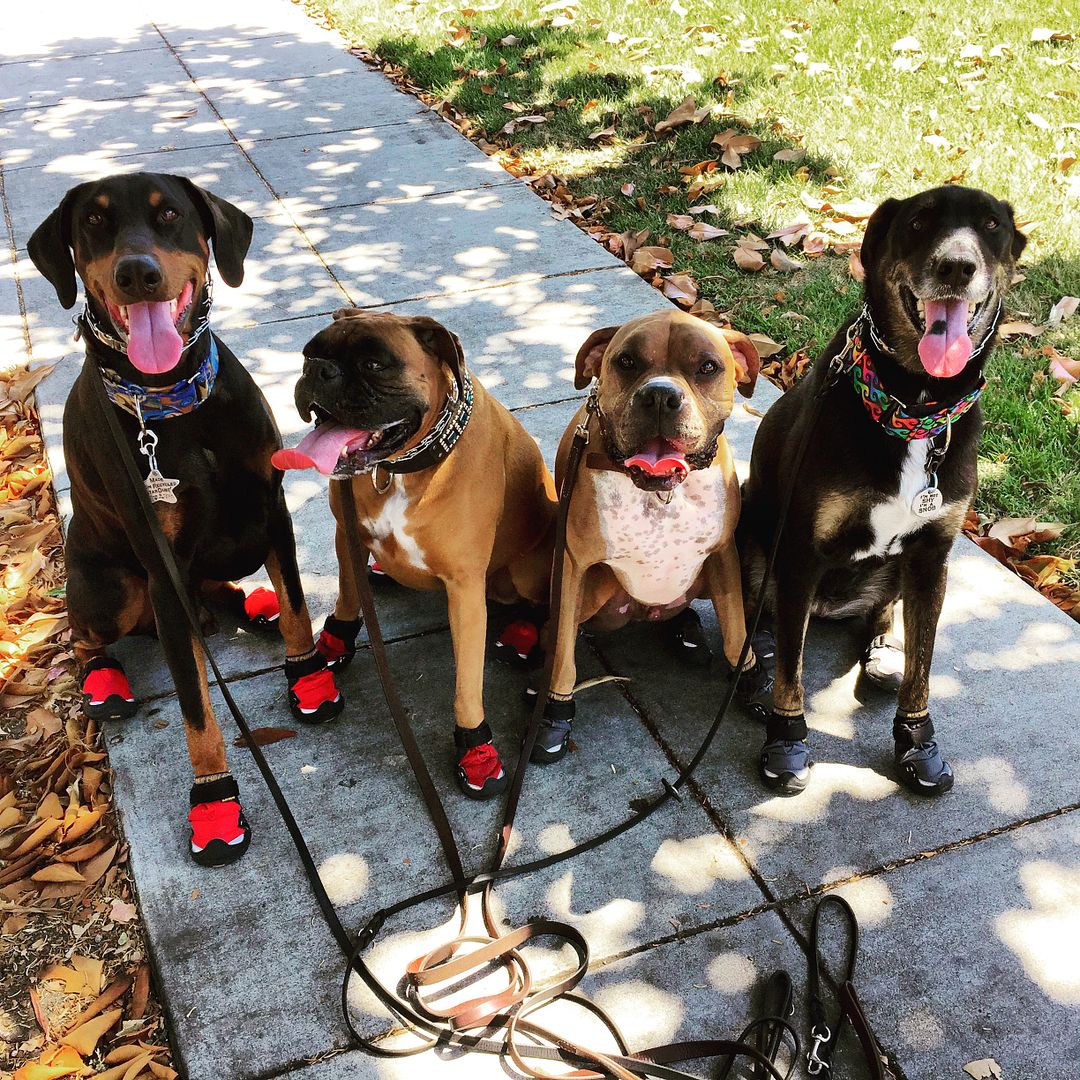
Juno, Kaline, and our Boxer packmates.
She also comes to my training job with me, unless it’s cold and/or wet. But she also gets a nice break every night from her loving but sometimes very annoying little “brother.”

Juno loves retirement. When Kaline and I head off for a trip, she gets to go have “spa time” with her Auntie Sonja and her devoted suitor, Sonja’s service dog Chief. Instead of working, she gets to hike off leash and go running on the beach. 
She also clearly enjoys not having to be quite so professional. Juno is still the queen and not interested in paying any attention to strangers who lack food offerings. 
The patented feed-me face.
But she loves making sad puppy eyes at all meals (it usually works), and being able to greet her human friends with wounded-bear sounds, kisses, and tail thwacks any time she sees them. After all Juno's hard work, it's great to see her getting to enjoy her retirement to the fullest.


Colt

17 November 2015

The Gift

I sometimes find it ironic that one of the biggest gifts I’ve ever received was given to me by complete strangers. I usually reserve the most valuable, time-consuming presents for my close family members, so the idea that someone would put such great effort into a gift for a stranger is, at times, baffling to me.   


The idea that someone would prepare such a gift 38 times is downright mind-boggling.


But that’s exactly what my dog, Roja’s, puppy raisers did. They raised 38 puppies prior to Roja. Of course, not all of those became guide dogs and not all of them were long-term raising situations, but from what they shared, they have seen a significant number of their pups graduate as guide dogs. In Roja’s case, they actually co-raised her with another family, due to work scheduling issues. The cooperation of two remarkable families resulted in the creation of a very adaptable, calm guide dog, which is exactly what I needed.


My raisers’ hours of work and play with Roja resulted in a  4-legged angel with a set of eyes that help me move smoothly through life. As if that gift weren’t enough, my raisers gave me other gifts on graduation day. They brought a toy they made for Roja, but more meaningful to me, they gave me the words I needed to hear that day. They told me that they could tell Roja was meant to be a guide dog from the time she was a puppy.


Before meeting them, I had been nervous that the interaction would be difficult, that maybe they’d be sobbing over the sadness of saying goodbye to her, as I had heard some classmates describe about their graduation day meeting with their previous dogs’ raisers. Such a reaction would have been understandable to me. I know that puppy raisers wake up in the middle of the night with their puppies in the early days, that they spend countless hours working with and training these pups that are constantly by their side and become part of their families. It wouldn’t have surprised me nor annoyed me in the least if there had been tears.


One of my classmates had told me that her first raisers had told her they had hoped the pup would never make it as a guide dog so that they could have adopted it instead. She felt bad taking their pup as her guide dog. Even this remark, as awkward as it sounds, is understandable to me. I could see how the sheer amount of time and effort spent raising a puppy could evoke such feelings. But I had also heard about raisers who gave incredible reassurance and encouragement to new guide dog users on graduation day.        


One classmate told me that his first puppy raiser’s parting words were: “She may be our puppy, but she’s your dog.” I appreciated hearing the distinction put in those words.


And I appreciated the words of encouragement from Roja’s raisers. I think after raising so many dogs, they had learned to detach themselves emotionally, and maybe since she was co-raised, they weren’t as attached. But they put a tremendous amount of time and effort and love into a puppy that they eventually gave up for a complete stranger. And then, as if that weren’t enough, they drove several hours to send Roja off with a proper farewell, and they offered that same stranger the gift of letting yet another puppy go graciously and with meaningful words.


They later sent me an email, telling me that they both felt that Roja seemed happy with me. They had no idea how much I doubted Roja’s and my bond at the beginning, so the idea that they would encourage me in that exact area  meant so much to me, especially since they had spent enough time with her as a puppy to assess whether she looked happy.

The interesting thing about receiving such a sizable gift from strangers is that there’s no suitable gift I can give in return that would be able to convey my gratitude. I gave Roja’s raisers framed pictures of Roja and myself, which seemed almost comical in its simplicity on graduation day, compared with the gift that would be leading me home. I can only hope that Roja’s raisers received an intrinsic gift as they watched Roja and me graduate. That watching a stranger gain newfound mobility, confidence and freedom as a result of their sacrifice made it somehow worth it for them. I have the sense that this must be true, or they wouldn’t have continued raising pups all these years. Even if it’s not an equal exchange, however, that’s the best part about gifts. When given genuinely, they are given without expectation, even to strangers.


Joy Thomas