Patrick, GUGP's 2015 Guide Dog Puppy

Patrick, GUGP's 2015 Guide Dog Puppy
GUGP Website
Showing posts with label distractions. Show all posts

15 March 2016

My puppy keeps barking!

Barking is a natural behavior for dogs, and some dogs bark more than others. Some bark at certain things, some bark at everything. Sometimes it is an alert bark, sometimes a happy bark, or sometimes a protective bark. But for a service dog, barking is almost always a no-no. Nobody wants to be seated in a restaurant at a table next to a dog that barks because they heard a noise or someone that looks weird to them walks by. Or be in a hotel room next to another room that has a dog staying in it that barks at every bump or noise. One of the worst is walking with your own dog and having someone else walk by with a crazy reactive dog that goes nuts when it sees your dog. Unfortunately, I seem to be the poor person walking by with the crazy dog-reactive dog.
Patrick barking at other dogs has been an issue since we got him as a baby puppy. He is great with dogs he knows but very reactive when he sees dogs he doesn’t know. Around 14-16 weeks of age he was making pretty good progress and doing better and we were very excited by his progress. And then while on a hike (on a trail where dogs are supposed to be leashed) an off-leash Golden came running up to Patrick, Ricki, and me. It stood in front of us and stared. Well, Patrick really didn’t like that and went into a huge barking fit that went on even after the owner of the dog came and took it away from us. That one moment set Patrick’s progress back—all the hard work and training seemed to just disappear. After that day, Patrick was very reactive with almost every dog he saw on a walk or out in public. We had to start our training all over again.
How can you fix this issue? Every dog is different and will respond to training differently. This is our first time working a puppy through this specific issue. I have raised puppies in the past that were very fearful of different situations and the best thing for them was to take a break for a few weeks and not expose them to what was bothering them. Patrick, on the other hand, does better the more stimuli you give him. As an experiment I decided to take him to a pet expo a few months ago where we knew lots of dogs would be there. He barked a little bit with excitement when I got him out of the car, but then no more while we were there. Although I had a hard time keeping him from pulling at times while walking, to my surprise he was quiet despite being around over 100 strange dogs. Now this hasn’t fixed the problem but it was definitely a step in the right direction. 
Since then I have been working Patrick to walk quietly around dog parks—not in them, just around them. There are multiple dog parks close to where we live, so it is easy to work him at many different locations. My goal is to be able to walk Patrick up to the fence and have him watch the other dogs inside running and playing, all while being able to remain calm and quiet. We aren’t there yet but making baby steps. 
We are also making trips to pet store, where the goal is to be able to walk calmly and quietly through the store even if he sees another dog. Once again, he isn’t perfect at this yet, but making progress. For me, it is a lot less embarrassing to be in a store that allows dogs if Patrick lets out a bark or two, than in a store where we may run into a pet dressed as a service dog and he lets out a couple of barks (and yes, this has happened). 

Patrick can smell if there is a dog close by him and his body language does change. One time, we were shopping in Target and I noticed his body language change. Sure enough, someone was passing by with a small dog in the shopping cart. I got lucky that Patrick didn’t see it in the cart and we were able to continue without any outbursts. 
We are also now attending dog training classes to get Patrick around other dogs in a controlled setting. I purposely put him in a class called “dogs with attitudes” so that he would at times be “set up” to be around other dogs that bark at things, because he will often bark if another dog by him barks first. After attending two classes I already see some improvement. I did have to laugh a little bit when I first joined that out of the seven dogs in attendance five of them were German Shepherds.

I will admit that I do get a little anxiety when working Patrick in public. I never know when we will come across another dog. While Patrick is doing much better when multiple dogs are around him, it seems to be the surprise appearance of a single dog that sets him off the most. His barking is embarrassing at times.One time we were walking in a mall and he saw another dog across they way and barked. He completely frightened the people walking in front of us, who had no idea that Patrick was behind them. Not to mention that a 65-pound Shepherd barking can be a little scary to some people. 

Another time we were having lunch with a friend and were seated outside on the sidewalk because Ricki and Ozzy were there as well. Along came a person walking down the sidewalk with their dog. That dog barked at us and then everyone was barking. That was probably our most embarrassing moment.
Patrick’s barking issue isn’t going to away overnight. Issues like this take a lot of time, work, guidance, and patience to get through. Despite this issue being frustrating and embarrassing at times, I still have high hopes for Patrick. He has been making progress in the right direction and he is so solid on almost every other aspect a working service dog needs. He settles nicely, has great relieving habits, is very confident, super smart, loves to learn new things, and most of all seems to love to work. I hope that by sharing some of my struggles with Patrick’s training I can help other people who are raising not feel so alone with their struggles. Puppy raising is a journey with good days and, well, let’s just say not so good days. I have learned with past puppies not to give up when things are hard—sometimes they will really surprise you. Some puppies take a little longer to mature and learn, so give them a chance to grow and learn at their pace.

Amie

09 February 2016

Why I call my service dog medical equipment


Medical equipment comes in many forms to help mitigate many types of disabilities. There are wheelchairs, insulin pumps, canes, oxygen tanks, and more. There are also dogs. Yes, those cute, cuddly, lovable creatures that many of us just ooh and ahh over. As a dog lover myself, I definitely get that big smile and sometimes the giggles as I see a cute pup or a breed I love walking down the street or playing with their owner in the park. However, there's a big difference between a pet dog and a service dog. The latter is, indeed, medical equipment.

When my service dog, Sulley, gears up and we head out that door, he is working. He's no longer just a dog. Really, he isn't a dog anymore. He's my highly trained and very much needed medical equipment. He is my monitor for my anxiety levels to let me know before it gets out of control. He is my guide when fibromyalgia leaves me in a heavy fog and I can't think or function well. He's my movement when my legs feel like they are on fire, or when I'm extremely fatigued from living with chronic pain. He's my hands when I drop something and I worry that bending down will mean vertigo and a possible fall. He becomes as much an extension of me as any other medical equipment does for another disabled individual. He serves a very important purpose: to keep me safe and able to live my life.  
Recently we took a trip to one of our favorite places, Disneyland! Sulley loves it because it means lots of work. The crowds, the noises, and other distractions can be very triggering and very difficult for me to deal with. Without Sulley, there's no chance I would be capable of going and enjoying as much of it as I do. There's another aspect of it, though, beyond the basic over-stimulation of the parks, that makes it tough for me as a disabled individual who uses medical equipment—particularly the kind that is furry with a beating heart.

"Oh my gosh! Quick, kids! Look at the doggie! Look, look, look! Say, 'Hi, doggie!' He's so cute!"

Now, some of you might not understand what the big deal is. A parent is simply helping her children to enjoy a moment of a very adorable dog passing by. They might not even be encouraging their kids to pet, though that does happen despite Sulley's multiple stop signs and "do not pet" patches affixed to his vest and harness. Fortunately, this is such a frequent occurrence that I can share a few things that have happened in the past.

1) Due to my panic disorder, I startle extremely easily. Loud screams, even of joy, can cause me to fall and hurt myself, cause a panic attack, cause me to have such a sudden burst—then decrease—of adrenaline that it leaves me very dizzy and fatigued.
2) These noises can distract my service dog from his job due to him needing to investigate the sound, even for a second, to determine what caused it. If he's in the middle of mobility work and needs to turn quickly to investigate a sound, that can put me in harm's way.

3) He could attempt to seek attention, as he is still a dog and has off days, which would require me to correct him.

In these situations, I do my best to make a short but educational statement to people while still moving on. Confrontation is very taxing on me and can trigger my anxiety, so by keeping it short and to the point, I hope to avoid any medical issues on my end. This, in turn, makes it so the cute dog they want to enjoy doesn't have to work harder after an anxiety attack from a confrontation.

"Do not distract my service dog. He's working."

My point here is clear, at least to me.

1) Do not distract my service dog. (This is a service dog who needs to focus.)

2) He's working. (This dog has a job.)
Sulley after retrieving a credit card on the floor and placing it back on the counter.
Sadly, this is all too often met with hostility. I'm called everything from "rude" to many various expletives. I'm yelled at because "we were just saying hi!" I'm told I shouldn't have a dog in public that can't be played with.

This particular trip, it dawned on me that there was something happening with these exchanges. They didn't see or hear "service dog." They saw and heard "service dog." No emphasis in the world would help them see past the word that meant "adorable fluffy plaything here for my entertainment." They couldn't see the harm in greeting, petting, calling a dog. Obviously, he's friendly and not a biter. What's the harm? They saw a dog. They didn't see medical equipment.

The remainder of the trip, I practiced. I do my best to practice responses to people so that my anxiety won't get in the way of what I want to say. The rest of the day and back at the hotel room, I practiced. I asked friends to randomly pop questions about my dog at me. I failed at responses over and over, and grinned when I would finally get one right. The next day, I felt a bit better. I felt nervous, but ready to deliver my new responses to the public when they intruded on my day.
Sulley doing deep pressure therapy to lessen a fibromyalgia flare or panic attack.
Sulley is no longer a service dog. He is, and always has been, my medical equipment.
I placed Sulley in the crate provided at the roller coaster and began to board. An employee ran over while I struggled into my seat, squealing about my cute dog and demanding to know his breed.

Deep breaths. You've got this. You practiced countless times.

"I don't feel comfortable discussing my medical equipment."

She looks confused. Please go away ...

"No, no. I mean your dog!"

More deep breaths. Stay calm, you've got this!

"No, you mean my medical equipment."

NAILED IT! Did you see that lightbulb come on?!

Just as the employee scowled a bit and rolled her eyes, there was a pause. I could see it click in her head. She never even thought that the dog, my dog, was medical equipment. It lit a fire in me. The rest of the day, I struggled through getting the proper words out. It began to get a bit easier. I began plotting new ways to say things. What to say if someone said something terrible back to me. It was brilliant!
I felt confident and self assured that I could handle these confrontations. More and more people throughout the day had their lights turned on. Even if it was just a teeny spark, it happened every single time. Something that never happened when I explained him as a service dog.

"Ma'am, keep your child away from my medical equipment."

"Sir, do not distract my medical equipment."

"Interfering with my medical equipment is a crime."

"I am not comfortable discussing my medical equipment." (Insert rude reply.) " ... And that is why I am not comfortable. Good day!"

On an ending note, I would like to point out that never once do I say "sorry" or "please." When it comes to my safety and that of my dedicated medical equipment, it is never, ever a request. I also will not apologize for not wanting to be grilled about my medical equipment, or having it played with or distracted. This does not make me rude. It makes the person forcing their way into my personal space, and interfering with Sulley, rude.

No one, disabled or otherwise, deserves to feel intruded upon or made into a spectacle. Remember that service dogs are medical equipment, and respect their and their handlers' space.


Kymi

10 November 2015

Travel with a service dog

The last time I wrote, I talked about flying with a service dog. Now it's time to talk about the actual trip!

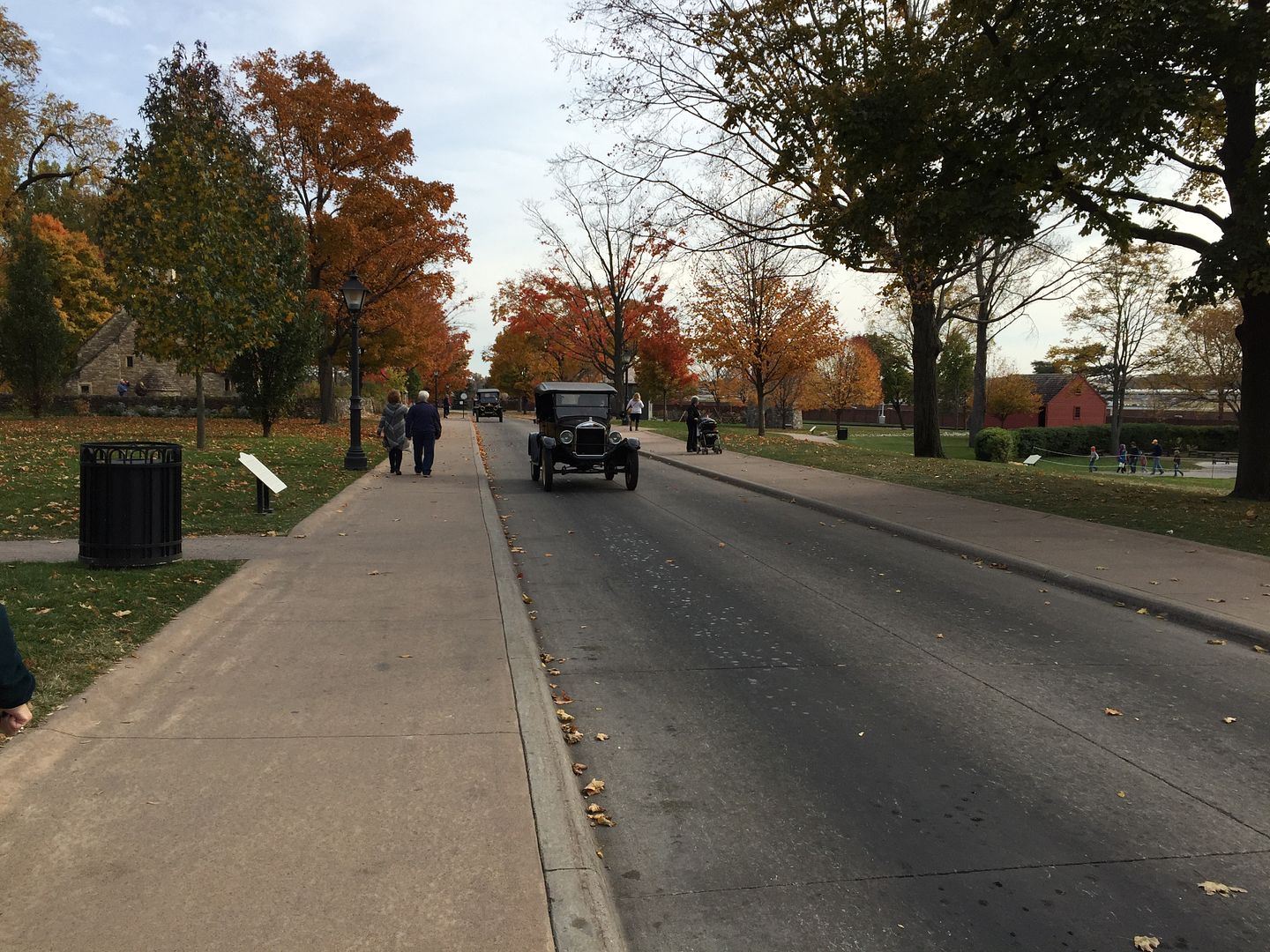
A few weeks ago, my service dog Kaline and I headed to Michigan with my mom (retired girl Juno went for a "spa week" of frolicking on beaches with her Auntie Sonja). It's a tradition for us to go to Ann Arbor every fall, where we visit the Henry Ford and Greenfield Village to celebrate Hallowe'en, and attend the University of Michigan's fall musical.

When we landed in Michigan that Tuesday, our first objective was the terminal's service dog relief area. Kaline loves to do momentum pull, which involves some elements of guiding when there are crowds. The Detroit airport is one of his favorite venues. It's always a straight shot from our gate to the relief area, but with many delightful challenges in our way. It's always great fun to see him assess crowd shapes, the placement of clusters of people, and decide which path offers the least resistance to us. According to my mom, the people in our wake were pretty impressed.
Our hotel in the fall is actually pet friendly, and has a long strip of lawn behind it for running a dog or playing fetch (plus unlimited free poop bags!). After unpacking, the first thing I did was have a game of Chuckit with Kaline out back. Trips are tiring for both of us—at home, he never spends as much time officially on duty as he does when we're traveling. The best way to keep him spunky and fresh, oddly, is by having at least one vigorous game of Chuckit every day. Service dogs really need their time to be ordinary, rambunctious, ridiculous dogs. Kaline runs like a maniac for his Chuckit balls!
One of the best but most challenging parts of our fall trip is the time spent at Greenfield Village in Dearborn. The village is one of the foremost history attractions in the U.S., containing numerous historical buildings as well as replicas that Henry Ford collected from all over the country.
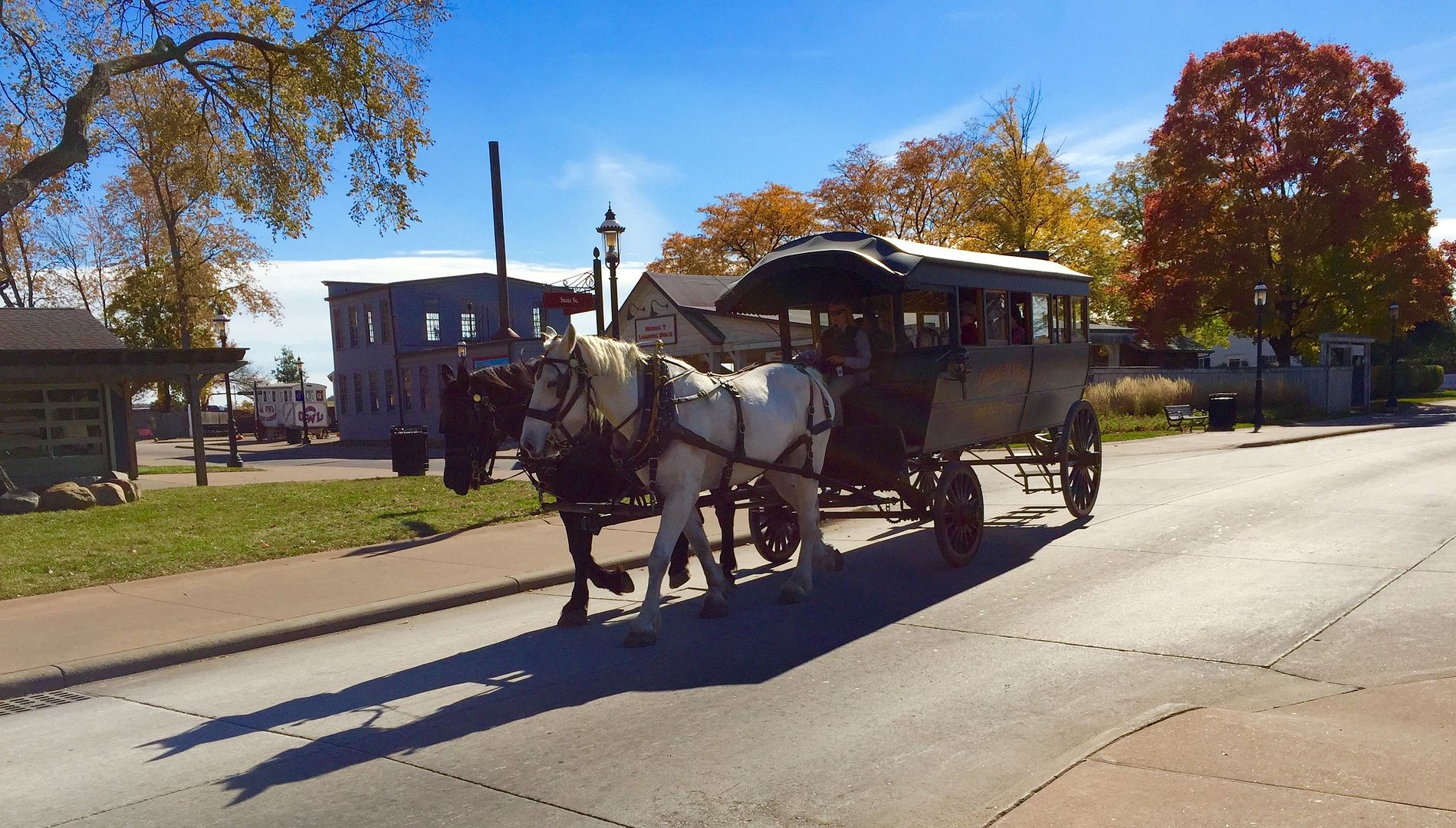
In the village are multiple horse-drawn omnibuses, Model T Fords, antique Ford buses, and steam locomotives. The locomotives are extremely loud, as they have to obey the state laws governing trains, even though they just go in a small loop. Therefore, their whistles have to be audible three miles away. Kaline has had to get acclimated to all of them, and since we are only there twice a year, it usually takes him a little while at the beginning to relax fully in the presence of all these things.
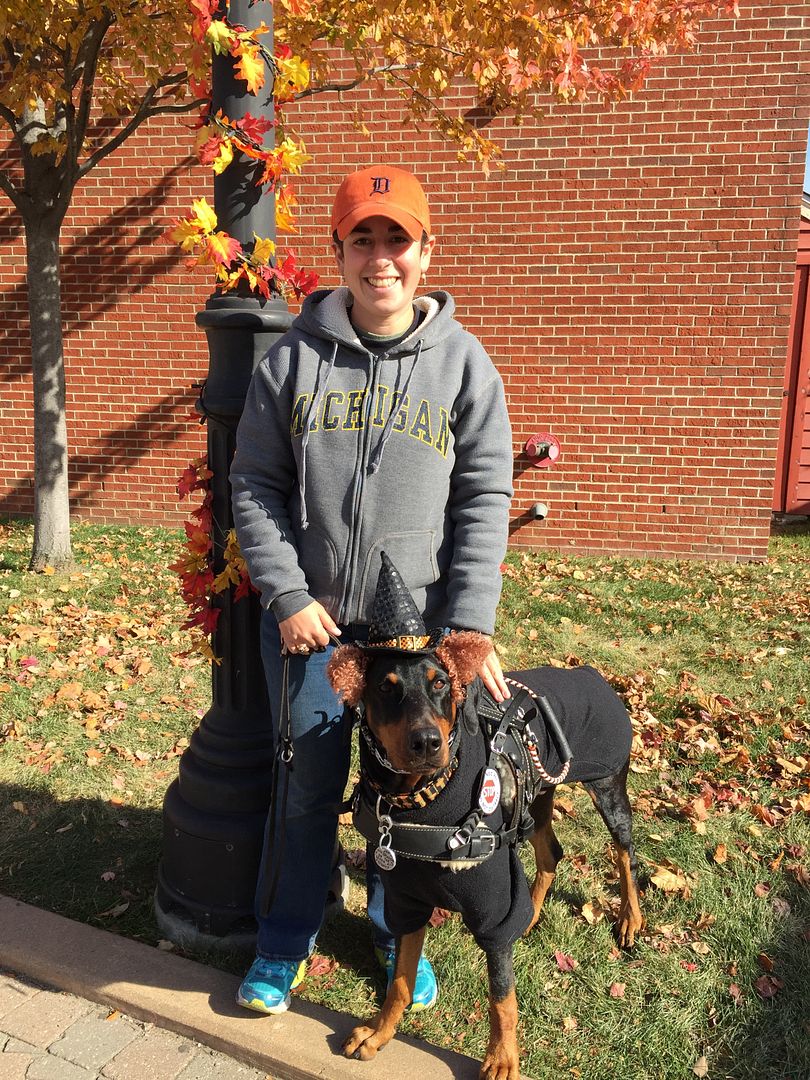
Showing our Hallowe'en spirit! Well, Kaline, anyway.
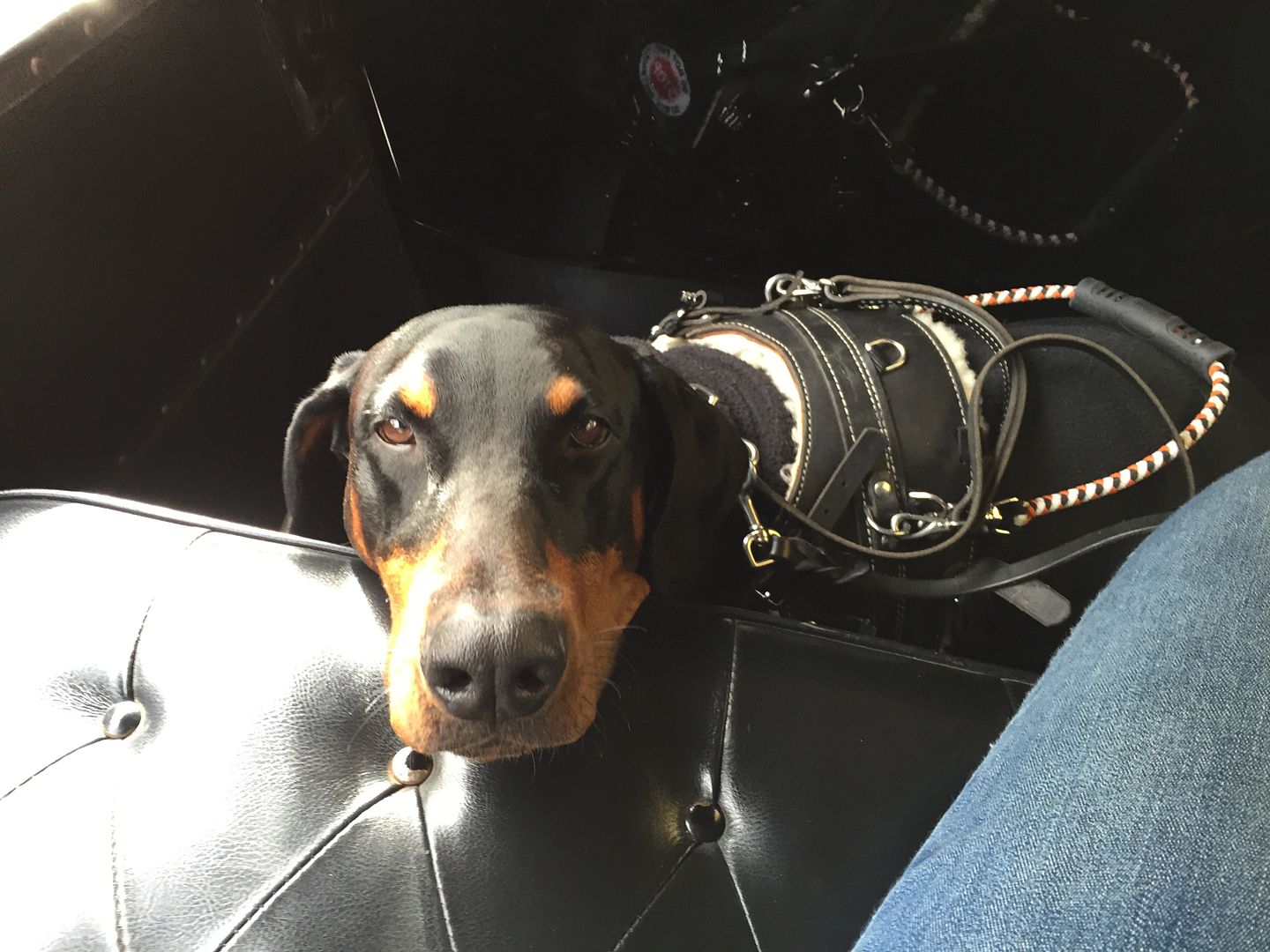
This was the first time he had no acclimation period! He's been going to the village since he was 16 months old, so maybe it's become old hat to him. It's lovely when we see some of the village presenters who remember him from his first trip—they can see how far he's come since then! Half the Model T drivers know him now; when we wait in line to ride them, the driver we're paired with inevitably lets out a joyful cry of "Kaline!" as we're about to get in.
Kaline on the Model T.
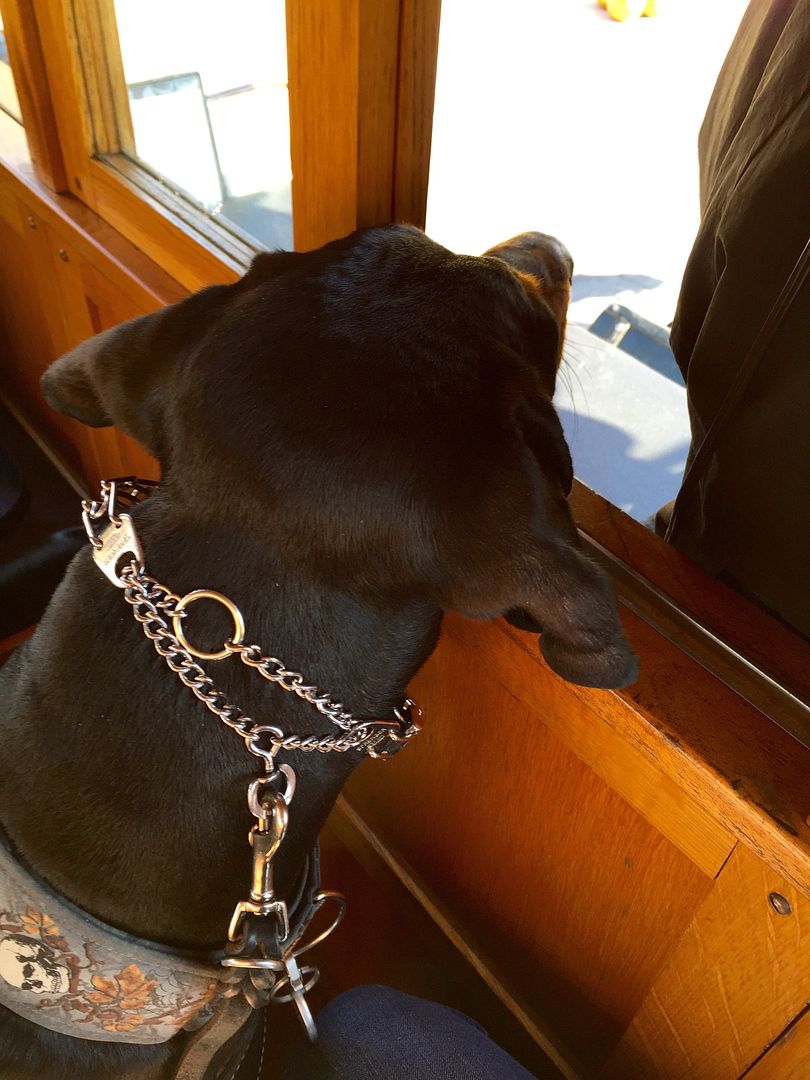
When we were the only ones on a particular horse-drawn omnibus, the driver let Kaline rest his chin on the window between the carriage and her driver's seat as she told us about her team, Wilbur and Orville. On the locomotive, he just objected to holding a down on the icy cold metal floor (can't really blame him). Kaline also enjoys riding the carousel.
Kaline on the horse-drawn omnibus.
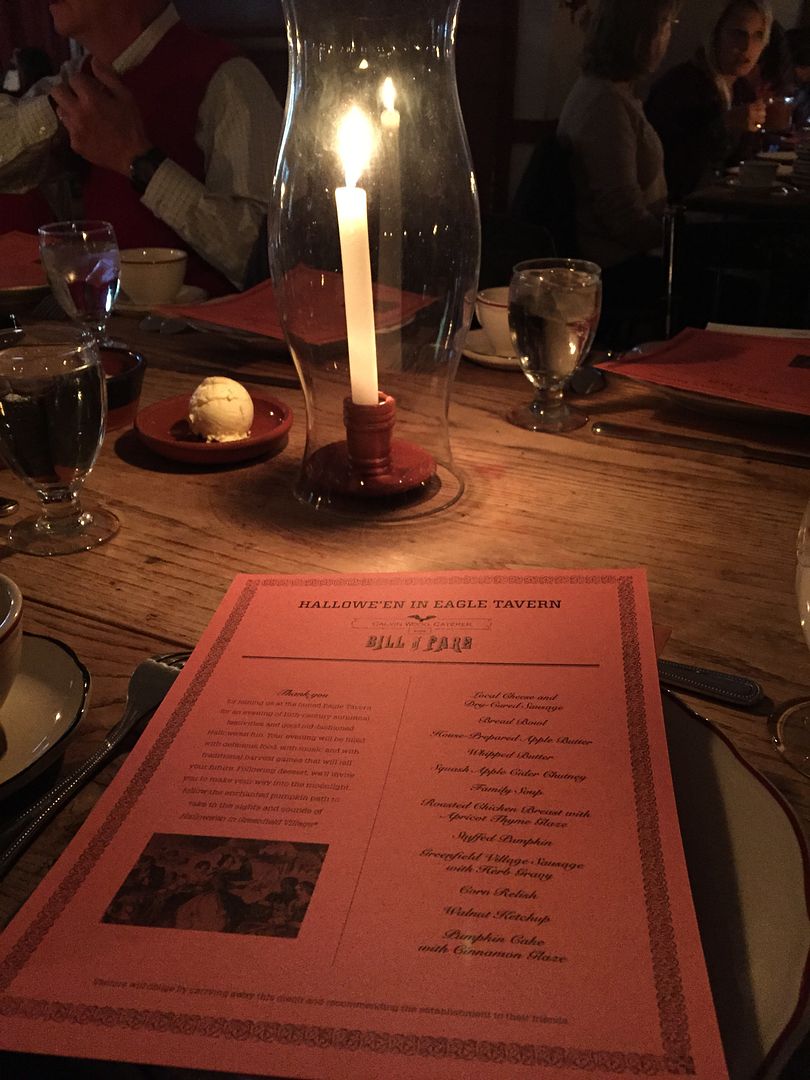
Another challenge of the village in the fall is our favorite special event, Hallowe'en Nights. We go to dinner in the packed Eagle Tavern with about 150 other guests—this year two of our tablemates were dressed as Sweeney Todd and Mrs. Lovett! It's dark, warm, and noisy—no electric lights—and a fiddler goes from table to table taking requests. Kaline was practically invisible, sleeping under the table until it was time to go out into the village.
After dinner, we followed a jack-o-lantern-lit path all through the village. There are performances of Hallowe'en stories and songs. Most of the visitors come in costume, and at various points on the path, village presenters greet everyone dressed in elaborate vintage costumes.
It's a lot of moving through crowds in the dark—at one point we walked over a fog-filled, laser-lit covered bridge. There are buildings lit up to look like someone is raising a Frankenstein monster inside; the carousel runs backward to creepy music; and a pair of horses run up and down in a field to reenact the Legend of Sleepy Hollow. It's a lot to ask of a dog, asking them to focus with all that going on. Kaline just did his first one last year.
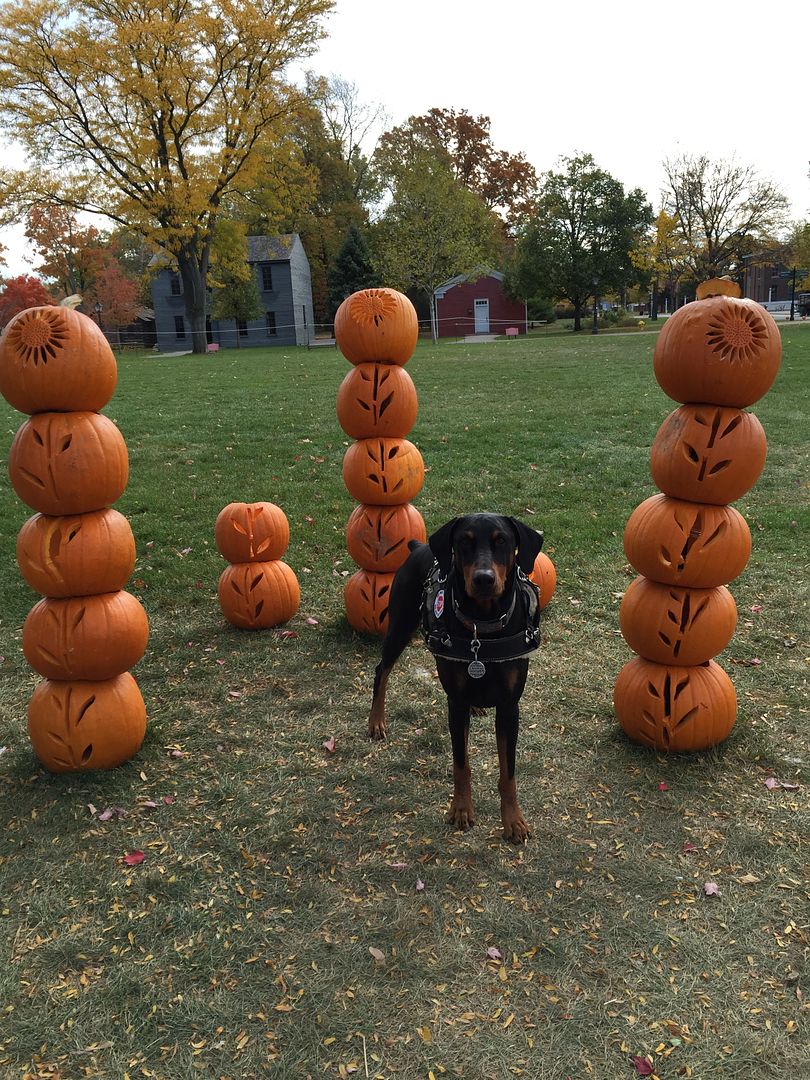
Kaline with some of the hundreds of hand-carved pumpkins.
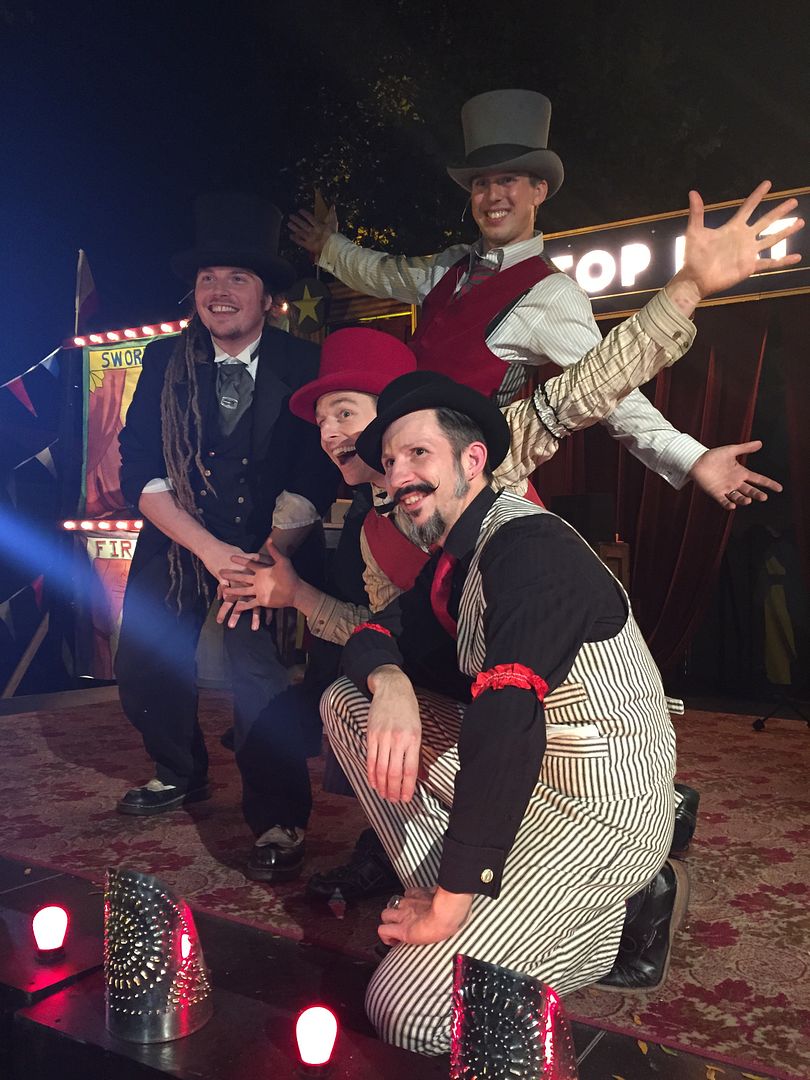
This year, he was totally unfazed by anything, except for one part in the excellent new Top Hat Sideshow where a performer was cracking a flaming whip. Suitable application of treats fixed that promptly. Kaline is quite willing to tolerate bizarre sights and strange loud noises if they mean he's going to get food. And while he doesn't need treats to perform his duties in normal locations, for events like Hallowe'en Nights I always make sure to take some high-value morsels with me. I like to think of it as hazard pay!
Kaline ably led me through all the crowds, ignoring all the costumed distractions. He was fantastic. We ended at the big restaurant, with Kaline passing out under a table while Mom and I shared some delicious mini-donuts and hot chocolate.
The next night was the fall musical, American Idiot, presented by the University of Michigan's amazing musical theatre department. If you've never seen it, it features songs from Green Day's album of the same name, at rock-concert volume. Earplugs for the human theatregoers were handed out at the door; for Kaline, I had purchased Mutt Muffs.
The ear protection for him was a rousing success—while the musical was blaring, I could feel Kaline twitching against my feet, so deeply asleep that he was having a fantastic dream.
It may be called a vacation, but it can actually be more exhausting than regular life, both for me and for Kaline. We are both under more stress than normal, and he is on duty far more than usual. He can go for twenty miles of pack walks and still want to do zoomies when he gets home. But after a full day of work—not just helping me, but maintaining his professionalism at all times—Kaline completely crashes.
Staying super focused in public is one of the hardest parts of being a service dog, sometimes even harder than learning the actual tasks. A good night of sleep restores him, though; it took me about a week after we got home to recover from our awesome and fun-filled vacation! Still, I can't wait to do it again.


Colt