Patrick, GUGP's 2015 Guide Dog Puppy

Patrick, GUGP's 2015 Guide Dog Puppy
GUGP Website
Showing posts with label service dog. Show all posts

16 February 2016

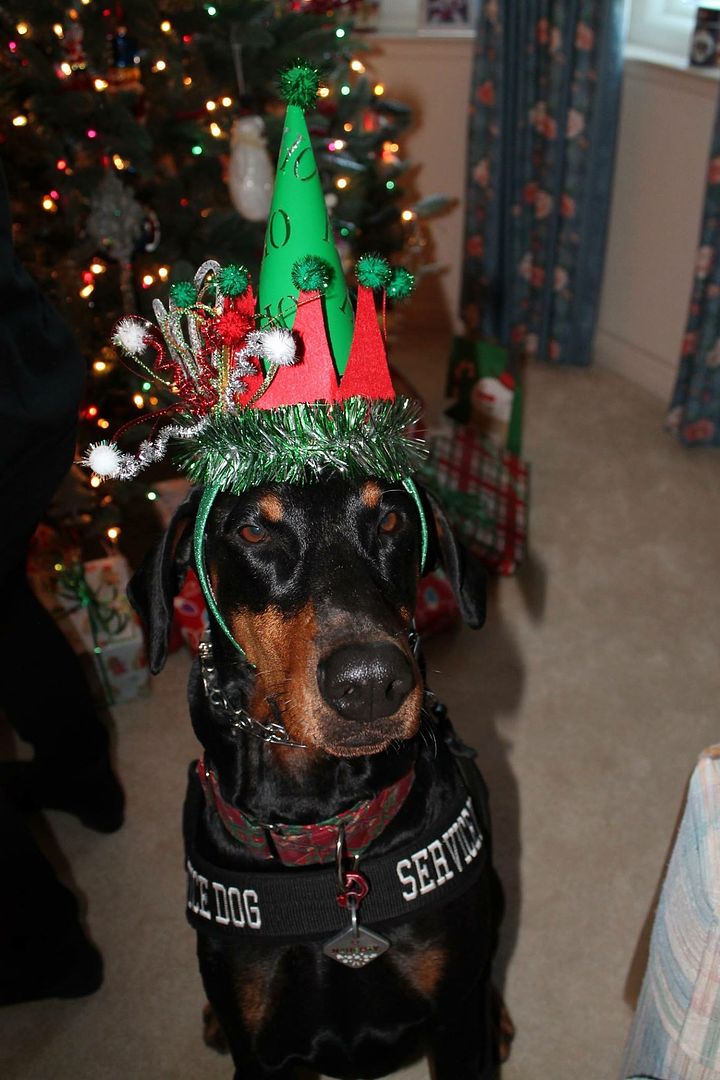
Dobermans are service dogs, too!

As you might have guessed, my service dog, Kaline, is a Doberman. It's not a breed that is commonly used in the service dog world, although they are gaining some popularity. Working a Doberman can sometimes be a bit different than working a Lab or Golden.

Happily for me, Kaline generally does not get questioned as to his legitimacy due to his breed. We do get a ton of comments along the lines of: "I didn't know THEY used Dobermans as service dogs!" (No word yet on the identity of the mysterious "they.") The one major access challenge we've had as a team, oddly, was because of his custom-made, very professional-looking mobility harness. Apparently it looked like some sort of extreme control device. (Pro-tip: If you try to control a dog's movements with a mobility harness, you will fail. Spectacularly.)
Kaline in his big mobility harness.
Most of the public seems conditioned to think that dogs of a certain (read: medium to large) size wearing service dog gear are "real." This has worked out nicely for me with Juno, a big black mutt who does look a little Labby, and with Kaline. You will get a little more scrutiny with an uncommon breed, as far as behavior goes, but it's generally not extreme. Obviously this is not so handy for handlers of small service dogs, who regardless of breed or impeccable behavior, seem to be viewed largely with suspicion.

If you love taking advantage of photo opportunities, Dobermans will certainly help you there. Kaline, anyway, is a huge ham. He absolutely loves to pose for photos. Where some dogs (read: Juno) require high-value bribery like string cheese to put their ears up nicely for a picture, all Kaline needs to see is that camera. Once, while he was having an off-duty romp at a beach, Kaline galloped past a guy with a massive camera who was getting pictures of the scene. Kaline screeched to a stop, made a U-turn, and began cavorting in front of the camera, much to the photographer's delight. While I don't usually like to be in photos myself, I love few things more than taking photos of Kaline looking handsome.
This was a completely irresistible photo-op.
The big issue Kaline's breed can cause is some bizarre questions and assumptions from members of the public. If I had a dollar for every time someone tried to begin a conversation by asking, "Does he bite?" Kaline's collar collection would be twice the size it is now. This should go without saying but: 1) all creatures with teeth have the capability to bite, and 2) any dog who is likely to bite without provocation should not, and generally is not, working as a service dog.

Many children will ask if he's a police dog, which I find completely adorable. Less than adorable is when parents, though usually not on a regular basis, use Kaline's breed to frighten their children away from him. While I appreciate parents who educate their kids about why they shouldn't pet working dogs, it's quite unnecessary to tell the children that if they go up to Kaline he will bite them. Kaline's major failing with kids is he really loves to kiss them. And given that he's at face level with small children, sometimes that can surprise and startle them; this is why he only gets to greet kids taller than he is.
"Of course I would love to pose on this rock!"
And then there are what I like to call the storytellers. Every service dog handler can tell you about the innumerable times someone has interrupted an errand to tell them, "My dog at home looks just like yours! Only a different breed, size, color, and gender. ... She died last night." When you have a Doberman, or other perceived "scary" breed, you get a special kind of storyteller. These are the people who, after they've asked permission to pet your Doberman, will launch into a long and intensely uncomfortable story about how they, or their sister's boyfriend's second cousin once removed, was horribly mauled by a Doberman. That's when you smile and nod—and wish you could just disappear.

You might wonder why Dobermans are so uncommon, given how fantastic they can be as working dogs. Being taller than most Labs and Goldens, they can be a better choice for people who need mobility. They tend to be very in-tune with their handlers' emotions, a plus as long as you can keep that from becoming serious separation anxiety or overprotectiveness. They're incredibly snuggly and delightfully low-maintenance when it comes to grooming. They're also fun to train and quite intelligent, if not so very biddable as Labs and Goldens.
A love of snuggling means Kaline is great at deep-pressure therapy.
However, Dobes tend not to be the best choice for first-time owner-trainers or handlers. They're much more likely to give you the "Make me, why don't you" face than a Lab or a Golden. They can also become overprotective if their handler isn't careful to curb those tendencies. They are a guarding breed, after all, and if the handler allows it, a Doberman will take on the handling of a situation, which can end badly for everyone.

They're also well-known for health problems, despite the tireless work of ethical breeders. One of the major health issues that crops up in Dobermans, as well as the most devastating, is dilated cardiomyopathy (DCM), a heart disorder that is inevitably fatal. It generally crops up in older dogs, and there isn't yet a reliable genetic test for it. By the time a breeder learns that one of their dogs has the condition, the dog is likely to have been bred already.

Dobermans aren't the greatest candidates for service dog programs, in the sense that they tend to bond very strongly to their person, and may have major difficulties shifting that bond to a trainer or trainers, and then again to a new handler. While you can't go on autopilot with any dog and expect it to maintain its training without regular refreshers, doing this with a Doberman can be especially bad.

Then you have the diva aspect. Dobermans' shiny, beautiful coats are pretty much only for show. They get cold very easily, and aren't shy in the least about informing you about their distaste for the situation. If I take Kaline to a baseball game in Oakland in the summer, for example, and don't bring his various jackets and his cocoon-blankie, he will shiver dramatically, fix me with utterly miserable puppy dog eyes, and poke me every inning to see if it's finally time to go. Ask him to lie down on a marble floor without his mat, and he'll drop his head into your lap and stare at you mournfully: "But it's so cold on the floor. I couldn't possibly lie down here."
Kaline enjoying summertime at the ballpark.
There's also the fact that almost nothing pre-made will fit them. This works out pretty well for me, since I'm a complete gear-nut and have several friends who make high-quality custom harnesses and other equipment. Nonetheless, it does tend to get expensive, and it was quite sad when the PetJoy vest that I loved to use on Juno just would not fit Kaline, no matter how I adjusted it.
My favorite old vest. Alas.
The best part of working a Doberman, when it comes to the general public, is that you attract other Doberman people. I was somewhat prepared for this, having graduated from the University of Michigan. If you wear Michigan gear anywhere in the world, you will inevitably be greeted with cries of "Go Blue!" from perfect strangers who also went to Michigan (we're everywhere). It's very similar with a Doberman. Since Dobes are not terribly common, either as working dogs or pets, lovers of the breed tend to get delightfully enthusiastic when they see one out working as a service dog.
Sometimes we attract both fellow Wolverines and Doberman aficionados.
It's lovely being able to educate receptive people about the versatility and all-around greatness of the breed. Like any breed, they're not for every person. But many times, when someone who has been scared of Dobermans all their life sees one working calmly and quietly in public, that can be just the impetus they need to ask some questions and find out that Dobes aren't scary after all. Kaline, even though his breed as a whole is usually fairly aloof with strangers, loves getting to say hi to new friends, and is so sweet and goofy that he can usually change people's minds about his breed. There are few things more gratifying than opening someone's mind about Dobermans.
Kaline makes a new buddy.

Colt

09 February 2016

Why I call my service dog medical equipment


Medical equipment comes in many forms to help mitigate many types of disabilities. There are wheelchairs, insulin pumps, canes, oxygen tanks, and more. There are also dogs. Yes, those cute, cuddly, lovable creatures that many of us just ooh and ahh over. As a dog lover myself, I definitely get that big smile and sometimes the giggles as I see a cute pup or a breed I love walking down the street or playing with their owner in the park. However, there's a big difference between a pet dog and a service dog. The latter is, indeed, medical equipment.

When my service dog, Sulley, gears up and we head out that door, he is working. He's no longer just a dog. Really, he isn't a dog anymore. He's my highly trained and very much needed medical equipment. He is my monitor for my anxiety levels to let me know before it gets out of control. He is my guide when fibromyalgia leaves me in a heavy fog and I can't think or function well. He's my movement when my legs feel like they are on fire, or when I'm extremely fatigued from living with chronic pain. He's my hands when I drop something and I worry that bending down will mean vertigo and a possible fall. He becomes as much an extension of me as any other medical equipment does for another disabled individual. He serves a very important purpose: to keep me safe and able to live my life.  
Recently we took a trip to one of our favorite places, Disneyland! Sulley loves it because it means lots of work. The crowds, the noises, and other distractions can be very triggering and very difficult for me to deal with. Without Sulley, there's no chance I would be capable of going and enjoying as much of it as I do. There's another aspect of it, though, beyond the basic over-stimulation of the parks, that makes it tough for me as a disabled individual who uses medical equipment—particularly the kind that is furry with a beating heart.

"Oh my gosh! Quick, kids! Look at the doggie! Look, look, look! Say, 'Hi, doggie!' He's so cute!"

Now, some of you might not understand what the big deal is. A parent is simply helping her children to enjoy a moment of a very adorable dog passing by. They might not even be encouraging their kids to pet, though that does happen despite Sulley's multiple stop signs and "do not pet" patches affixed to his vest and harness. Fortunately, this is such a frequent occurrence that I can share a few things that have happened in the past.

1) Due to my panic disorder, I startle extremely easily. Loud screams, even of joy, can cause me to fall and hurt myself, cause a panic attack, cause me to have such a sudden burst—then decrease—of adrenaline that it leaves me very dizzy and fatigued.
2) These noises can distract my service dog from his job due to him needing to investigate the sound, even for a second, to determine what caused it. If he's in the middle of mobility work and needs to turn quickly to investigate a sound, that can put me in harm's way.

3) He could attempt to seek attention, as he is still a dog and has off days, which would require me to correct him.

In these situations, I do my best to make a short but educational statement to people while still moving on. Confrontation is very taxing on me and can trigger my anxiety, so by keeping it short and to the point, I hope to avoid any medical issues on my end. This, in turn, makes it so the cute dog they want to enjoy doesn't have to work harder after an anxiety attack from a confrontation.

"Do not distract my service dog. He's working."

My point here is clear, at least to me.

1) Do not distract my service dog. (This is a service dog who needs to focus.)

2) He's working. (This dog has a job.)
Sulley after retrieving a credit card on the floor and placing it back on the counter.
Sadly, this is all too often met with hostility. I'm called everything from "rude" to many various expletives. I'm yelled at because "we were just saying hi!" I'm told I shouldn't have a dog in public that can't be played with.

This particular trip, it dawned on me that there was something happening with these exchanges. They didn't see or hear "service dog." They saw and heard "service dog." No emphasis in the world would help them see past the word that meant "adorable fluffy plaything here for my entertainment." They couldn't see the harm in greeting, petting, calling a dog. Obviously, he's friendly and not a biter. What's the harm? They saw a dog. They didn't see medical equipment.

The remainder of the trip, I practiced. I do my best to practice responses to people so that my anxiety won't get in the way of what I want to say. The rest of the day and back at the hotel room, I practiced. I asked friends to randomly pop questions about my dog at me. I failed at responses over and over, and grinned when I would finally get one right. The next day, I felt a bit better. I felt nervous, but ready to deliver my new responses to the public when they intruded on my day.
Sulley doing deep pressure therapy to lessen a fibromyalgia flare or panic attack.
Sulley is no longer a service dog. He is, and always has been, my medical equipment.
I placed Sulley in the crate provided at the roller coaster and began to board. An employee ran over while I struggled into my seat, squealing about my cute dog and demanding to know his breed.

Deep breaths. You've got this. You practiced countless times.

"I don't feel comfortable discussing my medical equipment."

She looks confused. Please go away ...

"No, no. I mean your dog!"

More deep breaths. Stay calm, you've got this!

"No, you mean my medical equipment."

NAILED IT! Did you see that lightbulb come on?!

Just as the employee scowled a bit and rolled her eyes, there was a pause. I could see it click in her head. She never even thought that the dog, my dog, was medical equipment. It lit a fire in me. The rest of the day, I struggled through getting the proper words out. It began to get a bit easier. I began plotting new ways to say things. What to say if someone said something terrible back to me. It was brilliant!
I felt confident and self assured that I could handle these confrontations. More and more people throughout the day had their lights turned on. Even if it was just a teeny spark, it happened every single time. Something that never happened when I explained him as a service dog.

"Ma'am, keep your child away from my medical equipment."

"Sir, do not distract my medical equipment."

"Interfering with my medical equipment is a crime."

"I am not comfortable discussing my medical equipment." (Insert rude reply.) " ... And that is why I am not comfortable. Good day!"

On an ending note, I would like to point out that never once do I say "sorry" or "please." When it comes to my safety and that of my dedicated medical equipment, it is never, ever a request. I also will not apologize for not wanting to be grilled about my medical equipment, or having it played with or distracted. This does not make me rude. It makes the person forcing their way into my personal space, and interfering with Sulley, rude.

No one, disabled or otherwise, deserves to feel intruded upon or made into a spectacle. Remember that service dogs are medical equipment, and respect their and their handlers' space.


Kymi

19 January 2016

New Year's Resolution

Part of being a service dog handler is transitioning from one dog to another. Unfortunately for us, service dogs can't work forever. Each dog has his or her own quirks, strengths, and weaknesses, and the transition can be hard.

You're with your service dog practically 24/7 for years on end, which means you both get used to each other's needs, signals, likes, and dislikes. Changing partners is a huge adjustment, and it's nearly impossible not to make comparisons between your previous and current dog (usually in the older dog's favor).
At Muir Woods with baby Kaline (then still in training) and Juno
(then still working mostly full-time).
Which brings me to my New Year's Resolution, which I'm going to do my best to keep: I want to stop (as much as I can) comparing my current partner, Kaline, to his predecessor, Juno. Well, except for right now, since I think it'll be interesting to do in a blog post!

Juno started service dog training when she was an adult, nearing middle age. Even when she was a pet, when we first adopted her, her general M.O. was to follow me around until I sat down somewhere, then curl up at my feet until I was ready to go somewhere else. You can see how that was a really handy tendency when she started working.
Juno during her training period at the San Francisco zoo with
her mentor, Jolanda (front), and SDIT pal, Hunter (left).

Though she was something of a hot mess as an under-socialized adolescent, by adulthood, Juno had grown to be an unflappably calm, solid presence. The only thing I can think of that ever fazed her during her working career was a performer cracking a whip on stage during a Cirque du Soleil show in Las Vegas.
Juno ignoring the festivities of Gay Pride in San Francisco
to pose for a photo.
Juno is also an extremely eager, creative learner. Not only will she do almost anything for food, she also took readily to clicker training. If she doesn't get rewarded for one behavior, she'll start running through a repertoire of behaviors and even think up new ones. Teaching her to do new things—like retrieve, carry objects around, and open and close drawers—was nearly always delightful and struggle-free. (Extinguishing bad behaviors, like her adolescent dog reactivity, was a struggle, though we eventually succeeded!)
With Juno in Las Vegas.
And another fabulous thing about Juno: Being part Lab, she has a basically Lab-shaped body, and thus every single piece of gear I ever got her fit her like it was custom-made for her. You don't appreciate that until you get a weird-shaped dog, let me tell you!
"Everything fits me, and I fit anywhere."
As you can see, Kaline had very big shoes to fill.

Kaline started training as a baby puppy. I like training dogs in general, but I especially love training puppies. They're a blast. But I'd never had my own puppy—Juno was adopted at 18 months, and my first dog, Angel, was about two when we got her. As a puppy, Kaline was a pretty quick learner, food-motivated like Juno, but it was exhausting being out and about with him. I thought I'd been pretty vigilant when working Juno—you're always on the lookout for possible distractions or threats to your service dog—but I didn't have to worry about her behavior. Not so with a puppy! Everything we encountered was a training opportunity: both a blessing and a curse. I quickly learned to wear a bait bag at all times so as not to miss one of these opportunities.
SDIT Kaline works on blocking (also known as covering).
He also wasn't, and isn't, nearly as creative about learning as Juno. Kaline does very well with luring (using a treat to help show him the desired behavior), but becomes easily bored and frustrated if he isn't getting hints. He won't just come up with new behaviors; he'll sit there and stare at you, then decide that your food isn't actually that enticing and go find something else to do.

Did I mention that nearly all of Kaline's gear beyond simple cape-vests has to be custom made? There's a reason he's lovingly known as the Princess Diva.

Where Juno is fairly aloof with strangers, Kaline is a social butterfly with both dogs and people. He just assumes that all new dogs and people are going to love him and be his new best friends. It was much harder for him to learn to ignore people trying to distract him, and it's something we are constantly working on. So many things that just came naturally to Juno, Kaline had to learn, sometimes laboriously over weeks. He had trouble learning to hold a long down-stay, so I began attending the "classic" movies religiously with him every Wednesday night. The ticket packages were cheap ($30 for six movies) and the movies sparsely attended—fewer people to notice if we had any trouble! I think we ended up getting three of those packages, and by the end his long down had improved markedly.

Teaching him to retrieve to hand seemed to take forever. What Juno picked up during one slow night at work, back when I had a job that wasn't dog-centric, Kaline took over a year to put together. Juno is very quick and doesn't need much amping up; once she realized there was a cookie in it for her if she picked things up and gave them to me, all I had to do was point, receive the object, and feed her. What Kaline needed was his Auntie Sonja, a soft zip-up pencil case full of high value treats, and for me to get SUPER EXCITED about everything to do with retrieving. Food just wasn't enough when it came to learning that. He needed me to be far more demonstrative than I'd ever been with Juno. Once Sonja helped me come to that realization, his retrieve improved swiftly and we're now to the point where I can use retrieving an object as Kaline's reward for doing something else.
During a long, boring airport wait, I can now
entertain Kaline with retrieving games.
Enough about Kaline's shortcomings. Now that we've had our own place for a year, I've come to realize anew just what a fantastic partner he is. For one, he is just about the most hilarious dog, service dog or pet, I've ever met. He makes me laugh every single day. Much of the time he falls asleep with all his feet in the air. Sometimes he finds tennis balls on our walks and, since he knows if he can get it home he can keep it, will doggedly carry the slimy object for a mile or so and then cuddle with it when we get back. He also has a huge obsession with sardines, and watching him struggle to contain himself while I make his dinner is endlessly entertaining. Kaline is quite a silly boy when he's not working, and he has no inhibitions about showing it!

Things that Juno does because I ask her, Kaline does because he absolutely loves to do it. Juno is not, in general, a cuddler. She would do deep pressure therapy for me, but she would get off whenever I told her and be very glad to be finished. Kaline will sometimes just do DPT, because he already knows I need it, and he will refuse to get off if he senses that I am still not calmed down enough. As an added bonus, he adores cuddling in bed and basically sleeps on me or pressed against me as tightly as possible. This might sound like annoying bed-hog behavior, but for me, it has improved my sleep tremendously.
Kaline delights in snuggling (off duty) and deep pressure therapy
(on duty).
Momentum pull, a task I use a lot and which Juno never found all that wonderful, is Kaline's calling. Where Juno never really got past needing a target person to follow, Kaline learned to pull in a straight line, follow directional commands, and seek out the path of least resistance in record time. He loves it. He's great at it. It's something you can end up taking for granted, since it seems so natural for him (much like holding long downs was natural for Juno).
Kaline in the early stages of his
momentum-pull training.
And while as a puppy, Kaline could be momentarily unnerved by random things—a fire in a fireplace, period costumes, large plastic figurines—as an adult, I think he's even more solid than Juno.
Kaline as an adult in front of the fireplace that scared him
as a SDIT.
His reaction (or lack thereof) to fireworks never fails to amaze me. We can be in the lower deck at a ballpark, with fireworks being set off on the field, and he just chills out on his mat, either watching the show or staring at me in hopes of getting rewards. I taught him early on that loud noises of all sorts mean he's probably going to get food, and have never regretted this!
Fireworks in Toledo—"Food now?"
He lay by my feet in the front row of Odysseo, a Cavalia show featuring about 30 horses performing each night, and had no problems (well, he didn't really like being splashed by cold water at the very end of the show, but can you blame him?). He still doesn't particularly like trucks rumbling by very close to us, but otherwise, nothing fazes him.
At Odysseo.
Learning to teach the way Kaline learns best—which is not always the way Juno learns best—was a really big part of us becoming a good working team. In some areas he needs more or different motivation than she does, while in others, where Juno needed a ton of encouragement, Kaline's got it, thank you very much, and please stop chattering, Mum. It took a long time, but for about a year and a half or so, we've been working smoothly as a team. It's become much less me showing him what to do and how to do it, and more both of us just knowing what needs to be done.

He now knows all my weird little signals, and I know his. For example, I taught him to shake off on cue because 1) I really don't like it when he does that inside restaurants and 2) even when he's out of gear, each shake off seems to last several minutes, like I just soaked him in water. Kaline knows he isn't supposed to shake in restaurants or when he's doing harness work, so he'll let me know if he needs a quick "shake break" by doing what looks like a head tremor. He'll just twitch his head a couple times, and then wait for me to take him to an appropriate place and give him his cue.

It takes a long time to reach the level of comfort and trust with your new dog that you had with your previous dog. And even though I've had that for a while now with Kaline, I still compare him to Juno (along with other friends' service dogs) far too often. Sometimes you forget that your previous partner had some things they struggled with, and some working quirks you found annoying. No dog is completely perfect, and even the ones you think can do no wrong have off days. It's important to appreciate everything that's wonderful about your current partner, and that's what I've set as a goal for 2016.

Because one day, I'm going to be training NextDog. (Hang out around service dog handlers enough, and you realize that we are constantly thinking about and tweaking plans for NextDog. It never stops.) And when that day comes, I know I'll be wishing I could just work with Kaline forever.

Colt

05 January 2016

When not to crusade

One day, I was browsing through my newsfeed on Facebook, as per usual, when an interesting photo popped up. It was a peer of mine holding her dog in a locally owned arts and crafts store. I looked at the comments, and the most recent was one of her friends asking: “Wow, they let you bring him in the store?”

For some people, this would have alarm bells ringing in their head. Because somebody is obviously going to reply, “They asked me if he was a service dog, I said yes and that’s all I had to do,” or “Ha ha, yeah, I just say he’s a service dog and they can’t kick him out.” It’s a struggle many handlers have come across. “Fake” service dogs, or more accurately, pets that are portrayed as service dogs, are certainly a problem for service dog teams. I know of some teams where the service dog has had to either go through retraining or be retired from work entirely, due to an unfortunate encounter with a pet dog in a place where the pet should not have been.

Yes, it would be a real kick to the face for this peer of mine to have responded with affirmation that she had, in fact, misrepresented her pet as a SD. Considering we have had classes and outings together, before and after Velvet and I were a working team; I should have every right to go in tooth and nail, bombs away, right? How dare she do this to me, to other teams?

No. All I had seen was a photo and the poster had not responded with any indication that she had posed her companion dog as a service dog. In fact, my phone had a notification that there was an additional comment on the photo. Scrolling down, she had responded to the person asking how she took her dog into the store. Her response: “I asked the owner if it was okay if I brought him in.” Bingo! Some stores, as long as they are not violating health department codes, are pet friendly. I commented explaining how some non-pet stores can be pet-friendly, and was thanked for the explanation.

Now, imagine if I had gone in prepared to start a war over this. Feelings probably could have been hurt over my assumption. Rather than being known as a friend who would gently educate, I would be known as a trouble-maker who can’t enjoy a good photo of a cute dog in a dog-friendly store. Also, this person knows I am a service dog handler. What example would I be setting for her as one of her few, possibly only, friends who uses a service dog to mitigate a disability?

How long did it take to avoid potentially starting a fight? About five minutes. Unless a person is blatantly saying, “I’m just saying my pet is a service dog to get him into stores,” we cannot know the full story behind a picture. Many people are uneducated about the laws behind service dogs. How many handlers knew all of the laws before utilizing a service dog to improve their daily life?

I am not saying to sit every person down and start with the history of service dogs being utilized. You do not have to go out of your way to educate, especially when you have your own daily life schedule to attend to. All I am saying is, be kind and do not make assumptions. Proper education of service dog laws in America is desperately needed. Simple misunderstandings due to  lack of service dog education are experienced by different teams every day, such as a greeter saying “Dogs aren’t allowed in here,” or a child exclaiming, “I didn’t know they let dogs in here!” It doesn’t take an entire lecture to gently educate these simple misunderstandings.

With the emergence of social media, many people have assigned themselves the task of hunting down fakers. Do some people blatantly pose their pets as service dogs, knowing exactly what they are doing? Of course. There are also many other cases that could be the story which people do not know. What if the person has been advised by their health professional to get an emotional support animal and is not educated about the different between ESAs and service animals?  What if the individual does have a disability that could be mitigated by a service dog specifically trained to assist with the individual, but doesn’t know how to get started? Until the full story is posted, assumptions should not be made about a snapshot.

Many misunderstandings service dog users encounter with the public are not direct insults to the team, but simply a lack of education. This is why I am glad Growing Up Guide Pup is dedicating themselves to educating the general public in various ways. Aside from laws, Growing Up Guide Pup also showcases the adventures of puppy-raising, introducing readers to the various types of service dogs, and much more. Even as a service dog handler, I love reading the articles that are posted by guest bloggers and watching Matt and Amie’s vlogs of their puppy raising adventures. The website, videos, and social media tools utilized by GUGP are a vault of valuable educational tools.

Sara

30 December 2015

Holidays with a service dog

Kaline worked his first Christmas this year. It may seem a little odd, given that he's over three years old. But the holiday season can be a special kind of challenge for service dogs and their handlers.

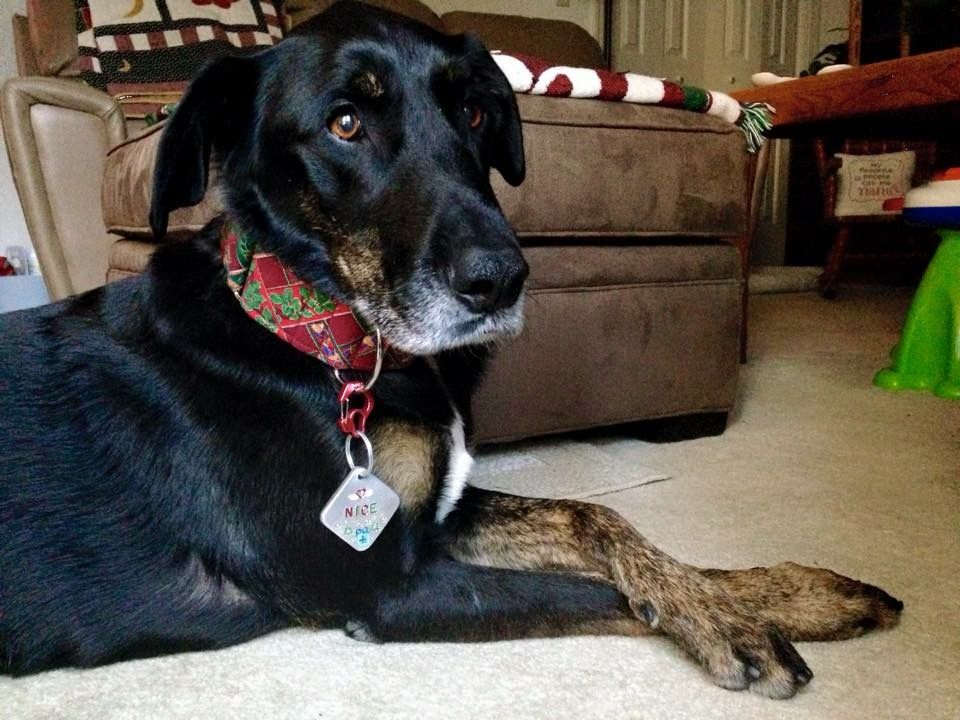
Juno, my now-retired service dog, has been working Christmas since she became my partner in 2011. It's very different than working in public. You don't always take your dog "dressed," because you're with family and may want to allow more socializing than is normal for your dog when on duty. It's easier to tell strangers to leave your dog alone than well-meaning family members. You can also end up in close quarters for much longer than normal, with more tempting food in easily accessible places. For some dogs, the whole thing can be a little confusing.

Juno doing Serious Work Face even without her vest on.
All of the above assumes that your family and friends accept you and your partner at the holidays. Juno, Kaline, and I are very fortunate in that our family and extended family understand my need for a service dog and don't bar my dog from the festivities. For family events, you have no ADA protection. Family members who don't comprehend the importance and necessity of a service dog can put handlers in an uncomfortable position: Do you leave your crucial medical equipment at home and get to be with family/friends for the holidays? Or do you stand your ground and refuse to attend without your partner, missing out on the traditional family gathering? It's an awful decision to force someone to make at any time, but especially around the holidays.

Kaline's first Christmas was a lot of fun and probably the most hectic one I've experienced with a service dog. Four more people than usual came, and four young children were running around. Gift-opening was kind of chaotic and ended up being overwhelming for me. So in the midst of all the noise and excitement, Kaline calmly did deep pressure therapy on me, ignoring everything going on around him. He also did a great job resisting the tempting morsels all around during dinner.

I kept Kaline in his harness for most of the time we were there, since he has a harder time than Juno transitioning to working behavior while he's out of his gear. Especially at an event like a holiday celebration, it's important to know your dog's individual quirks and set him or her up to succeed as much as possible.

Juno is the kind of dog who doesn't much care about socializing and will dependably pad just behind you no matter what is going on or what she's wearing (or not wearing). The only thing you have to worry about is her wagging her long tail near low tables or children.
Kaline loves to socialize when he's not vested or harnessed. He also adores children, but doesn't quite realize how intimidating his size can be. Two of the kids at Christmas this year haven't had much exposure to dogs, especially big ones, so it was important for Kaline to make a good impression. Happily, his cute little Doberman nub isn't capable of knocking anyone over.
Another reason to keep Kaline geared up was that I just needed more help this year than last year. I have fibromyalgia—it's a problem all the time, but this year about a week before Christmas I began what most people with fibro call a "flareup." You get used to your usual level of pain, and can pretty much fake feeling fine most of the time (provided you still do good self-care). But when you get a flareup, the usual level of pain ratchets up dramatically.

Last year, even though Juno was retired from public work, I let her work Christmas because I knew I wouldn't need assistance that she was incapable of providing (like counterbalance). This year, there was just no way I could have had anything resembling a good time without Kaline's help. He did a lot of counterbalance, which would have hurt Juno.
In addition to his work, Kaline posed for silly photos with good grace.

Anytime I had to get up from a couch, he helped me. Walking around mingling, he provided stability. And with the added crowding, his deep pressure work was crucial. Don't get me wrong—these are people I love. I was so happy to see and catch up with everyone who was there. That many people in such a small space, however, especially when it gets loud, can just be too much for me to handle without either my dog's help, or flat out leaving the situation until I can get it back together again.

Kaline did an excellent job. I was really proud of him. Because of him—and my wonderful family—we had a fantastic Christmas. It wouldn't have been possible without his help.
Kaline got some cozy and well-deserved rest after the festivities.


Colt


23 December 2015

So you want a service dog ...

The first and most important thing to ask yourself before pursuing a service dog is: Do you have a disability?

It sounds a bit silly, but some people don't quite understand that to have a service dog, you need to have a professionally diagnosed disability/ illness. I continue to make a point of the professional diagnosis, because self-diagnosis does not, by law, mean much. For you to have a service dog with you in public, you need to have a doctor's acknowledgement of your disability. If they also support you having a service dog, then fantastic! However, a lot of doctors have not heard of service dogs assisting anyone other than the blind, so they may not want to sign their name to something they don't understand. Try to educate them if you can, but don't loose sleep over it. Their job is to simply say: "Yes, this person has [insert disability here]."

Next you'll need to think about what you want the dog to do for you.

There are many things a dog can do, but there are also many things they cannot. Some tasks may be easy to teach, while others may take many months of practice. 

Are you prepared for this specialized training? What effect will a Service Dog have on your day to day life? Does your family/partner/flatmate approve of this decision?

The people with that you live with will understandably have opinions about adding a dog to the household. A flatmate, for example, may not want a dog around, so it may mean getting a new flatmate or changing accommodation. However, if your partner has an issue with a new dog in the house, you've got a whole new problem. Not to sound negative, but do not underestimate any possible resistance to you having a new dog in the home. To do so may leave you and your dog open to very difficult situations.

Is the dog for a child, and are there other children who may want to be involved with the dog? How will the dog fit into the daily schedule? Who will supervise training? Who will be ultimately responsible for the dog? Allergies may also be an issue, but this might be overcome by getting a hypo-allergenic breed of dog.

Please do proper research on this. No dog can actually be classified as a "allergy free dog." People with allergies to dogs are usually allergic to the dander of the dog's skin, not the actual fur. If you have a dog that sheds less, like a Poodle, Schnauzer, or Italian Greyhound, they are usually easier for allergy sufferers to deal with. Again though, you need to think of how this breed will fit in as a working dog, how much exercise they need, are they people oriented, how much grooming will they need, and so on.

Have you considered your friends?

You may lose friends over a decision to get a service dog. It's sad to say, but I have lost a few friends who did not understand or like my decision to get a service dog. As training intensifies after a year or so, you may find more friends drop off. Not everyone feels comfortable around dogs. Friends may not understand why you are choosing to use a service dog instead of other options. Your friends may not want you to have the dog in their homes or even around them. Talk to your friends before you decide to get a service dog and see the effect it may have on your social life. You may decide that the benefits of using a service dog are greater than keeping the friends who don’t agree with your decision, but it is good to be aware.

Are you ready for the greatly increased public attention?
You will draw attention to yourself (and your disability) with a service dog. A service dog attracts attention, both to the dog and to the handler. This can really change how people perceive you, especially if your disability is invisible. A service dog openly labels the handler as a person with a disability. People who had not known you as disabled will suddenly have it drawn to their attention, and you may find that their perception of you changes when you get a service dog. Members of the general public will want to stop and talk to you about your dog and often also about your disability. Small children may chase your dog and try to pat it or even hug it. If your dog is large, small children may try to climb on it and ride it. A service dog is not a good option for someone that cannot tolerate a lot of public attention.

Can you handle confrontation?
Even if you get to the level where your dog is a fully trained service dog, some people will deny you access to places you have every right to enter. You will also have people tell you that dogs should not be in public places, or you may even be accosted by an animal loving activist for enslaving an animal (of course we know this is false, however some people don't understand).

These confrontations can be emotionally exhausting and hurtful. They can also be time consuming. Are you able to stand up for your rights to business owners and insist on access? This is a very real and unfortunate part of having a service dog. If you are not able to deal with this, you probably should not get a service dog.

What about the responsibilities of service dog/pet dog ownership?
Financial responsibility comes with dog ownership. Medical emergencies may pop up, with the average emergency vet bill coming in at $1000-$3000.

Further costs include leads, bedding, service coat/jacket, toys, grooming equipment, shampoo, flea and worming treatments, council fees. If you are not financially stable, a service dog (or a dog at all) might not be the best move. Check your local council regulations regarding the housing and keeping of dogs. This does need to be explored, particularly if you already own other dogs. Some councils' restrictions are severe, while others are more accommodating. All will require some form of licence. And they usually have a limit of 2-3 dogs per house.

Are you ready for the long term commitment that comes with dog ownership?

Dog ownership is a commitment! If you're lucky, the dog will be a good worker for roughly 8 years. On retirement, you must decide if you will keep the dog or find a new and suitable retirement home for them. What will you do if the dog develops behaviour problems or health issues and must be retired early? Will you be able to keep them? Will it be safe to keep them if you need to get a new service dog to replace them?

What are the responsibilities of Service Dog ownership?

Do you have the time and patience to work with a service dog both initially in the partnership and commit to ongoing training during the dog's life? Getting a service dog, regardless of whether it comes fully trained from an organisation, or for you to train under supervision/on your own, is a huge transition. Initially you need to spend a lot of time going over the basics, earning their trust and learning to work comfortably with a constant canine companion. 

Have you ever trained a dog entirely on your own? 

Learning to understand and “read” your dog and learning to work with your dog in public is not a walk in the park, so to speak.

As you progress together, the amount of time spent on dedicated training may decrease, but a certain amount of ongoing training is necessary during the working life of the dog. If the training is not maintained, your dog's skills will deteriorate.
Training your dog to be a service dog is not something that can be done in a weekend or even in a month. It will be an ongoing process continuing for the whole life of the dog. However, the most intense training will be in the early months/years, especially if you opt for getting a puppy instead of a young dog. There will be days when you will feel you are not progressing and in fact you may think the whole process is going backwards. These days are normal. Training requires consistent, daily effort even when starting with a dog that has already had significant obedience and socialisation. If you do not have the time to do this, or you are not willing to spend time working and practising with your dog daily, a service dog will not be a good option. You may decide a companion dog that you can just enjoy at home is a more appropriate choice.
You need to understand the basics of dog training before starting to train your Service Dog.

It is important to use humane, balanced, science-based training techniques when training any dog. Improper training techniques will at best decrease the dog's performance reliability and at the very worst can turn your dog into a dangerous, unpredictable animal. A service dog must be able to demonstrate very high standards in both public behaviour and task performance. If you do not already know the current basics of training methods, you should first seek professional assistance and instruction before starting. A service dog is still a dog. Even the best trained dog in the world will not be a perfect dog. If you cannot handle imperfection from your dog, you definitely should not train a dog, and probably should not consider working with a service dog.

While service dogs are highly trained, they are nonetheless animals, and will make mistakes. They will have good days and bad days. Someone who struggles with the ups and downs of dog training will not be an effective trainer and may compound the situation. You should be willing and able to seek outside help if you need it. If at any point you realize that you are not succeeding with your dog, you must be willing to discuss this openly with a specialist trainer.

This help could come in a variety of forms and it could be as simple as a telephone call to talk over the problem. If you are not the sort of person who is able to ask for help, please reconsider attempting to train your own service dog.

What breed of dog should you get?

There is no one breed of dog that is a better service dog than other breeds. However, there are breeds which are known for this work because of their trainability and easy recognition by the public. Common service dog breeds can include Labradors, Golden Retrievers, and Standard Poodles.

While many people have had success working with breeds such as American Pit Bull Terriers, Dobermans, and Rottweilers, you need to be aware that certain breeds invoke strong negative public feelings (especially the stronger breeds/bully type breeds).

Back to the question, from where should you get your dog and what sort of dog?

Look for dogs that are healthy, with the right temperament, and suitable for the tasks you want the dog to do. Shelters at times have great dogs that are available for adoption for unfortunate non- behaviour related reasons (e.g. owners moved, passed away, had a new child etc.) This may mean that a temperamentally great dog may become available. However, there are also many dogs in the pound because they are no longer wanted, or have issues, either in health and/or behaviour. Sometimes too what you see of the dog’s behaviour while it is in the lost dog’s home is not the behaviour it will exhibit two months later in your home.

A good service dog is near bomb proof, and restores to its "natural behavioural settings" in a very short time. This is very important as the dog needs to be able to cope (or learn to cope) with any type of situation, noise or visual stimuli, crowds, or confined spaces etc.
A rescue dog can bring greater risks as usually there is a very limited history of family backgrounds and of care and treatment that has been given. Within breed groups there are also specialist re-homing services, normally operated by and for a breeders' group to protect the breed and ensure that re-homing is done to the best possible homes. There can be terrific candidates available, and being a breed related group, health and temperament information is more readily accessible. 

Once again, be careful to do your homework, because anybody can call themselves a breeder. Ask if the dog is registered through a state body; ask for references from the breeder’s vet and other people who have bought dogs or puppies from them. They're usually delighted to give you these details if they have the breed’s interests at heart. You may also be asked or references about your ability to care for a dog.

Similar risks apply to puppies—their parents may be great, but puppies are still developing their personalities. Puppies need to progress through the juvenile periods, they will be silly at times, push boundaries and may not make the mark.

The International Association of Assistance Dog Partners (IAADP) believe that around 30% of puppies out of well-bred adults will make the mark to become a Service Dog.

Another source to consider is recruiting from "Show Ring" dogs that did not make it in that world, but are genetically and behaviourally very balanced—that is, unless they are being discarded from the show ring and breeding plans because of behavioural issues. The dogs that are being discarded because they do not meet the breed standard (e.g. too tall, too short, etc.) are better bets and often have reasonable social skills and are normally sound of health. Like anything, the cost associated with getting a dog this way may be higher than through a rescue.

Do you need a dog to perform retrieval based tasks?

Most dogs, with enough training, can be taught to retrieve - not just breeds with "retriever" in their name. However, some dogs love to retrieve and do it naturally or can be easily trained to do it. If you need a dog that can do a lot of retrieving, it would be in your best interest to make sure you point that out to your chosen source of a dog.

How active do you expect to be with your Service Dog?

Your activity level and expected daily routine is an important consideration. Be sure to be 100% honest with yourself about this, a bored or under exercised dog can be destructive and difficult to train.

Do you work at an office job where your dog will be sleeping under your desk for hours at a time? Do you have an active job where you are up and about for most of the day? Dogs are as individual in their activity levels as people. If you have a dog that needs frequent stimulation and activity and you sit behind a desk all day, the dog will not be happy. However, if you have a dog that enjoys his naps but is still ready to go when the day is over, then you have the perfect office companion. In the same way, if you are very active and your dog is not, you will find yourself dragging your dog along everywhere you go, and no one will be happy with that! Keep in mind that all dogs need some level of physical activity to stay healthy and happy, and if that cannot be provided by either yourself or by arranging for your dog to get exercise you may want to reconsider getting a service dog.

What kind of personality do you like in a dog?
Dogs are individuals; your partnership success depends on the compatibility of you and your dog. Some dogs are sensitive and responsive. These are usually easily corrected and want your approval and praise. They work because they want to make you happy, and they are satisfied when you are satisfied. This is often (but certainly not always) a good type of dog for a first-time dog owner, or a sensitive, quiet person who does not want to try and "talk" an independent dog into working.

At the other end of the scale is a hard dog. They are stubborn, independent and self motivated. They can be frustrating to train. They work because they want to, and because they like their jobs. They like praise, but don't necessarily need it. They are happy when they feel they have done a good job. Hard dogs are often the best dog for an experienced owner/trainer, or a handler that is more outgoing, loud and assertive or someone that wants a self-motivated independent thinker in a dog.

Realistically, most dogs fall somewhere between these two extremes. Look critically at your preferences, personality, and training experience as you do the selection process. Like the difference between hard and soft, some dogs have independent characters while others are more social creatures. Most dogs have times when they need both their own space and close companionship. 

When evaluating preference for independent or social dog, take into account the preferences of other family members or house mates. If you like an extremely social dog, but others do not, it might be best to compromise.
When considering a dog, think about the size, where it will live—in an apartment with a small yard, will it be required for mobility assistance (support when getting up or walking). Think about the longevity of the breed as some giant breeds have a very short lifespan (5-6 years). Consider the coat care, the amount of grooming needed, how much clipping is required (will it need to be professionally done to maintain an acceptable standard for public access? Professional groomers can cost a lot), will the dog to cope well with the your climate? Some people are very concerned about doggy odour, and some breeds have more than others. This may cause irritation in a relationship or even with a very sensitive person.

There are other issues to be considered, but this might help focus your ideas and expectations. And of course after reading all of that, if you have any further questions or worried feel free to contact me. Again, I'm no expert by any means, but sometimes it's nice to know you're not alone. 


Robbi Flynn
Robbi is a service dog handler in Australia who owner-trained her dog, Musa. She can be reached through her website.