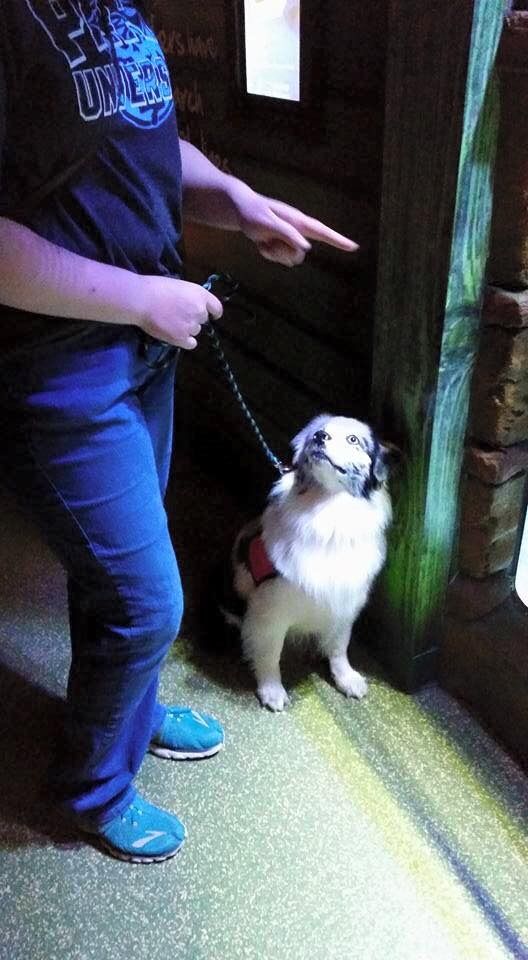
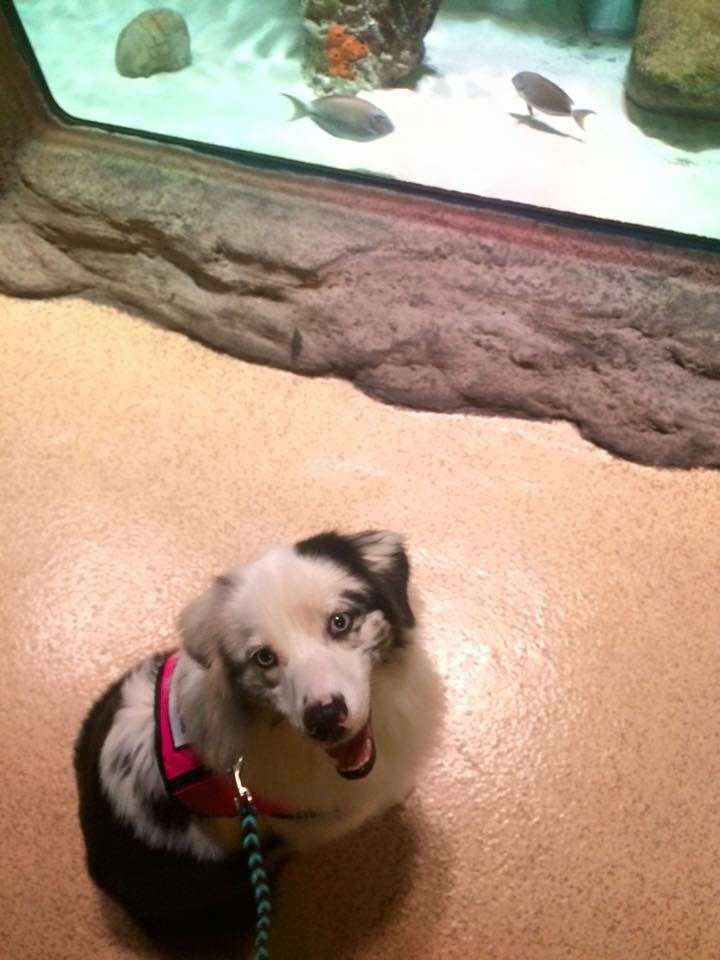
Patrick, GUGP's 2015 Guide Dog Puppy

Patrick, GUGP's 2015 Guide Dog Puppy
GUGP Website
Showing posts with label training. Show all posts

15 March 2016

My puppy keeps barking!

Barking is a natural behavior for dogs, and some dogs bark more than others. Some bark at certain things, some bark at everything. Sometimes it is an alert bark, sometimes a happy bark, or sometimes a protective bark. But for a service dog, barking is almost always a no-no. Nobody wants to be seated in a restaurant at a table next to a dog that barks because they heard a noise or someone that looks weird to them walks by. Or be in a hotel room next to another room that has a dog staying in it that barks at every bump or noise. One of the worst is walking with your own dog and having someone else walk by with a crazy reactive dog that goes nuts when it sees your dog. Unfortunately, I seem to be the poor person walking by with the crazy dog-reactive dog.
Patrick barking at other dogs has been an issue since we got him as a baby puppy. He is great with dogs he knows but very reactive when he sees dogs he doesn’t know. Around 14-16 weeks of age he was making pretty good progress and doing better and we were very excited by his progress. And then while on a hike (on a trail where dogs are supposed to be leashed) an off-leash Golden came running up to Patrick, Ricki, and me. It stood in front of us and stared. Well, Patrick really didn’t like that and went into a huge barking fit that went on even after the owner of the dog came and took it away from us. That one moment set Patrick’s progress back—all the hard work and training seemed to just disappear. After that day, Patrick was very reactive with almost every dog he saw on a walk or out in public. We had to start our training all over again.
How can you fix this issue? Every dog is different and will respond to training differently. This is our first time working a puppy through this specific issue. I have raised puppies in the past that were very fearful of different situations and the best thing for them was to take a break for a few weeks and not expose them to what was bothering them. Patrick, on the other hand, does better the more stimuli you give him. As an experiment I decided to take him to a pet expo a few months ago where we knew lots of dogs would be there. He barked a little bit with excitement when I got him out of the car, but then no more while we were there. Although I had a hard time keeping him from pulling at times while walking, to my surprise he was quiet despite being around over 100 strange dogs. Now this hasn’t fixed the problem but it was definitely a step in the right direction. 
Since then I have been working Patrick to walk quietly around dog parks—not in them, just around them. There are multiple dog parks close to where we live, so it is easy to work him at many different locations. My goal is to be able to walk Patrick up to the fence and have him watch the other dogs inside running and playing, all while being able to remain calm and quiet. We aren’t there yet but making baby steps. 
We are also making trips to pet store, where the goal is to be able to walk calmly and quietly through the store even if he sees another dog. Once again, he isn’t perfect at this yet, but making progress. For me, it is a lot less embarrassing to be in a store that allows dogs if Patrick lets out a bark or two, than in a store where we may run into a pet dressed as a service dog and he lets out a couple of barks (and yes, this has happened). 

Patrick can smell if there is a dog close by him and his body language does change. One time, we were shopping in Target and I noticed his body language change. Sure enough, someone was passing by with a small dog in the shopping cart. I got lucky that Patrick didn’t see it in the cart and we were able to continue without any outbursts. 
We are also now attending dog training classes to get Patrick around other dogs in a controlled setting. I purposely put him in a class called “dogs with attitudes” so that he would at times be “set up” to be around other dogs that bark at things, because he will often bark if another dog by him barks first. After attending two classes I already see some improvement. I did have to laugh a little bit when I first joined that out of the seven dogs in attendance five of them were German Shepherds.

I will admit that I do get a little anxiety when working Patrick in public. I never know when we will come across another dog. While Patrick is doing much better when multiple dogs are around him, it seems to be the surprise appearance of a single dog that sets him off the most. His barking is embarrassing at times.One time we were walking in a mall and he saw another dog across they way and barked. He completely frightened the people walking in front of us, who had no idea that Patrick was behind them. Not to mention that a 65-pound Shepherd barking can be a little scary to some people. 

Another time we were having lunch with a friend and were seated outside on the sidewalk because Ricki and Ozzy were there as well. Along came a person walking down the sidewalk with their dog. That dog barked at us and then everyone was barking. That was probably our most embarrassing moment.
Patrick’s barking issue isn’t going to away overnight. Issues like this take a lot of time, work, guidance, and patience to get through. Despite this issue being frustrating and embarrassing at times, I still have high hopes for Patrick. He has been making progress in the right direction and he is so solid on almost every other aspect a working service dog needs. He settles nicely, has great relieving habits, is very confident, super smart, loves to learn new things, and most of all seems to love to work. I hope that by sharing some of my struggles with Patrick’s training I can help other people who are raising not feel so alone with their struggles. Puppy raising is a journey with good days and, well, let’s just say not so good days. I have learned with past puppies not to give up when things are hard—sometimes they will really surprise you. Some puppies take a little longer to mature and learn, so give them a chance to grow and learn at their pace.

Amie

02 February 2016

The rights of businesses

Most people are aware that service dogs must be permitted to accompany their disabled handlers into non-pet friendly businesses. Unfortunately, many business owners are not aware that they too have rights concerning service dogs, and whether or not those service dogs are legally allowed to be in their business. There is much misinformation and fear surrounding the rights of service dog handlers, and thus, business owners. This article hopes to clear up some of these misconceptions, and to educate businesses on their rights, outlined in the Americans with Disabilities Act (ADA).


What is a service dog?

The Americans with Disabilities Act defines a Service Animal as:


“A dog that has been house broken and individually trained to do work or perform tasks for an individual with a disability.  The task(s) performed by the dog must be directly related to the person's disability.”


Contrary to popular misconception, a service dog can be any breed, or combination of breeds, of any dog. This could be your standard Labrador Retriever, or it could be a Terrier mix. Breeds are not discounted based on size, breed specific legislation, or public opinion. I personally work an American Bulldog/English Pointer mix named Cow. You cannot determine whether or not a dog is a service dog just by looking at their appearance.


You also cannot determine a service dog by the gear they are wearing. The ADA permits disabled handlers to work their service dog in whatever gear they so choose; this includes working the dog completely free of any identifying gear. Some handlers choose to dress their dogs in a singular vest or cape with patches identifying the dog, and possibly asking the public not to pet or distract the dog. Some handlers require more intricate gear to accommodate their disability, such as a guide harness, or a mobility harness. Some handlers use a simple bandanna, a leash wrap stating "service dog," or no gear at all.


What if I don't think a dog is a service dog?

This is a fair question. Unfortunately, as any business owner will tell you, there has been an influx of pet owners dressing up their pets in vests and bringing them in public by claiming they are a service dog. Most businesses leave it at that, despite the dog’s misbehavior, out of fear or being sued or vilified by the media for discrimination.

As a business owner or employee, you have quite a few rights in this situation. First, per the ADA, you are allowed to ask two questions of any service dog handler:

“(1) is the dog a service animal required because of a disability, and (2) what work or task has the dog been trained to perform. Staff cannot ask about the person’s disability, require medical documentation, require a special identification card or training documentation for the dog, or ask that the dog demonstrate its ability to perform the work or task.”

What do they mean by "task"? A task is considered any trained behavior that mitigates the handler’s disability. For example, this includes, but is not limited to, mobility and balance assistance, medical alert (cardiac alert, diabetic alert, seizure alert, blood pressure alert, etc.), guiding, alerting their Deaf handler to sounds, pulling wheelchairs, picking up dropped items, performing grounding tasks for psychiatric disorders, medication reminders, seizure response, blocking the individual from a crowd, removing the dissociated handler from the public space, alerting a person with PTSD that a stranger is coming up behind them, and more.

What is NOT meant by "task," includes, but is not limited to, emotional support, comfort, protection, intimidation, or any other benefits unrelated to disability. While service dogs may provide comfort by their mere presence, this is not considered a task under the ADA. If the animal is not trained to do anything else but provide comfort or emotional support, then they are not a service animal, even if their owner is disabled. More importantly, service dogs MAY NOT be used for protection or intimidation. Service dogs may intimidate people by their very presence, but this is not considered a task, and is highly frowned upon by the Department of Justice and other handlers. Service dogs should not have a high protection drive, and should not automatically protect their handler unless genuine harm is befalling them. After such an event, service dogs should be reevaluated by a qualified behaviorist to confirm that they are still fit to work around the public.

What about documentation or certification that the dog is indeed a service animal? This will come as a surprise to most people, but there is no such thing as a certification or registration for service dogs. As a result, there is not legal identification or "paper" for service animals, and asking for one will only get you a long lecture by the handler, a sobbing handler in the middle of a panic attack, or a call to the Department of Justice or the police. In my personal experience, the people who carry and offer identification for their dogs are typically pet owners who have paid $75 to "register" their pet on a scam website in return for a vest, identification card, and paperwork stating that the dog is a service dog. This does not require any training or proof that the person is disabled and the dog is trained. It’s simply a scam that needs to be made illegal and prosecuted. Of course, this does not include paperwork from specific programs that some handlers carry as an extra precaution, or the fake identification that some legitimate handlers carry and use as a last resort if asked for it by an uninformed manager, as the handler’s disability prevents them from educating the often-belligerent employee.
Pumpkin Balancing Level: Expert
This, unfortunately, is not considered a task.


How can I tell if a dog is a service dog?

Despite the lack of uniformity and identification amongst service dogs and their handlers, there are a few good ways to tell if a dog is really a service dog. The most important, and surest sign of a dog’s legitimacy and training is behavior. Behavior always shows, whether it be the behavior of the dog or the handler.

A service dog will have their basic obedience down pat. They will not be incessantly sniffing merchandise, soliciting attention or barking at passersby, taking products off shelves, or leaving their handler to explore on their own. While some handlers do carry their small service dogs in their arms or in a sling, businesses do not have to allow dogs in shopping carts or baskets, and service dogs should never be on the business’ furniture unless their task demands it, such as performing deep pressure therapy on the lap of the handler. However, even during this task, the dog should not be using this opportunity to sniff food on the table of a restaurant or merchandise on higher shelves. The dog should be focused on their handler, not on the benefits of being higher than the floor. 

However, there are some tasks that appear to be the dog out of control. For instance, my service dog, Cow, will perform a gradual alert if I am shut down and need to be led out of the public area. First, he will nudge my hand with his nose. If I don’t respond, he will graduate to more incessant alerts, such as pawing at my leg, with him finally ending up jumping his front half into my lap, pawing at my chest, howling quietly, before he hops down, and grabs his leash in his mouth and attempts to pull me. If I’m unresponsive to the first quieter, more subtle alerts, he will always end up performing the alert that looks as if he’s just misbehaving. Seizure alert dogs also occasionally use barking if their handler is unresponsive to their alerts. 

It takes a trained eye to spot the difference between a service dog performing a task, and a pet dog throwing a fit, but the differences are there if you know what to look for. For instance, the service dog will always be focused on their handler, and will be trying to get the handler to do something, even if it’s not immediately obvious what that something is. For me, it is to allow Cow to lead me outside and to a safe, quiet place. For others, it could be to lay down to prepare for an impending seizure. Either way, the dog will have an obvious goal in mind, and they will not just be barking wildly and jumping on passerby. Seeing both in person often allows the layperson to discern the difference.


No dog is perfect, no matter their level of training or professionalism. This applies to service dogs as well. All service dogs have their bad days. The days where they don’t ignore the person calling out to them, or they sniff at some merchandise, or their handler doesn’t notice that their dog has an upset stomach. These things have happened, or will happen, to every single handler, no matter the training of their dog. For every handler, this is mortifying. 

We are often our dog’s biggest critics, as our dogs are an extension of ourselves. The important thing is that we take actions to control our dog’s behavior. If a service dog is soliciting attention from passerby, their handler will correct the behavior. If the service dog is throwing a legitimate hissy fit because they do not want to be doing their job that day, the handler will take immediate actions to control or remove the dog. 

Pet owners who are fraudulently representing their pet as a service dog will usually do none of these things. I’ve had pets in vests attack my service dog, doing their best to hurt him, while their owner just laughs and shrugs. I’ve seen pets in vests urinate all over merchandise, as their owner looks around and walks away as quickly as they can. Service dog handlers are not looking to get away with things. We are just trying to go about our lives. As such, we take responsibility for the actions of our medical equipment, no matter how humiliated and close to, or way past, tears that we are.

Cow thinks that if he stares deeply into my soul and makes googly eyes—also known as checking in—I’ll give him food. He’s usually right.

What can I do about out-of-control dogs?


Service dogs must be under the control of the handler at all times. Service animals must be leashed, tethered, or harnessed at all times unless this interferes with the handler’s disability, or the dog’s ability to perform their job. If unable to leash the dog, the handler must still maintain control of the dog through signal, voice, or other commands. If a dog, even a legitimate service dog, is out of control and the handler takes no appropriate and effective steps to correct the behavior or remove the dog, then staff may request and demand that the dog be removed from the premises. If the handler removes the dog and wishes to obtain goods and services without the dog, this must be allowed. Out of control could include, and is not limited to, jumping on patrons, barking incessantly or in a non-alert, handling merchandise, showing dangerous or aggressive behavior, urinating or defecting on the premises, or wandering alone without the handler.


Why should I risk my good name by removing possible service dogs?

Even when I’ve had dogs who are obviously pets attack my dog, businesses have been afraid to remove the pet, despite the danger it poses to myself, my medical equipment, and any other member of the public, including children who may run up to and hug or pull on the dog. Businesses are afraid that they will be sued or that the owner will immediately go to the media and cry discrimination. 

These are legitimate fears. Many a pet owner has attempted, and sometimes succeeded, in ruining businesses who have asserted their legal rights against their out-of-control pet. In these cases, service dog handlers have risen up to defend the business and reveal the fraud by the pet owner. In fact, service dog handlers generally prefer business owners to assert their rights. Too many good service dogs have had to be expensively rehabilitated or retired early because of an aggressive pet in a vest who attacked them while they were working, because the business was unaware of, or afraid to assert, their rights. 

I am writing this article because I want businesses to start asking me the two questions. I want businesses to listen to me when I beg them to please, please remove the aggressive dog on a flexi lead that tried to rip my dog’s face off when it saw us. I want them to stop being afraid of fraudulent pet owners who know that they have the power to make businesses cower under the threat of litigation and bad media, and who use that to endanger the safety and life of myself, my medical equipment, and every other patron they come in contact with, as well as the life of their “beloved” pet when that pet is pushed over their threshold and bites a kid.
Cow is a sensitive flower who has a lot of feelings about everything, including the floor.

Is that it?


Not at all! I couldn’t even begin to cover everything in this article. I only covered the major points. If you’d like to learn more about the specifics of the Americans with Disabilities Act in concern to service dogs, you can visit their FAQ. For a “too long; didn’t read” version of this article, go ahead and read the ADA’s Business Brief. For more information about service dogs and what they do to help disabled persons like myself, check out the rest of Growing Up Guide Pup. There are videos, articles, and cute puppy pictures made specifically to inform the public about service dogs and their many attributes.


Lindsay

05 January 2016

When not to crusade

One day, I was browsing through my newsfeed on Facebook, as per usual, when an interesting photo popped up. It was a peer of mine holding her dog in a locally owned arts and crafts store. I looked at the comments, and the most recent was one of her friends asking: “Wow, they let you bring him in the store?”

For some people, this would have alarm bells ringing in their head. Because somebody is obviously going to reply, “They asked me if he was a service dog, I said yes and that’s all I had to do,” or “Ha ha, yeah, I just say he’s a service dog and they can’t kick him out.” It’s a struggle many handlers have come across. “Fake” service dogs, or more accurately, pets that are portrayed as service dogs, are certainly a problem for service dog teams. I know of some teams where the service dog has had to either go through retraining or be retired from work entirely, due to an unfortunate encounter with a pet dog in a place where the pet should not have been.

Yes, it would be a real kick to the face for this peer of mine to have responded with affirmation that she had, in fact, misrepresented her pet as a SD. Considering we have had classes and outings together, before and after Velvet and I were a working team; I should have every right to go in tooth and nail, bombs away, right? How dare she do this to me, to other teams?

No. All I had seen was a photo and the poster had not responded with any indication that she had posed her companion dog as a service dog. In fact, my phone had a notification that there was an additional comment on the photo. Scrolling down, she had responded to the person asking how she took her dog into the store. Her response: “I asked the owner if it was okay if I brought him in.” Bingo! Some stores, as long as they are not violating health department codes, are pet friendly. I commented explaining how some non-pet stores can be pet-friendly, and was thanked for the explanation.

Now, imagine if I had gone in prepared to start a war over this. Feelings probably could have been hurt over my assumption. Rather than being known as a friend who would gently educate, I would be known as a trouble-maker who can’t enjoy a good photo of a cute dog in a dog-friendly store. Also, this person knows I am a service dog handler. What example would I be setting for her as one of her few, possibly only, friends who uses a service dog to mitigate a disability?

How long did it take to avoid potentially starting a fight? About five minutes. Unless a person is blatantly saying, “I’m just saying my pet is a service dog to get him into stores,” we cannot know the full story behind a picture. Many people are uneducated about the laws behind service dogs. How many handlers knew all of the laws before utilizing a service dog to improve their daily life?

I am not saying to sit every person down and start with the history of service dogs being utilized. You do not have to go out of your way to educate, especially when you have your own daily life schedule to attend to. All I am saying is, be kind and do not make assumptions. Proper education of service dog laws in America is desperately needed. Simple misunderstandings due to  lack of service dog education are experienced by different teams every day, such as a greeter saying “Dogs aren’t allowed in here,” or a child exclaiming, “I didn’t know they let dogs in here!” It doesn’t take an entire lecture to gently educate these simple misunderstandings.

With the emergence of social media, many people have assigned themselves the task of hunting down fakers. Do some people blatantly pose their pets as service dogs, knowing exactly what they are doing? Of course. There are also many other cases that could be the story which people do not know. What if the person has been advised by their health professional to get an emotional support animal and is not educated about the different between ESAs and service animals?  What if the individual does have a disability that could be mitigated by a service dog specifically trained to assist with the individual, but doesn’t know how to get started? Until the full story is posted, assumptions should not be made about a snapshot.

Many misunderstandings service dog users encounter with the public are not direct insults to the team, but simply a lack of education. This is why I am glad Growing Up Guide Pup is dedicating themselves to educating the general public in various ways. Aside from laws, Growing Up Guide Pup also showcases the adventures of puppy-raising, introducing readers to the various types of service dogs, and much more. Even as a service dog handler, I love reading the articles that are posted by guest bloggers and watching Matt and Amie’s vlogs of their puppy raising adventures. The website, videos, and social media tools utilized by GUGP are a vault of valuable educational tools.

Sara

23 December 2015

So you want a service dog ...

The first and most important thing to ask yourself before pursuing a service dog is: Do you have a disability?

It sounds a bit silly, but some people don't quite understand that to have a service dog, you need to have a professionally diagnosed disability/ illness. I continue to make a point of the professional diagnosis, because self-diagnosis does not, by law, mean much. For you to have a service dog with you in public, you need to have a doctor's acknowledgement of your disability. If they also support you having a service dog, then fantastic! However, a lot of doctors have not heard of service dogs assisting anyone other than the blind, so they may not want to sign their name to something they don't understand. Try to educate them if you can, but don't loose sleep over it. Their job is to simply say: "Yes, this person has [insert disability here]."

Next you'll need to think about what you want the dog to do for you.

There are many things a dog can do, but there are also many things they cannot. Some tasks may be easy to teach, while others may take many months of practice. 

Are you prepared for this specialized training? What effect will a Service Dog have on your day to day life? Does your family/partner/flatmate approve of this decision?

The people with that you live with will understandably have opinions about adding a dog to the household. A flatmate, for example, may not want a dog around, so it may mean getting a new flatmate or changing accommodation. However, if your partner has an issue with a new dog in the house, you've got a whole new problem. Not to sound negative, but do not underestimate any possible resistance to you having a new dog in the home. To do so may leave you and your dog open to very difficult situations.

Is the dog for a child, and are there other children who may want to be involved with the dog? How will the dog fit into the daily schedule? Who will supervise training? Who will be ultimately responsible for the dog? Allergies may also be an issue, but this might be overcome by getting a hypo-allergenic breed of dog.

Please do proper research on this. No dog can actually be classified as a "allergy free dog." People with allergies to dogs are usually allergic to the dander of the dog's skin, not the actual fur. If you have a dog that sheds less, like a Poodle, Schnauzer, or Italian Greyhound, they are usually easier for allergy sufferers to deal with. Again though, you need to think of how this breed will fit in as a working dog, how much exercise they need, are they people oriented, how much grooming will they need, and so on.

Have you considered your friends?

You may lose friends over a decision to get a service dog. It's sad to say, but I have lost a few friends who did not understand or like my decision to get a service dog. As training intensifies after a year or so, you may find more friends drop off. Not everyone feels comfortable around dogs. Friends may not understand why you are choosing to use a service dog instead of other options. Your friends may not want you to have the dog in their homes or even around them. Talk to your friends before you decide to get a service dog and see the effect it may have on your social life. You may decide that the benefits of using a service dog are greater than keeping the friends who don’t agree with your decision, but it is good to be aware.

Are you ready for the greatly increased public attention?
You will draw attention to yourself (and your disability) with a service dog. A service dog attracts attention, both to the dog and to the handler. This can really change how people perceive you, especially if your disability is invisible. A service dog openly labels the handler as a person with a disability. People who had not known you as disabled will suddenly have it drawn to their attention, and you may find that their perception of you changes when you get a service dog. Members of the general public will want to stop and talk to you about your dog and often also about your disability. Small children may chase your dog and try to pat it or even hug it. If your dog is large, small children may try to climb on it and ride it. A service dog is not a good option for someone that cannot tolerate a lot of public attention.

Can you handle confrontation?
Even if you get to the level where your dog is a fully trained service dog, some people will deny you access to places you have every right to enter. You will also have people tell you that dogs should not be in public places, or you may even be accosted by an animal loving activist for enslaving an animal (of course we know this is false, however some people don't understand).

These confrontations can be emotionally exhausting and hurtful. They can also be time consuming. Are you able to stand up for your rights to business owners and insist on access? This is a very real and unfortunate part of having a service dog. If you are not able to deal with this, you probably should not get a service dog.

What about the responsibilities of service dog/pet dog ownership?
Financial responsibility comes with dog ownership. Medical emergencies may pop up, with the average emergency vet bill coming in at $1000-$3000.

Further costs include leads, bedding, service coat/jacket, toys, grooming equipment, shampoo, flea and worming treatments, council fees. If you are not financially stable, a service dog (or a dog at all) might not be the best move. Check your local council regulations regarding the housing and keeping of dogs. This does need to be explored, particularly if you already own other dogs. Some councils' restrictions are severe, while others are more accommodating. All will require some form of licence. And they usually have a limit of 2-3 dogs per house.

Are you ready for the long term commitment that comes with dog ownership?

Dog ownership is a commitment! If you're lucky, the dog will be a good worker for roughly 8 years. On retirement, you must decide if you will keep the dog or find a new and suitable retirement home for them. What will you do if the dog develops behaviour problems or health issues and must be retired early? Will you be able to keep them? Will it be safe to keep them if you need to get a new service dog to replace them?

What are the responsibilities of Service Dog ownership?

Do you have the time and patience to work with a service dog both initially in the partnership and commit to ongoing training during the dog's life? Getting a service dog, regardless of whether it comes fully trained from an organisation, or for you to train under supervision/on your own, is a huge transition. Initially you need to spend a lot of time going over the basics, earning their trust and learning to work comfortably with a constant canine companion. 

Have you ever trained a dog entirely on your own? 

Learning to understand and “read” your dog and learning to work with your dog in public is not a walk in the park, so to speak.

As you progress together, the amount of time spent on dedicated training may decrease, but a certain amount of ongoing training is necessary during the working life of the dog. If the training is not maintained, your dog's skills will deteriorate.
Training your dog to be a service dog is not something that can be done in a weekend or even in a month. It will be an ongoing process continuing for the whole life of the dog. However, the most intense training will be in the early months/years, especially if you opt for getting a puppy instead of a young dog. There will be days when you will feel you are not progressing and in fact you may think the whole process is going backwards. These days are normal. Training requires consistent, daily effort even when starting with a dog that has already had significant obedience and socialisation. If you do not have the time to do this, or you are not willing to spend time working and practising with your dog daily, a service dog will not be a good option. You may decide a companion dog that you can just enjoy at home is a more appropriate choice.

You need to understand the basics of dog training before starting to train your Service Dog.

It is important to use humane, balanced, science-based training techniques when training any dog. Improper training techniques will at best decrease the dog's performance reliability and at the very worst can turn your dog into a dangerous, unpredictable animal. A service dog must be able to demonstrate very high standards in both public behaviour and task performance. If you do not already know the current basics of training methods, you should first seek professional assistance and instruction before starting. A service dog is still a dog. Even the best trained dog in the world will not be a perfect dog. If you cannot handle imperfection from your dog, you definitely should not train a dog, and probably should not consider working with a service dog.

While service dogs are highly trained, they are nonetheless animals, and will make mistakes. They will have good days and bad days. Someone who struggles with the ups and downs of dog training will not be an effective trainer and may compound the situation. You should be willing and able to seek outside help if you need it. If at any point you realize that you are not succeeding with your dog, you must be willing to discuss this openly with a specialist trainer.

This help could come in a variety of forms and it could be as simple as a telephone call to talk over the problem. If you are not the sort of person who is able to ask for help, please reconsider attempting to train your own service dog.

What breed of dog should you get?

There is no one breed of dog that is a better service dog than other breeds. However, there are breeds which are known for this work because of their trainability and easy recognition by the public. Common service dog breeds can include Labradors, Golden Retrievers, and Standard Poodles.

While many people have had success working with breeds such as American Pit Bull Terriers, Dobermans, and Rottweilers, you need to be aware that certain breeds invoke strong negative public feelings (especially the stronger breeds/bully type breeds).

Back to the question, from where should you get your dog and what sort of dog?

Look for dogs that are healthy, with the right temperament, and suitable for the tasks you want the dog to do. Shelters at times have great dogs that are available for adoption for unfortunate non- behaviour related reasons (e.g. owners moved, passed away, had a new child etc.) This may mean that a temperamentally great dog may become available. However, there are also many dogs in the pound because they are no longer wanted, or have issues, either in health and/or behaviour. Sometimes too what you see of the dog’s behaviour while it is in the lost dog’s home is not the behaviour it will exhibit two months later in your home.

A good service dog is near bomb proof, and restores to its "natural behavioural settings" in a very short time. This is very important as the dog needs to be able to cope (or learn to cope) with any type of situation, noise or visual stimuli, crowds, or confined spaces etc.
A rescue dog can bring greater risks as usually there is a very limited history of family backgrounds and of care and treatment that has been given. Within breed groups there are also specialist re-homing services, normally operated by and for a breeders' group to protect the breed and ensure that re-homing is done to the best possible homes. There can be terrific candidates available, and being a breed related group, health and temperament information is more readily accessible. 

Once again, be careful to do your homework, because anybody can call themselves a breeder. Ask if the dog is registered through a state body; ask for references from the breeder’s vet and other people who have bought dogs or puppies from them. They're usually delighted to give you these details if they have the breed’s interests at heart. You may also be asked or references about your ability to care for a dog.

Similar risks apply to puppies—their parents may be great, but puppies are still developing their personalities. Puppies need to progress through the juvenile periods, they will be silly at times, push boundaries and may not make the mark.

The International Association of Assistance Dog Partners (IAADP) believe that around 30% of puppies out of well-bred adults will make the mark to become a Service Dog.

Another source to consider is recruiting from "Show Ring" dogs that did not make it in that world, but are genetically and behaviourally very balanced—that is, unless they are being discarded from the show ring and breeding plans because of behavioural issues. The dogs that are being discarded because they do not meet the breed standard (e.g. too tall, too short, etc.) are better bets and often have reasonable social skills and are normally sound of health. Like anything, the cost associated with getting a dog this way may be higher than through a rescue.

Do you need a dog to perform retrieval based tasks?

Most dogs, with enough training, can be taught to retrieve - not just breeds with "retriever" in their name. However, some dogs love to retrieve and do it naturally or can be easily trained to do it. If you need a dog that can do a lot of retrieving, it would be in your best interest to make sure you point that out to your chosen source of a dog.

How active do you expect to be with your Service Dog?

Your activity level and expected daily routine is an important consideration. Be sure to be 100% honest with yourself about this, a bored or under exercised dog can be destructive and difficult to train.

Do you work at an office job where your dog will be sleeping under your desk for hours at a time? Do you have an active job where you are up and about for most of the day? Dogs are as individual in their activity levels as people. If you have a dog that needs frequent stimulation and activity and you sit behind a desk all day, the dog will not be happy. However, if you have a dog that enjoys his naps but is still ready to go when the day is over, then you have the perfect office companion. In the same way, if you are very active and your dog is not, you will find yourself dragging your dog along everywhere you go, and no one will be happy with that! Keep in mind that all dogs need some level of physical activity to stay healthy and happy, and if that cannot be provided by either yourself or by arranging for your dog to get exercise you may want to reconsider getting a service dog.

What kind of personality do you like in a dog?
Dogs are individuals; your partnership success depends on the compatibility of you and your dog. Some dogs are sensitive and responsive. These are usually easily corrected and want your approval and praise. They work because they want to make you happy, and they are satisfied when you are satisfied. This is often (but certainly not always) a good type of dog for a first-time dog owner, or a sensitive, quiet person who does not want to try and "talk" an independent dog into working.

At the other end of the scale is a hard dog. They are stubborn, independent and self motivated. They can be frustrating to train. They work because they want to, and because they like their jobs. They like praise, but don't necessarily need it. They are happy when they feel they have done a good job. Hard dogs are often the best dog for an experienced owner/trainer, or a handler that is more outgoing, loud and assertive or someone that wants a self-motivated independent thinker in a dog.

Realistically, most dogs fall somewhere between these two extremes. Look critically at your preferences, personality, and training experience as you do the selection process. Like the difference between hard and soft, some dogs have independent characters while others are more social creatures. Most dogs have times when they need both their own space and close companionship. 

When evaluating preference for independent or social dog, take into account the preferences of other family members or house mates. If you like an extremely social dog, but others do not, it might be best to compromise.
When considering a dog, think about the size, where it will live—in an apartment with a small yard, will it be required for mobility assistance (support when getting up or walking). Think about the longevity of the breed as some giant breeds have a very short lifespan (5-6 years). Consider the coat care, the amount of grooming needed, how much clipping is required (will it need to be professionally done to maintain an acceptable standard for public access? Professional groomers can cost a lot), will the dog to cope well with the your climate? Some people are very concerned about doggy odour, and some breeds have more than others. This may cause irritation in a relationship or even with a very sensitive person.

There are other issues to be considered, but this might help focus your ideas and expectations. And of course after reading all of that, if you have any further questions or worried feel free to contact me. Again, I'm no expert by any means, but sometimes it's nice to know you're not alone. 


Robbi Flynn
Robbi is a service dog handler in Australia who owner-trained her dog, Musa. She can be reached through her website.

17 December 2015

Time flies!

Where does the time go? It seems like just last month Patrick was a little puppy—now my little brother is bigger than I am! He hasn’t just grown in size but in knowledge as well. He has been a pretty good boy and I have been trying to teach him as much as I can. He knows all his basic commands pretty well now, and is getting really good at posing for photographs. I often look unhappy in my photos because doing obedience skills makes me nervous. I don’t like messing up and being wrong. Mom and Dad are really nice to me if I make a mistake, but I hate disappointing them. 
Patrick doesn’t pester me nearly as much as he used to. We can now go outside and play as a family in the yard. Mom and Dad used to have to take Patrick out by himself instead of with Ozzy and me. Patrick was really bad about chasing me and trying to herd me. I didn’t like it very much and got a little nervous about running after my ball when he was out with us. Now that he knows to play with his own toys instead of nipping at me while I run, it’s so much better. I run after my ball and he runs after his own toys. We still play tug a lot, and now that he is bigger and stronger Ozzy comes and helps me—we double team him. 
Ozzy seems to have finally accepted him as part of the family and is playing with Patrick a lot more these days. Ozzy playing with him has helped take some of the responsibility of teaching Patrick manners and have more time to myself to enjoy chewing on my bones. Mom has been trying to do special outings with me as well so I don’t feel left out. She spends a lot of time with Patrick, since he is even more needy than I am! 

But I have to say Patrick is doing pretty well. Now if I can just get through to him that we aren’t supposed to bark at other dogs, and to stop trying to pull when walking he would be pawesome. I try to show him by example, but he is having a hard time paying attention when other dogs are around or if he is really excited to be going out. Oh well, I guess I will keep trying. 
This boy has even more energy than I do! But he is also doing much better about being calm and quiet in the house. He finds toys by himself now rather than trying to steal mine. Patrick has also being going out more by himself in his blue jacket. This makes me happy that he is out working and learning about his future job, but I don’t like being left home. At least I have Ozzy with me. I’m so happy that we kept him. He is my best friend. Well, it looks like it’s about bed time here, so I better go claim my spot next to Mommy before Ozzy or one my kitty siblings takes it. She’s my mommy! Just kidding—I will share her.

Wags and kisses,
Ricki