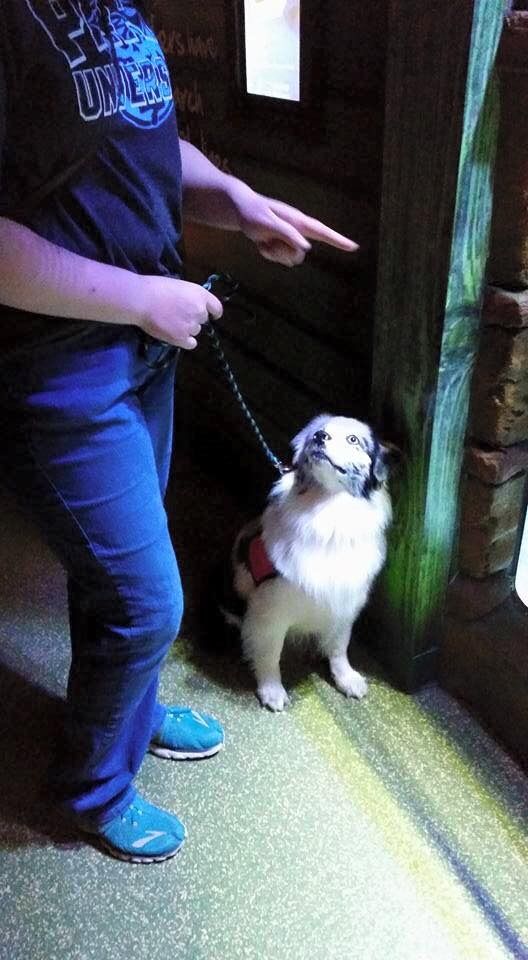
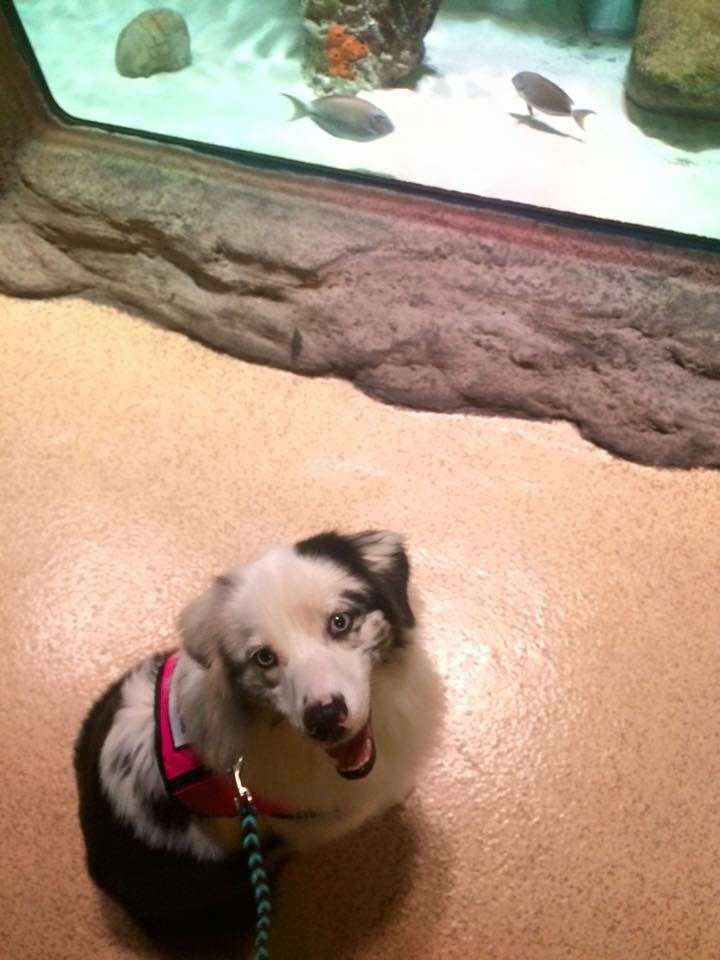
Patrick, GUGP's 2015 Guide Dog Puppy

Patrick, GUGP's 2015 Guide Dog Puppy
GUGP Website
Showing posts with label education. Show all posts

16 February 2016

Dobermans are service dogs, too!

As you might have guessed, my service dog, Kaline, is a Doberman. It's not a breed that is commonly used in the service dog world, although they are gaining some popularity. Working a Doberman can sometimes be a bit different than working a Lab or Golden.

Happily for me, Kaline generally does not get questioned as to his legitimacy due to his breed. We do get a ton of comments along the lines of: "I didn't know THEY used Dobermans as service dogs!" (No word yet on the identity of the mysterious "they.") The one major access challenge we've had as a team, oddly, was because of his custom-made, very professional-looking mobility harness. Apparently it looked like some sort of extreme control device. (Pro-tip: If you try to control a dog's movements with a mobility harness, you will fail. Spectacularly.)
Kaline in his big mobility harness.
Most of the public seems conditioned to think that dogs of a certain (read: medium to large) size wearing service dog gear are "real." This has worked out nicely for me with Juno, a big black mutt who does look a little Labby, and with Kaline. You will get a little more scrutiny with an uncommon breed, as far as behavior goes, but it's generally not extreme. Obviously this is not so handy for handlers of small service dogs, who regardless of breed or impeccable behavior, seem to be viewed largely with suspicion.

If you love taking advantage of photo opportunities, Dobermans will certainly help you there. Kaline, anyway, is a huge ham. He absolutely loves to pose for photos. Where some dogs (read: Juno) require high-value bribery like string cheese to put their ears up nicely for a picture, all Kaline needs to see is that camera. Once, while he was having an off-duty romp at a beach, Kaline galloped past a guy with a massive camera who was getting pictures of the scene. Kaline screeched to a stop, made a U-turn, and began cavorting in front of the camera, much to the photographer's delight. While I don't usually like to be in photos myself, I love few things more than taking photos of Kaline looking handsome.
This was a completely irresistible photo-op.
The big issue Kaline's breed can cause is some bizarre questions and assumptions from members of the public. If I had a dollar for every time someone tried to begin a conversation by asking, "Does he bite?" Kaline's collar collection would be twice the size it is now. This should go without saying but: 1) all creatures with teeth have the capability to bite, and 2) any dog who is likely to bite without provocation should not, and generally is not, working as a service dog.

Many children will ask if he's a police dog, which I find completely adorable. Less than adorable is when parents, though usually not on a regular basis, use Kaline's breed to frighten their children away from him. While I appreciate parents who educate their kids about why they shouldn't pet working dogs, it's quite unnecessary to tell the children that if they go up to Kaline he will bite them. Kaline's major failing with kids is he really loves to kiss them. And given that he's at face level with small children, sometimes that can surprise and startle them; this is why he only gets to greet kids taller than he is.
"Of course I would love to pose on this rock!"
And then there are what I like to call the storytellers. Every service dog handler can tell you about the innumerable times someone has interrupted an errand to tell them, "My dog at home looks just like yours! Only a different breed, size, color, and gender. ... She died last night." When you have a Doberman, or other perceived "scary" breed, you get a special kind of storyteller. These are the people who, after they've asked permission to pet your Doberman, will launch into a long and intensely uncomfortable story about how they, or their sister's boyfriend's second cousin once removed, was horribly mauled by a Doberman. That's when you smile and nod—and wish you could just disappear.

You might wonder why Dobermans are so uncommon, given how fantastic they can be as working dogs. Being taller than most Labs and Goldens, they can be a better choice for people who need mobility. They tend to be very in-tune with their handlers' emotions, a plus as long as you can keep that from becoming serious separation anxiety or overprotectiveness. They're incredibly snuggly and delightfully low-maintenance when it comes to grooming. They're also fun to train and quite intelligent, if not so very biddable as Labs and Goldens.
A love of snuggling means Kaline is great at deep-pressure therapy.
However, Dobes tend not to be the best choice for first-time owner-trainers or handlers. They're much more likely to give you the "Make me, why don't you" face than a Lab or a Golden. They can also become overprotective if their handler isn't careful to curb those tendencies. They are a guarding breed, after all, and if the handler allows it, a Doberman will take on the handling of a situation, which can end badly for everyone.

They're also well-known for health problems, despite the tireless work of ethical breeders. One of the major health issues that crops up in Dobermans, as well as the most devastating, is dilated cardiomyopathy (DCM), a heart disorder that is inevitably fatal. It generally crops up in older dogs, and there isn't yet a reliable genetic test for it. By the time a breeder learns that one of their dogs has the condition, the dog is likely to have been bred already.

Dobermans aren't the greatest candidates for service dog programs, in the sense that they tend to bond very strongly to their person, and may have major difficulties shifting that bond to a trainer or trainers, and then again to a new handler. While you can't go on autopilot with any dog and expect it to maintain its training without regular refreshers, doing this with a Doberman can be especially bad.

Then you have the diva aspect. Dobermans' shiny, beautiful coats are pretty much only for show. They get cold very easily, and aren't shy in the least about informing you about their distaste for the situation. If I take Kaline to a baseball game in Oakland in the summer, for example, and don't bring his various jackets and his cocoon-blankie, he will shiver dramatically, fix me with utterly miserable puppy dog eyes, and poke me every inning to see if it's finally time to go. Ask him to lie down on a marble floor without his mat, and he'll drop his head into your lap and stare at you mournfully: "But it's so cold on the floor. I couldn't possibly lie down here."
Kaline enjoying summertime at the ballpark.
There's also the fact that almost nothing pre-made will fit them. This works out pretty well for me, since I'm a complete gear-nut and have several friends who make high-quality custom harnesses and other equipment. Nonetheless, it does tend to get expensive, and it was quite sad when the PetJoy vest that I loved to use on Juno just would not fit Kaline, no matter how I adjusted it.
My favorite old vest. Alas.
The best part of working a Doberman, when it comes to the general public, is that you attract other Doberman people. I was somewhat prepared for this, having graduated from the University of Michigan. If you wear Michigan gear anywhere in the world, you will inevitably be greeted with cries of "Go Blue!" from perfect strangers who also went to Michigan (we're everywhere). It's very similar with a Doberman. Since Dobes are not terribly common, either as working dogs or pets, lovers of the breed tend to get delightfully enthusiastic when they see one out working as a service dog.
Sometimes we attract both fellow Wolverines and Doberman aficionados.
It's lovely being able to educate receptive people about the versatility and all-around greatness of the breed. Like any breed, they're not for every person. But many times, when someone who has been scared of Dobermans all their life sees one working calmly and quietly in public, that can be just the impetus they need to ask some questions and find out that Dobes aren't scary after all. Kaline, even though his breed as a whole is usually fairly aloof with strangers, loves getting to say hi to new friends, and is so sweet and goofy that he can usually change people's minds about his breed. There are few things more gratifying than opening someone's mind about Dobermans.
Kaline makes a new buddy.

Colt

05 January 2016

When not to crusade

One day, I was browsing through my newsfeed on Facebook, as per usual, when an interesting photo popped up. It was a peer of mine holding her dog in a locally owned arts and crafts store. I looked at the comments, and the most recent was one of her friends asking: “Wow, they let you bring him in the store?”

For some people, this would have alarm bells ringing in their head. Because somebody is obviously going to reply, “They asked me if he was a service dog, I said yes and that’s all I had to do,” or “Ha ha, yeah, I just say he’s a service dog and they can’t kick him out.” It’s a struggle many handlers have come across. “Fake” service dogs, or more accurately, pets that are portrayed as service dogs, are certainly a problem for service dog teams. I know of some teams where the service dog has had to either go through retraining or be retired from work entirely, due to an unfortunate encounter with a pet dog in a place where the pet should not have been.

Yes, it would be a real kick to the face for this peer of mine to have responded with affirmation that she had, in fact, misrepresented her pet as a SD. Considering we have had classes and outings together, before and after Velvet and I were a working team; I should have every right to go in tooth and nail, bombs away, right? How dare she do this to me, to other teams?

No. All I had seen was a photo and the poster had not responded with any indication that she had posed her companion dog as a service dog. In fact, my phone had a notification that there was an additional comment on the photo. Scrolling down, she had responded to the person asking how she took her dog into the store. Her response: “I asked the owner if it was okay if I brought him in.” Bingo! Some stores, as long as they are not violating health department codes, are pet friendly. I commented explaining how some non-pet stores can be pet-friendly, and was thanked for the explanation.

Now, imagine if I had gone in prepared to start a war over this. Feelings probably could have been hurt over my assumption. Rather than being known as a friend who would gently educate, I would be known as a trouble-maker who can’t enjoy a good photo of a cute dog in a dog-friendly store. Also, this person knows I am a service dog handler. What example would I be setting for her as one of her few, possibly only, friends who uses a service dog to mitigate a disability?

How long did it take to avoid potentially starting a fight? About five minutes. Unless a person is blatantly saying, “I’m just saying my pet is a service dog to get him into stores,” we cannot know the full story behind a picture. Many people are uneducated about the laws behind service dogs. How many handlers knew all of the laws before utilizing a service dog to improve their daily life?

I am not saying to sit every person down and start with the history of service dogs being utilized. You do not have to go out of your way to educate, especially when you have your own daily life schedule to attend to. All I am saying is, be kind and do not make assumptions. Proper education of service dog laws in America is desperately needed. Simple misunderstandings due to  lack of service dog education are experienced by different teams every day, such as a greeter saying “Dogs aren’t allowed in here,” or a child exclaiming, “I didn’t know they let dogs in here!” It doesn’t take an entire lecture to gently educate these simple misunderstandings.

With the emergence of social media, many people have assigned themselves the task of hunting down fakers. Do some people blatantly pose their pets as service dogs, knowing exactly what they are doing? Of course. There are also many other cases that could be the story which people do not know. What if the person has been advised by their health professional to get an emotional support animal and is not educated about the different between ESAs and service animals?  What if the individual does have a disability that could be mitigated by a service dog specifically trained to assist with the individual, but doesn’t know how to get started? Until the full story is posted, assumptions should not be made about a snapshot.

Many misunderstandings service dog users encounter with the public are not direct insults to the team, but simply a lack of education. This is why I am glad Growing Up Guide Pup is dedicating themselves to educating the general public in various ways. Aside from laws, Growing Up Guide Pup also showcases the adventures of puppy-raising, introducing readers to the various types of service dogs, and much more. Even as a service dog handler, I love reading the articles that are posted by guest bloggers and watching Matt and Amie’s vlogs of their puppy raising adventures. The website, videos, and social media tools utilized by GUGP are a vault of valuable educational tools.

Sara

20 October 2015

A Service Dog in College

Greetings! My name is Sara, and I am a full-time college student studying biology. My owner-trained service dog, Velvet, is an Australian Shepherd. There are many educational posts about service dogs and public access, but that is only a small part of their daily activities they experience with their handler. I have seen various potential handlers and current handlers wondering how being a service dog handler works while in college. This sparked my idea to do a write-up about how an average day in college while accompanied by a service dog works for me.

Let’s start off with how I prepare for Velvet’s day with me.

Supplies: I have a bag filled with Velvet’s supplies. These supplies include a mat, a popup crate, a travel water bowl, boots, and a rain coat. We don’t use each of these supplies every day, but it’s good to be prepared.

Potty Breaks: I am fortunate in that I have a ten-minute break in between my back-to-back classes, and that all of my classes and laboratories are in the same building. When you are creating a class schedule, as a SD handler it is important to factor in time for your dog to be able to take a break and do their business. Especially for those on bigger campuses where you might have to go from one side of campus to the other in a mere ten-minute window.

Now on to our day!

Lectures

Currently, my lectures can last from 50 to 90 minutes depending on the days the class is scheduled. For this, Velvet has to lay quietly and not be a disturbance to the class. I also picked out a seat where she wouldn’t be obstructing an aisle as she cannot comfortably tuck under the desks in the classrooms. This is where the mat comes in handy, so she can lay beside my desk while I’m taking notes and participating in class.
Along with sitting through calm lectures, she also has to be calm during the more exciting lectures. One time my physics professor was throwing a ball around the classroom to various students while lecturing about free-fall objects.  This was a big test, but I had worked with Velvet on impulse control around various distractions. Even in “boring” lectures, you have to be prepared for anything!

Around Campus
Velvet at the coffee shop.
During my longer breaks in between lectures, I might go to the computer lab to work on coursework. In this case, Velvet will go into a tuck underneath the desk as to not take up additional room. If I don’t have anything to work on, I will go to the coffee shop and chat with friends over a frappe. I also have to consider that Velvet has been cooped up in lectures, and could use an off-duty break. This is especially important to remember if I have a lab that day, as that can last 3-4 hours. So often, I will take her for an off-duty walk around campus to let her stretch her legs and have some fun. After all, at the end of the day, she is a dog!

Laboratories

This is one topic that has different responses. To take your service dog to laboratories or not? In my experience thus far, it depends. For example, I do not take Velvet to my biochemistry lab due to the chemicals we are working with. I do not want to expose her to that, or disrupt that kind of environment by bringing in a dog. But for my physics lab, as long as we aren’t working with projectiles, I bring her. She is underneath the lab table on her mat, and I let her work on her Benebone for entertainment while my lab partner and I work on the experiment.
Along with my credit hour labs, I am also doing independent research in paleobotany. Part of my research includes making acetate peels of specimens, part of which involves having to etch the fossils in a tub of hydrofluoric acid. I am in a lab coat, rubber apron, rubber gloves and a face shield, so I obviously wouldn’t bring Velvet into this environment. My research setup is in a lab side room, so when I am working on my project, I have Velvet's popup crate set up in the main lab. The lab room she is set up in only hosts introductory level biology courses, so she is not exposed to chemicals there.
Overall, while we had to make some adjustments, we were still able to work around having a service dog in college. While it might seem daunting to have to not only adjust from “college life” to “college with a furry shadow life,” the benefits of the accommodation were worth it. My daily life has been enhanced with Velvet by my side as I go through my education.


Sara

01 September 2015

Bringing back Growing Up Guide Pup: A Cause for Hope

As we head back to California on another Growing Up Guide Pup adventure, I ponder what to discuss for my premiere topic on the GUGP blog. I usually don't have a problem finding a topic I want to blog about because it seems I always have something to say. Amie tells me I never shut up.

As we work out of our mobile work station—a 2001 Toyota Highlander—returning through Lake Tahoe, I find myself in a bit of a mental freeze. I don't know if it's the foul stench of that disgusting rest stop in Nevada, or the gas station pizza near the California-Oregon border I should have avoided like the Black Plague. All I know is my brain is fried, so I ask Amie for ideas.  She says, "Why don't you talk about bringing back Growing Up Guide Pup and what it means to you?" Given that Amie and I often come to the rescue for each other, and she has not failed me yet, I take the idea and will run with it ... so here goes.

Bringing back Growing Up Guide Pup means many things to me, but most importantly it means hope.

Guide puppy in training Pilaf at a fire station.
Hope that we at GUGP can make a difference with our non-profit. Hope that the many obstacles we have observed in the service dog world may be addressed in some fashion. Hope that our various forms of new media will inspire more service dog volunteers. Hope that GUGP may help attract more financial backing to the service dog industry.

Hope that puppy raisers will have increasing societal tools for training, as well as the support of governing laws and culture to allow them to do their job at the highest level possible. Hope that service dog teams will find their lives more productive and easier to live as culture moves towards a better understanding of disabilities. Hope that people will acquire knowledge about service dogs' crucial role, and not assume this is just a person who put a jacket on their pet.

Hope that service dogs may be able to help increasing numbers of people with disabilities. Hope that service dog organizations will look towards a unified goal of helping the disabled regardless of economic, societal, fundraising, and political obstacles that may get in their way. And most importantly, I hope that GUGP will take all these needs and shake them up, stir them around, and pour them into a glass for enjoyable consumption. 

In the following years, the likelihood of coming in contact with a working service dog team will reach critical mass, yet the general public has limited knowledge of these wonderful animals, their jobs, and how to interact with their handlers. The demand for more service dogs to help people with disabilities will grow and the level of awareness and understanding will need to grow to keep up. Growing Up Guide Pup would be honored to assist as much as we can! 

Matt with his and Amie's first guide pup, Macklin.
Five years ago Amie and I observed that despite dozens of service dog schools in existence, something was missing that not too many organizations prioritize. What is missing is education that bridges the gap between the service dog world and the average person who knows nothing about the topic. I hope our that our new media approach and other developing visions for Growing Up Guide Pup may directly improve this area. Service dog schools have their hands full with their primary missions of breeding, training, and partnering service dog teams. Growing Up Guide Pup's goal is to raise awareness about service dogs, service dog etiquette, and service dog laws. This is an important public service to assist the service dog organizations throughout the world.

Therefore GUGP's hope is to:

1. Continue displaying the joy as well as benefits of raising service dogs.

2. Provide education and understanding to the general public, so people are familiar with services that service dogs provide, and how to engage when near a working service dog team.

3. Spotlight service dogs, service dog users, and service dog training organizations.

4. Advocate for service dog users, raising awareness about issues including access and what rights are granted by the Americans with Disabilities Act.

5. Raise awareness about fake service dogs, whom they hurt, and what we can do to fix it.

So as I see it, a cause for hope is what bringing back Growing Up Guide Pup means to me.
Now let's get back to work!


Matt