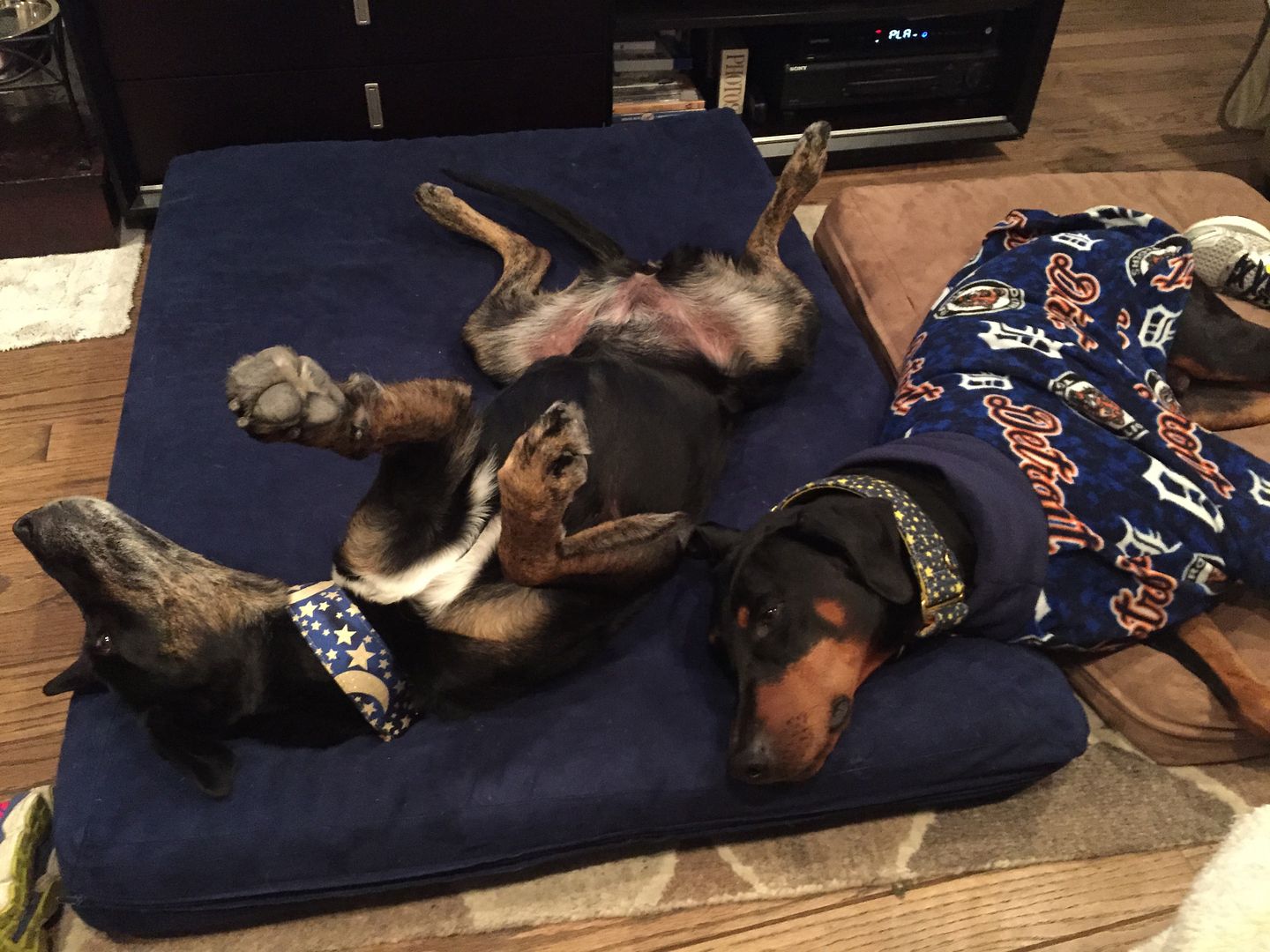
Patrick, GUGP's 2015 Guide Dog Puppy

Patrick, GUGP's 2015 Guide Dog Puppy
GUGP Website
Showing posts with label owner training. Show all posts

01 March 2016

Don't get your kid a dog

When I was seven, like a lot of kids, I asked my parents for a dog. Like most (smart) parents, they said no. They told me I could have one when I turned nine.

I turned nine. They said I could have a dog when I was 13.

I used to be kind of bitter about this. Many of my friends' families had dogs, and they didn't have to be 13. How unfair!

But as I've gotten older, I realized that what my parents did was brilliant. And if they hadn't, I doubt I would be the type of dog person I am today.

Since I had to wait for what seemed like forever for my first dog, I researched. Well, as much as an elementary-school kid can. I went to after school care at the local Rec Center, where once a week or so they'd troop all of us off to the library down the street. Methodically, I managed to check out and read every single book in their dog section. Every week, I'd return the five or so books I'd taken the past week and get the next five on the shelf.

I learned about all the different breeds I could. My parents thought it was a hilarious trick that I could be walking down the street and immediately rattle off the breed of every dog we passed. I learned about what happened when you put time and effort into training a dog, and what happened when you didn't. I learned about The Seeing Eye, the oldest guide dog school in America, based in Morristown, New Jersey. I realized that my dream dog (at that time a German Shepherd) was probably not the best choice to have in a townhouse where it would have to amuse itself alone for six to eight hours.

By the time my parents and I seriously began our search for my first dog, I knew pretty well how to pick a dog suited to our lifestyle. We needed a young adult dog; nobody was ready or willing to take on the challenge of a puppy. We could offer about an hour of walking a day, so a high-energy large dog was out of the question. Short coat was a must, since extensive grooming wasn't and still isn't my favorite thing. We decided to adopt, and went through several shelters before arriving at Pets In Need, a rescue I'd done a report on in sixth grade. (When I was in school, if you gave me an open-ended project you could bet money that it would either be about Jackie Robinson or dogs.)

There, we found Buddy, a black Lab mix with some emotional baggage. I wanted him; the parents were less sure. Finally, I convinced them. My mom called Pets In Need and discovered that just that morning, someone had walked in and adopted this dog who had been in Pets In Need's care for more than twelve months.

I was devastated. But just a short time later, Pets In Need called to tell us that a two-year-old female Doberman mix had come in, and they thought she'd be perfect for us. She was gorgeous. She was sweet. She wasn't loud or pushy. She, like Buddy, had certain baggage; she had had at least one litter, and had a somewhat shy and reserved temperament. We brought her home and named her Angel (not because she was so lovely, oh no—because I was and still am obsessed with Buffy the Vampire Slayer and she had to be named for the vampire with a soul, Angel).
Lots of kids, when their parents get them dogs as soon as they ask for them, lose interest fairly quickly. To be honest, parents need to expect that on some level, and not turn the dog into some kind of life lesson where if the child forgets to walk him, the parent returns the dog to the shelter (yes, this happens). I, on the other hand, had been waiting six years for this dog. I was so ready. I had enrolled us in a training class, I was getting up early to walk her before school; if Angel needed something, I was going to do it. Except for walking her alone late at night, which became my dad's job.
Angel and me a few weeks after we got her.
I made a ton of mistakes with Angel, and she taught me a lot. I still cringe when I think about how often I walked her on a Flexi leash let out to its full length, or how I let other dogs get in her face to "say hi." I did not keep her nails nearly as short as they should have been. I also let her wear nylon collars her whole life (mea culpa!).
But Angel was a perfect first dog. Within three days of coming home, she was refusing to be confined in the dog-proof front hallway. So we let her have the run of the house, and she never destroyed a thing or stole a morsel of food. She was super food-motivated, so I had a fantastic time in training classes with her. She learned to be a lady in public, and everyone loved her. I was able to take her anywhere that dogs were welcome and know that she would behave properly. She wasn't a service dog, but looking at old photos, I realized that we did do a rudimentary type of deep pressure therapy together.
Angel did freak out during thunderstorms and when she heard fireworks, but otherwise, you couldn't have asked for more in a dog. I was heartbroken to leave her with my parents when I went to college, and crushed when she passed away while I was in Michigan in December of 2007, and not home with her.

Because of Angel, and how I had to work and wait for her, I was a much better dog person when I got Juno, my wild woman turned service dog. Angel taught me how great life with a dog is when you fulfill that dog's needs. I don't just mean food and shelter—I mean proper exercise, mental stimulation, and affection. She also taught me that Dobermans are the best. I'd known Dobermans most of my life, as my childhood best friend always had a rescue Dobe in the house, but being quite a short person, I was often intimidated by them. They were basically at eye level with me a lot of the time, after all. But once I got Angel, I knew I always wanted a Doberman or Doberman mix in my life.
Without the work and wait for Angel, and the rewards that followed, I wouldn't have become so passionate about dogs and dog training. It's not enough just to love dogs. I was and am constantly learning new things about dog body language, dog etiquette, dog training, the works. I am convinced that you cannot be a successful owner-trainer of a service dog unless you are devoted to learning constantly about dogs in general and training specifically, as well as doing all you can to improve your own training techniques. Training has to be something you think about every single day, something you're passionate about, something you want to talk with people about endlessly.

I doubt I would have developed my passion, and therefore my skills, if my parents hadn't made me wait six long years for a dog. So, Mom and Dad—thanks for NOT getting me a dog when I asked for one. It was a really good decision, and one I'll be grateful for the rest of my life.


Colt

19 January 2016

New Year's Resolution

Part of being a service dog handler is transitioning from one dog to another. Unfortunately for us, service dogs can't work forever. Each dog has his or her own quirks, strengths, and weaknesses, and the transition can be hard.

You're with your service dog practically 24/7 for years on end, which means you both get used to each other's needs, signals, likes, and dislikes. Changing partners is a huge adjustment, and it's nearly impossible not to make comparisons between your previous and current dog (usually in the older dog's favor).
At Muir Woods with baby Kaline (then still in training) and Juno
(then still working mostly full-time).
Which brings me to my New Year's Resolution, which I'm going to do my best to keep: I want to stop (as much as I can) comparing my current partner, Kaline, to his predecessor, Juno. Well, except for right now, since I think it'll be interesting to do in a blog post!

Juno started service dog training when she was an adult, nearing middle age. Even when she was a pet, when we first adopted her, her general M.O. was to follow me around until I sat down somewhere, then curl up at my feet until I was ready to go somewhere else. You can see how that was a really handy tendency when she started working.
Juno during her training period at the San Francisco zoo with
her mentor, Jolanda (front), and SDIT pal, Hunter (left).

Though she was something of a hot mess as an under-socialized adolescent, by adulthood, Juno had grown to be an unflappably calm, solid presence. The only thing I can think of that ever fazed her during her working career was a performer cracking a whip on stage during a Cirque du Soleil show in Las Vegas.
Juno ignoring the festivities of Gay Pride in San Francisco
to pose for a photo.
Juno is also an extremely eager, creative learner. Not only will she do almost anything for food, she also took readily to clicker training. If she doesn't get rewarded for one behavior, she'll start running through a repertoire of behaviors and even think up new ones. Teaching her to do new things—like retrieve, carry objects around, and open and close drawers—was nearly always delightful and struggle-free. (Extinguishing bad behaviors, like her adolescent dog reactivity, was a struggle, though we eventually succeeded!)
With Juno in Las Vegas.
And another fabulous thing about Juno: Being part Lab, she has a basically Lab-shaped body, and thus every single piece of gear I ever got her fit her like it was custom-made for her. You don't appreciate that until you get a weird-shaped dog, let me tell you!
"Everything fits me, and I fit anywhere."
As you can see, Kaline had very big shoes to fill.

Kaline started training as a baby puppy. I like training dogs in general, but I especially love training puppies. They're a blast. But I'd never had my own puppy—Juno was adopted at 18 months, and my first dog, Angel, was about two when we got her. As a puppy, Kaline was a pretty quick learner, food-motivated like Juno, but it was exhausting being out and about with him. I thought I'd been pretty vigilant when working Juno—you're always on the lookout for possible distractions or threats to your service dog—but I didn't have to worry about her behavior. Not so with a puppy! Everything we encountered was a training opportunity: both a blessing and a curse. I quickly learned to wear a bait bag at all times so as not to miss one of these opportunities.
SDIT Kaline works on blocking (also known as covering).
He also wasn't, and isn't, nearly as creative about learning as Juno. Kaline does very well with luring (using a treat to help show him the desired behavior), but becomes easily bored and frustrated if he isn't getting hints. He won't just come up with new behaviors; he'll sit there and stare at you, then decide that your food isn't actually that enticing and go find something else to do.

Did I mention that nearly all of Kaline's gear beyond simple cape-vests has to be custom made? There's a reason he's lovingly known as the Princess Diva.

Where Juno is fairly aloof with strangers, Kaline is a social butterfly with both dogs and people. He just assumes that all new dogs and people are going to love him and be his new best friends. It was much harder for him to learn to ignore people trying to distract him, and it's something we are constantly working on. So many things that just came naturally to Juno, Kaline had to learn, sometimes laboriously over weeks. He had trouble learning to hold a long down-stay, so I began attending the "classic" movies religiously with him every Wednesday night. The ticket packages were cheap ($30 for six movies) and the movies sparsely attended—fewer people to notice if we had any trouble! I think we ended up getting three of those packages, and by the end his long down had improved markedly.

Teaching him to retrieve to hand seemed to take forever. What Juno picked up during one slow night at work, back when I had a job that wasn't dog-centric, Kaline took over a year to put together. Juno is very quick and doesn't need much amping up; once she realized there was a cookie in it for her if she picked things up and gave them to me, all I had to do was point, receive the object, and feed her. What Kaline needed was his Auntie Sonja, a soft zip-up pencil case full of high value treats, and for me to get SUPER EXCITED about everything to do with retrieving. Food just wasn't enough when it came to learning that. He needed me to be far more demonstrative than I'd ever been with Juno. Once Sonja helped me come to that realization, his retrieve improved swiftly and we're now to the point where I can use retrieving an object as Kaline's reward for doing something else.
During a long, boring airport wait, I can now
entertain Kaline with retrieving games.
Enough about Kaline's shortcomings. Now that we've had our own place for a year, I've come to realize anew just what a fantastic partner he is. For one, he is just about the most hilarious dog, service dog or pet, I've ever met. He makes me laugh every single day. Much of the time he falls asleep with all his feet in the air. Sometimes he finds tennis balls on our walks and, since he knows if he can get it home he can keep it, will doggedly carry the slimy object for a mile or so and then cuddle with it when we get back. He also has a huge obsession with sardines, and watching him struggle to contain himself while I make his dinner is endlessly entertaining. Kaline is quite a silly boy when he's not working, and he has no inhibitions about showing it!

Things that Juno does because I ask her, Kaline does because he absolutely loves to do it. Juno is not, in general, a cuddler. She would do deep pressure therapy for me, but she would get off whenever I told her and be very glad to be finished. Kaline will sometimes just do DPT, because he already knows I need it, and he will refuse to get off if he senses that I am still not calmed down enough. As an added bonus, he adores cuddling in bed and basically sleeps on me or pressed against me as tightly as possible. This might sound like annoying bed-hog behavior, but for me, it has improved my sleep tremendously.
Kaline delights in snuggling (off duty) and deep pressure therapy
(on duty).
Momentum pull, a task I use a lot and which Juno never found all that wonderful, is Kaline's calling. Where Juno never really got past needing a target person to follow, Kaline learned to pull in a straight line, follow directional commands, and seek out the path of least resistance in record time. He loves it. He's great at it. It's something you can end up taking for granted, since it seems so natural for him (much like holding long downs was natural for Juno).
Kaline in the early stages of his
momentum-pull training.
And while as a puppy, Kaline could be momentarily unnerved by random things—a fire in a fireplace, period costumes, large plastic figurines—as an adult, I think he's even more solid than Juno.
Kaline as an adult in front of the fireplace that scared him
as a SDIT.
His reaction (or lack thereof) to fireworks never fails to amaze me. We can be in the lower deck at a ballpark, with fireworks being set off on the field, and he just chills out on his mat, either watching the show or staring at me in hopes of getting rewards. I taught him early on that loud noises of all sorts mean he's probably going to get food, and have never regretted this!
Fireworks in Toledo—"Food now?"
He lay by my feet in the front row of Odysseo, a Cavalia show featuring about 30 horses performing each night, and had no problems (well, he didn't really like being splashed by cold water at the very end of the show, but can you blame him?). He still doesn't particularly like trucks rumbling by very close to us, but otherwise, nothing fazes him.
At Odysseo.
Learning to teach the way Kaline learns best—which is not always the way Juno learns best—was a really big part of us becoming a good working team. In some areas he needs more or different motivation than she does, while in others, where Juno needed a ton of encouragement, Kaline's got it, thank you very much, and please stop chattering, Mum. It took a long time, but for about a year and a half or so, we've been working smoothly as a team. It's become much less me showing him what to do and how to do it, and more both of us just knowing what needs to be done.

He now knows all my weird little signals, and I know his. For example, I taught him to shake off on cue because 1) I really don't like it when he does that inside restaurants and 2) even when he's out of gear, each shake off seems to last several minutes, like I just soaked him in water. Kaline knows he isn't supposed to shake in restaurants or when he's doing harness work, so he'll let me know if he needs a quick "shake break" by doing what looks like a head tremor. He'll just twitch his head a couple times, and then wait for me to take him to an appropriate place and give him his cue.

It takes a long time to reach the level of comfort and trust with your new dog that you had with your previous dog. And even though I've had that for a while now with Kaline, I still compare him to Juno (along with other friends' service dogs) far too often. Sometimes you forget that your previous partner had some things they struggled with, and some working quirks you found annoying. No dog is completely perfect, and even the ones you think can do no wrong have off days. It's important to appreciate everything that's wonderful about your current partner, and that's what I've set as a goal for 2016.

Because one day, I'm going to be training NextDog. (Hang out around service dog handlers enough, and you realize that we are constantly thinking about and tweaking plans for NextDog. It never stops.) And when that day comes, I know I'll be wishing I could just work with Kaline forever.

Colt

12 January 2016

Choosing a service dog breed

Editor's Note: Not all of the breeds pictured are suitable for inexperienced handlers/trainers. However, in the right hands, they can be excellent working partners.
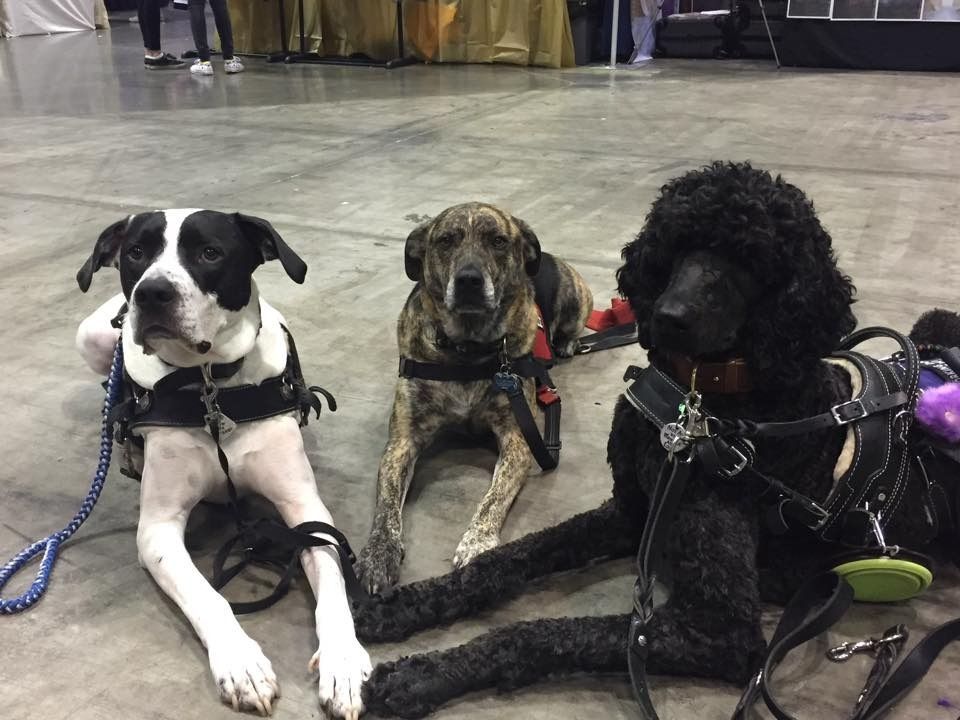
Service Dog Cow, Pointer/American Bulldog Mix
Service Dog Luke, Plott Hound/Lab Mix
Service Dog Watson, Standard Poodle
You've done your research, spoken to family and friends, and you've decided a service dog will be a valuable part of managing your disability. Now you need to pick a breed.

First and foremost, the most important tip you'll ever hear: Do not assume you'll be the exception to the rule. 

The goal of having a service dog is to be able to gain back some independence. Getting the same high-energy breed you had and loved as a kid now that you're an adult couch potato is not such a good idea. Just like when training our dogs, you want to set yourself up for success.

I'll mention this a lot throughout the article: It's about the specific dog, not the breed. It's important to remember that dogs are living creatures. They will all have their own personalities. Knowing the common issues for breeds is going to help you narrow it down from all to a few, and from there you can start to look at the individual dogs instead of individual breeds.

You'll also need to research your breeder and the lines they have. Just because a breeder is registered or has papers for their dog does not mean they're a responsible breeder. Take the time to ask questions, see where the dogs are raised, ask around.

Good First-Time Service Dog Breeds

These are just examples, and good first-time breeds are not limited to those mentioned here.

Labradors: There's a reason these are some of the most commonly used dogs. While not all Labs will be happy-go-lucky lovers, there are a lot of responsible breeders out there with some fantastic working lines.
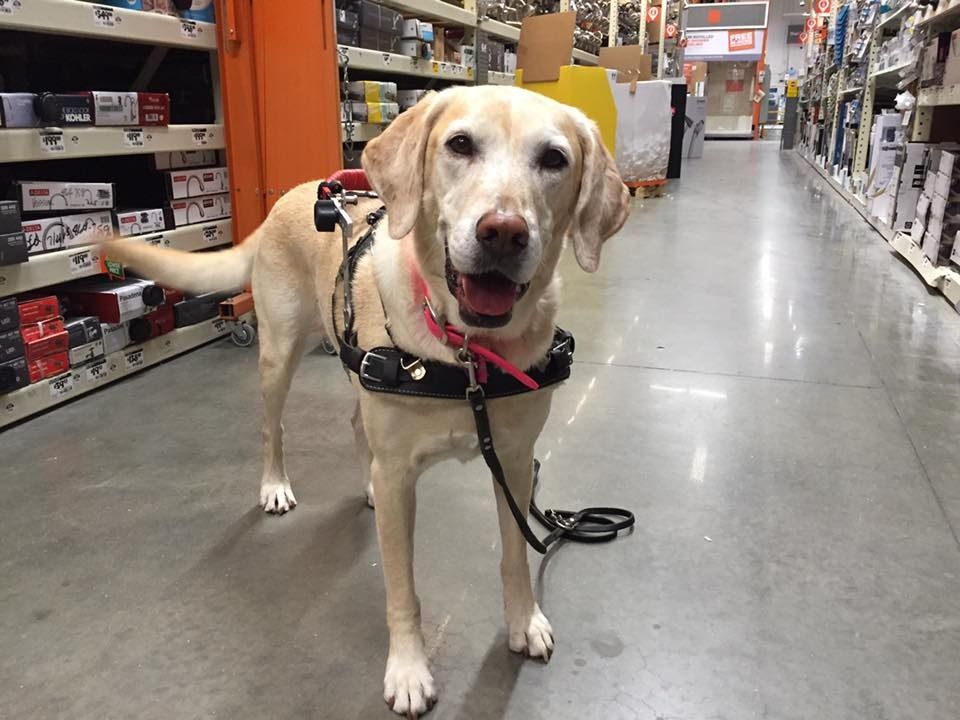
Service Dog Daphne, Yellow Labrador
One of the best things about these dogs is the general public recognize them as "working dogs." Yes, they generally recognize them as guide dogs, so you may get a few comments about that. However they're also likely to instantly connect a guide dog handlers' well-known right for public access to you and your dog, causing you fewer issues.

Golden Retrievers: Again, there's a reason they're common. While grooming maintenance will be a little more for Goldies than Labs, they tend to be a willing and loyal breed.
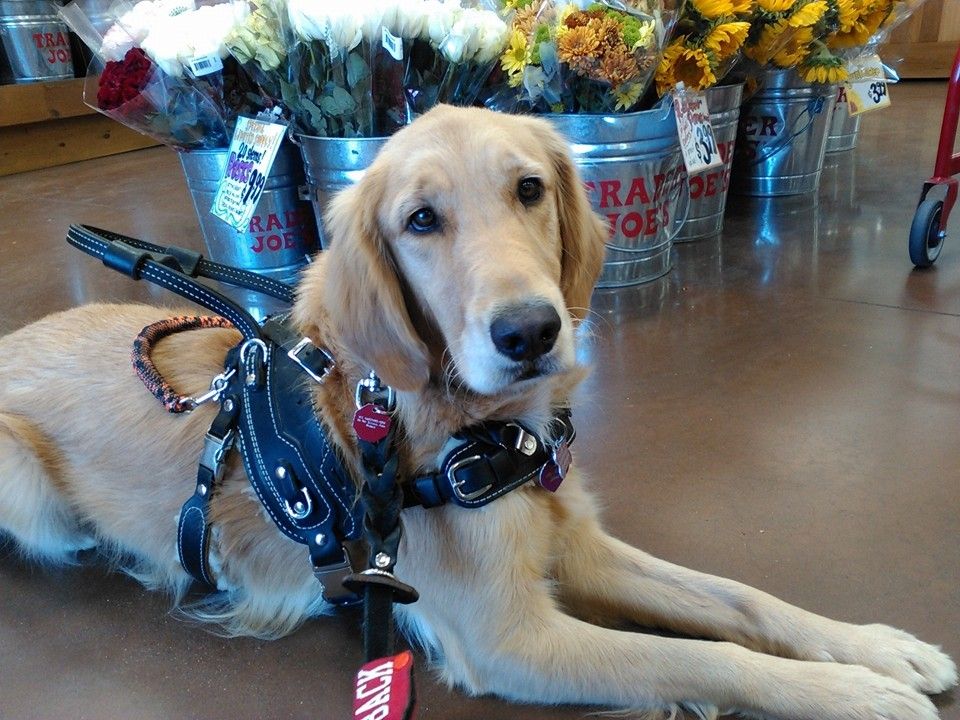
Service Dog Sky, Golden Retriever
Standard Poodles: A wonderful breed, but do take a lot of grooming. Keep in mind as well that a service dog's level of hygiene and grooming compared to a pet dog are generally worlds apart.
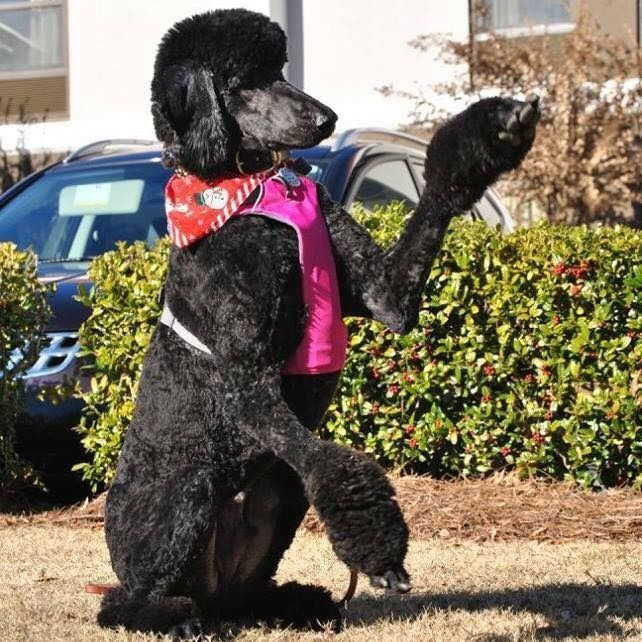
Service Dog Watson, Standard Poodle
Some lines of Poodles have shown aggression issues stemming from fear. So, as with all dogs, well-balanced socializing is key.

Collies (Smooth & Rough): An incredibly smart breed with a good will to work. However, if you can't keep up with them, they'll leave you in the dirt. Remember to match your potential breed with your own lifestyle. Don't get a Collie if you're hoping to go from a couch potato to a world class mountain climber. Because if you don't make it to be a world class mountain climber and this dog is left to sit around all day, you will suffer. They will find their own thing to do and you will most likely not enjoy it. There are very few dogs out there who wouldn't love to go exploring with you, no matter their breed. So be sure to match a potential dog with your potential worst day to give you the best chance of success.
Service Dog Lucas, Rough Collie
Service Dog Billy, Smooth Collie
Greyhounds: A newer breed in the world of service dog work, they're quickly picking up popularity. More and more people realize these dogs are bred for sprints, not endurance. They give you the large size which most people appreciate, without the buckets of energy.

However, they are restricted in some countries. So please be sure, no matter what breed you get, to think long term. Do you plan on travelling? Ask around and see if there are any odd breeds that are restricted in places you're likely to go. In Australia, unless a Greyhound has passed a special test they must be muzzled at all times. Will a muzzle get in the way of your dog's tasks?

This leads me to an important tangent. It's important to be honest with yourself about the impact a dog's breed/looks will have on your life.
Service Dog Cow, Pointer/American Bulldog Mix
You're about to start going out into public areas with a dog, like it or not people will stop, they will point, they will try to take photos, they will notice you more.

The breed you choose will affect things like public access. Cold hard truth here, and I'm sorry, but if you go for a bully breed type dog over a Lab, you may find more people acting like morons around your service dog. Of course that's not always the case. I had a Shar Pei service dog in training that I worked with briefly. A lot of people would take the time come over and express how wonderful it was to see a "bully breed" out in public working so nicely.
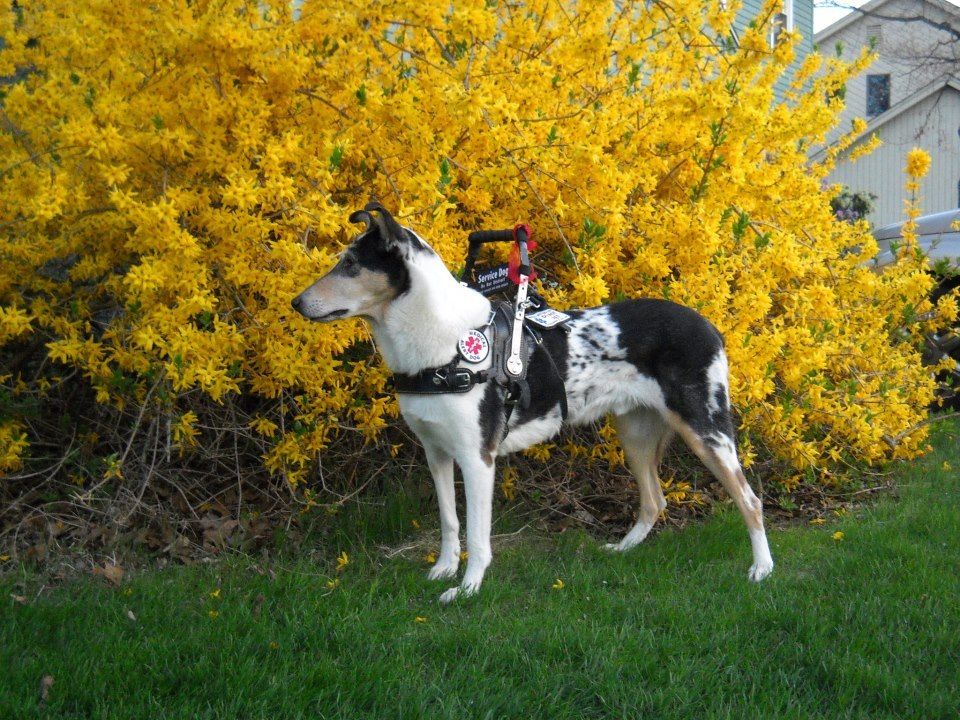
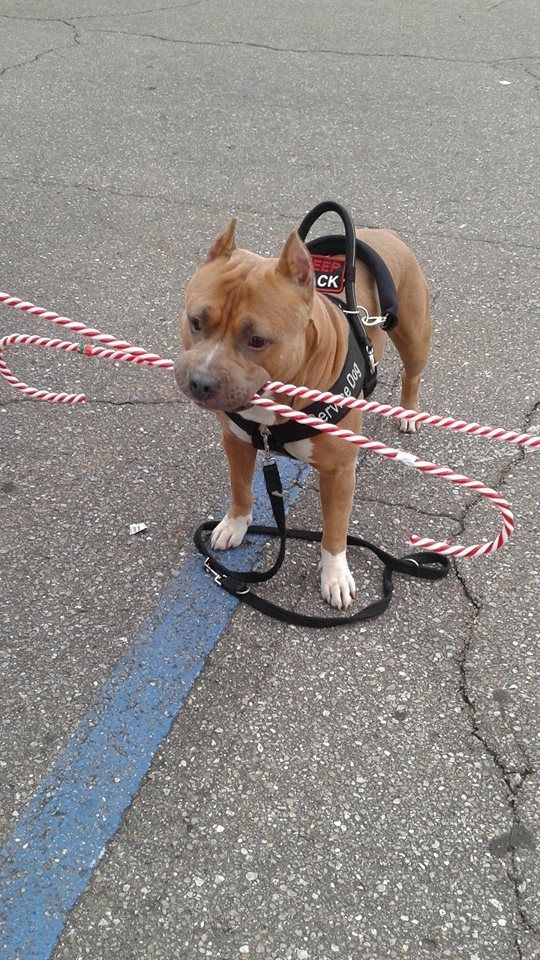
Service Dog Doogan, American Pit Bull Terrier
So the public may not always have the reaction you think they will. Nonetheless, it's something you have to be willing to consider in great detail. Once again, please don't assume you'll be the exception to the rule. Going off of that belief will only heighten your chances of failure, especially if this is your first service dog. Please think about your options and set yourself up for a win.

Poor Breed Choices for First-Time Service Dog Handlers


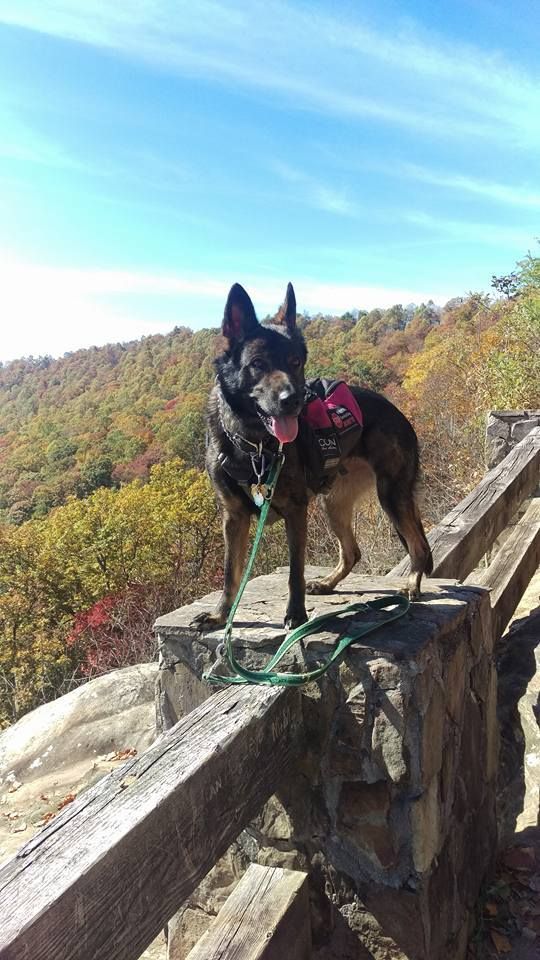
Service Dog Shanti, German Shepherd Dog
German Shepherds
Dobermans
Rottweilers
Huskies
Belgians
Malamutes
Any brachycephalic breed
Any breed that will have a short working career such as a Dane or Mastiff

I won't go into all of the reasons for these because basically they're all the same. These are breeds that are incredibly intelligent and often this intelligence comes with a lot of free thinking.

These breeds can without a doubt make wonderful working dogs, but you need to know how to work with them. Experience is important here. You can, of course, be one of those people who just gets on with it and does fine, but you're trying to set yourself up for a win, remember. So take steps towards these breeds by all means! But don't just jump in because you saw one on a show once and they were amazing.
Service Dog Link, Icelandic Sheepdog
Brachycephalic breeds are not on here (squashed-faced dogs, like Boxers, Bulldogs, Pugs, etc) because they can't make wonderful working dogs. They can. However, if you don't know how to work a dog and condition them and read their body language, you'll likely miss the important warning signs of their health issues and they'll be washed out earlier than need be. These types of breeds take a lot of care and usually for a first time service dog handler, it's a bit overwhelming.

Finally, the slow-to-mature breeds. Again, there's always the exception, but on a whole these types of breeds tend to be more difficult for first-time service dog handlers because they can take longer to mature, which can be tricky when you're hoping to have a dog to support you.

If you're going to go with a giant breed, it is even more important to make sure you find a very reputable breeder and know your breed inside and out. The bigger the dog, the bigger the health issues they tend to have.

Factors To Consider When Considering a New Prospect

Size at maturity: What is the size of the breed that interests you? Keep in mind that males and females can often differ in sizes. It may not be much, but those extra three inches can be the difference between a safe working dog for mobility support and a huge vet bill. Please don't go to a breeder who breeds above-standard sizes—this is a dodgy way of breeding and I can guarantee they're not a reputable breeder if they do such things.
Service Dog Rico, Papillon, and Service Dog Travi, Chocolate Labrador
Longevity: This is a big one to consider when thinking of larger breeds for mobility assistance work. Another factor to investigate is the average lifespan of a breed. Please be sure, once again, to be honest with yourself about this issue. You may have heard of that one exception to the rule, a Great Dane who lived to be 10, but know that as a whole the breed on average lives for 5-7 years.

A larger or giant breed dog may not mature until well after their second birthday. Make sure to consider its working longevity as well as its general life expectancy. Most Great Danes, while living for 5-7 years, only get 2-5 years of solid mobility work in, as they take longer to mature and if pushed into work too young will need to retire sooner as well.

Hereditary breed traits: Each breed was developed for a purpose. While there are always an exceptions to the rules, you need to think about the general standards of breeds. This dog will be there to make your life easier. Picking your breed based on false or unrealistic possibilities will likely lead to issues for both you and your future partner.
Service Dog Apollo, Australian Shepherd
If considering a breed developed for hunting, herding or guard dog work, realize that the traits that made a dog of that particular breed an excellent hunting dog, an effective sheepdog or a successful guard dog do not disappear just because the traits are no longer highly desired by most dog owners. The ancestral urges to hunt, swim, chase livestock, sound an alarm, kill predators or drive away strangers that dare approach are likely still there lurking under the surface.
Service Dog Gir, Shetland Sheepdog
Guardian breeds or breeds originally bred for fighting/aggression can be a little more difficult for the newer handlers to train. If you choose to ignore this warning and work with a stronger breed, please respect their heritage. Learn how to train with their breed traits, using their weak points to turn into strong points and strengthening the traits you were attracted to originally.
Service Dog Evan, Doberman

Be sure to consider the traits of your own disabilities as well. Breeds with these types of instincts are not generally suggested for people with psychiatric issues as they can become overly protective in times of trouble.
Coat Care: A simple point that a lot of people don't take into full consideration when making the final choice on breed is that a service dog must be kept at a very high level of grooming and hygiene as they're in areas not usually open to dogs. Once again, please be brutally honest with yourself about this.
Service Dog Sulley, Mixed Breed (aka Slovakian Mop Dog)
Picking a service dog takes a lot of planning and thought. If you don't think you'll have the financial or physical ability to manage the grooming needs of your final chosen breed possibilities, then take some time to reconsider.

Age: One of the most important decisions to make is whether to start out with a young puppy or to seek an adult dog, 18 months to three years old, which can commence training immediately. This is a huge thing to consider and has its pros and it's cons.
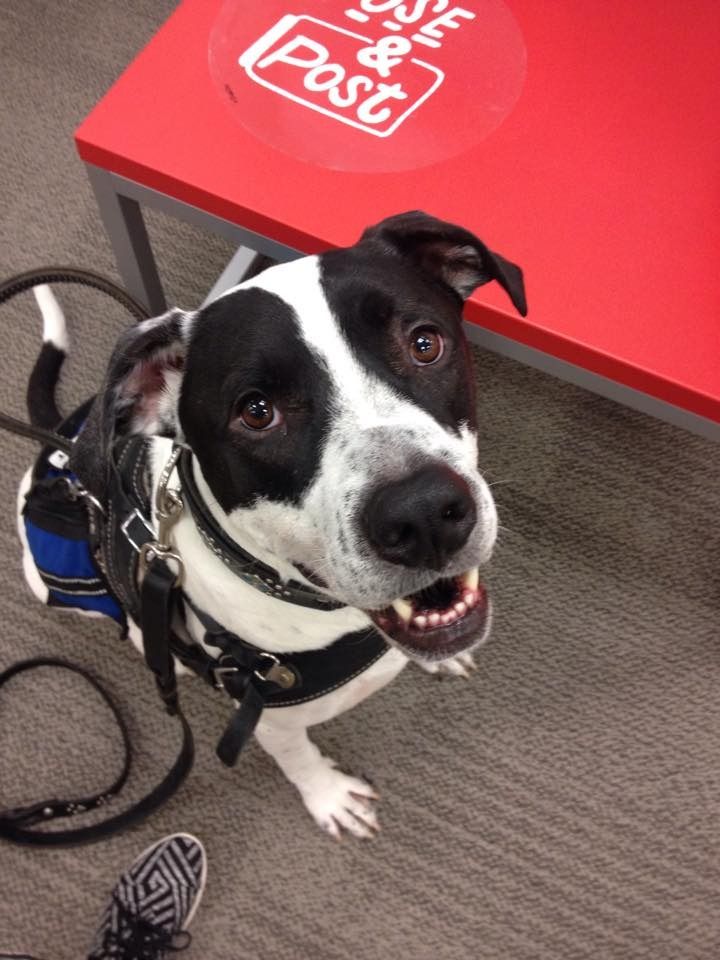
Service Dog Willow, Bully Mix
If this is your first service dog, I would suggest starting with a young adult so you have more of an idea what you're working with by way of temperament etc. While training can take up to three years to transition from service dog in training to Service Dog, it's generally easier for an adult dog to get into work sooner as they're physically and mentally more mature.

Gender: A female usually is smaller and has a shorter coat/less feathering when compared to their male counterparts if spayed. A female is equal to a male in terms of competency in this career. Both genders tend to be pretty even in temperament, but do take into consideration desexing (neutering/spaying).
Service Dog Bindi, Kelpie
Females who are intact may have issues with hormones and spot bleeding, whereas males who are intact may have issues ignoring other female dogs who're in heat.

Keep in mind, there's a lot of interesting research being done about when and how to alter dogs. So please consult a vet and/or do some research online for further information about the pros and cons of these choices to make sure you have the latest information.

Bottom line, everyone is different. Just as every dog is different.

Please take all of these things into consideration when choosing a breed. It's not a decision to take lightly.


Robbi Flynn
Robbi is a service dog handler in Australia who owner-trained her dog, Musa. She can be reached through her website.


23 December 2015

So you want a service dog ...

The first and most important thing to ask yourself before pursuing a service dog is: Do you have a disability?

It sounds a bit silly, but some people don't quite understand that to have a service dog, you need to have a professionally diagnosed disability/ illness. I continue to make a point of the professional diagnosis, because self-diagnosis does not, by law, mean much. For you to have a service dog with you in public, you need to have a doctor's acknowledgement of your disability. If they also support you having a service dog, then fantastic! However, a lot of doctors have not heard of service dogs assisting anyone other than the blind, so they may not want to sign their name to something they don't understand. Try to educate them if you can, but don't loose sleep over it. Their job is to simply say: "Yes, this person has [insert disability here]."

Next you'll need to think about what you want the dog to do for you.

There are many things a dog can do, but there are also many things they cannot. Some tasks may be easy to teach, while others may take many months of practice. 

Are you prepared for this specialized training? What effect will a Service Dog have on your day to day life? Does your family/partner/flatmate approve of this decision?

The people with that you live with will understandably have opinions about adding a dog to the household. A flatmate, for example, may not want a dog around, so it may mean getting a new flatmate or changing accommodation. However, if your partner has an issue with a new dog in the house, you've got a whole new problem. Not to sound negative, but do not underestimate any possible resistance to you having a new dog in the home. To do so may leave you and your dog open to very difficult situations.

Is the dog for a child, and are there other children who may want to be involved with the dog? How will the dog fit into the daily schedule? Who will supervise training? Who will be ultimately responsible for the dog? Allergies may also be an issue, but this might be overcome by getting a hypo-allergenic breed of dog.

Please do proper research on this. No dog can actually be classified as a "allergy free dog." People with allergies to dogs are usually allergic to the dander of the dog's skin, not the actual fur. If you have a dog that sheds less, like a Poodle, Schnauzer, or Italian Greyhound, they are usually easier for allergy sufferers to deal with. Again though, you need to think of how this breed will fit in as a working dog, how much exercise they need, are they people oriented, how much grooming will they need, and so on.

Have you considered your friends?

You may lose friends over a decision to get a service dog. It's sad to say, but I have lost a few friends who did not understand or like my decision to get a service dog. As training intensifies after a year or so, you may find more friends drop off. Not everyone feels comfortable around dogs. Friends may not understand why you are choosing to use a service dog instead of other options. Your friends may not want you to have the dog in their homes or even around them. Talk to your friends before you decide to get a service dog and see the effect it may have on your social life. You may decide that the benefits of using a service dog are greater than keeping the friends who don’t agree with your decision, but it is good to be aware.

Are you ready for the greatly increased public attention?
You will draw attention to yourself (and your disability) with a service dog. A service dog attracts attention, both to the dog and to the handler. This can really change how people perceive you, especially if your disability is invisible. A service dog openly labels the handler as a person with a disability. People who had not known you as disabled will suddenly have it drawn to their attention, and you may find that their perception of you changes when you get a service dog. Members of the general public will want to stop and talk to you about your dog and often also about your disability. Small children may chase your dog and try to pat it or even hug it. If your dog is large, small children may try to climb on it and ride it. A service dog is not a good option for someone that cannot tolerate a lot of public attention.

Can you handle confrontation?
Even if you get to the level where your dog is a fully trained service dog, some people will deny you access to places you have every right to enter. You will also have people tell you that dogs should not be in public places, or you may even be accosted by an animal loving activist for enslaving an animal (of course we know this is false, however some people don't understand).

These confrontations can be emotionally exhausting and hurtful. They can also be time consuming. Are you able to stand up for your rights to business owners and insist on access? This is a very real and unfortunate part of having a service dog. If you are not able to deal with this, you probably should not get a service dog.

What about the responsibilities of service dog/pet dog ownership?
Financial responsibility comes with dog ownership. Medical emergencies may pop up, with the average emergency vet bill coming in at $1000-$3000.

Further costs include leads, bedding, service coat/jacket, toys, grooming equipment, shampoo, flea and worming treatments, council fees. If you are not financially stable, a service dog (or a dog at all) might not be the best move. Check your local council regulations regarding the housing and keeping of dogs. This does need to be explored, particularly if you already own other dogs. Some councils' restrictions are severe, while others are more accommodating. All will require some form of licence. And they usually have a limit of 2-3 dogs per house.

Are you ready for the long term commitment that comes with dog ownership?

Dog ownership is a commitment! If you're lucky, the dog will be a good worker for roughly 8 years. On retirement, you must decide if you will keep the dog or find a new and suitable retirement home for them. What will you do if the dog develops behaviour problems or health issues and must be retired early? Will you be able to keep them? Will it be safe to keep them if you need to get a new service dog to replace them?

What are the responsibilities of Service Dog ownership?

Do you have the time and patience to work with a service dog both initially in the partnership and commit to ongoing training during the dog's life? Getting a service dog, regardless of whether it comes fully trained from an organisation, or for you to train under supervision/on your own, is a huge transition. Initially you need to spend a lot of time going over the basics, earning their trust and learning to work comfortably with a constant canine companion. 

Have you ever trained a dog entirely on your own? 

Learning to understand and “read” your dog and learning to work with your dog in public is not a walk in the park, so to speak.

As you progress together, the amount of time spent on dedicated training may decrease, but a certain amount of ongoing training is necessary during the working life of the dog. If the training is not maintained, your dog's skills will deteriorate.
Training your dog to be a service dog is not something that can be done in a weekend or even in a month. It will be an ongoing process continuing for the whole life of the dog. However, the most intense training will be in the early months/years, especially if you opt for getting a puppy instead of a young dog. There will be days when you will feel you are not progressing and in fact you may think the whole process is going backwards. These days are normal. Training requires consistent, daily effort even when starting with a dog that has already had significant obedience and socialisation. If you do not have the time to do this, or you are not willing to spend time working and practising with your dog daily, a service dog will not be a good option. You may decide a companion dog that you can just enjoy at home is a more appropriate choice.

You need to understand the basics of dog training before starting to train your Service Dog.

It is important to use humane, balanced, science-based training techniques when training any dog. Improper training techniques will at best decrease the dog's performance reliability and at the very worst can turn your dog into a dangerous, unpredictable animal. A service dog must be able to demonstrate very high standards in both public behaviour and task performance. If you do not already know the current basics of training methods, you should first seek professional assistance and instruction before starting. A service dog is still a dog. Even the best trained dog in the world will not be a perfect dog. If you cannot handle imperfection from your dog, you definitely should not train a dog, and probably should not consider working with a service dog.

While service dogs are highly trained, they are nonetheless animals, and will make mistakes. They will have good days and bad days. Someone who struggles with the ups and downs of dog training will not be an effective trainer and may compound the situation. You should be willing and able to seek outside help if you need it. If at any point you realize that you are not succeeding with your dog, you must be willing to discuss this openly with a specialist trainer.

This help could come in a variety of forms and it could be as simple as a telephone call to talk over the problem. If you are not the sort of person who is able to ask for help, please reconsider attempting to train your own service dog.

What breed of dog should you get?

There is no one breed of dog that is a better service dog than other breeds. However, there are breeds which are known for this work because of their trainability and easy recognition by the public. Common service dog breeds can include Labradors, Golden Retrievers, and Standard Poodles.

While many people have had success working with breeds such as American Pit Bull Terriers, Dobermans, and Rottweilers, you need to be aware that certain breeds invoke strong negative public feelings (especially the stronger breeds/bully type breeds).

Back to the question, from where should you get your dog and what sort of dog?

Look for dogs that are healthy, with the right temperament, and suitable for the tasks you want the dog to do. Shelters at times have great dogs that are available for adoption for unfortunate non- behaviour related reasons (e.g. owners moved, passed away, had a new child etc.) This may mean that a temperamentally great dog may become available. However, there are also many dogs in the pound because they are no longer wanted, or have issues, either in health and/or behaviour. Sometimes too what you see of the dog’s behaviour while it is in the lost dog’s home is not the behaviour it will exhibit two months later in your home.

A good service dog is near bomb proof, and restores to its "natural behavioural settings" in a very short time. This is very important as the dog needs to be able to cope (or learn to cope) with any type of situation, noise or visual stimuli, crowds, or confined spaces etc.
A rescue dog can bring greater risks as usually there is a very limited history of family backgrounds and of care and treatment that has been given. Within breed groups there are also specialist re-homing services, normally operated by and for a breeders' group to protect the breed and ensure that re-homing is done to the best possible homes. There can be terrific candidates available, and being a breed related group, health and temperament information is more readily accessible. 

Once again, be careful to do your homework, because anybody can call themselves a breeder. Ask if the dog is registered through a state body; ask for references from the breeder’s vet and other people who have bought dogs or puppies from them. They're usually delighted to give you these details if they have the breed’s interests at heart. You may also be asked or references about your ability to care for a dog.

Similar risks apply to puppies—their parents may be great, but puppies are still developing their personalities. Puppies need to progress through the juvenile periods, they will be silly at times, push boundaries and may not make the mark.

The International Association of Assistance Dog Partners (IAADP) believe that around 30% of puppies out of well-bred adults will make the mark to become a Service Dog.

Another source to consider is recruiting from "Show Ring" dogs that did not make it in that world, but are genetically and behaviourally very balanced—that is, unless they are being discarded from the show ring and breeding plans because of behavioural issues. The dogs that are being discarded because they do not meet the breed standard (e.g. too tall, too short, etc.) are better bets and often have reasonable social skills and are normally sound of health. Like anything, the cost associated with getting a dog this way may be higher than through a rescue.

Do you need a dog to perform retrieval based tasks?

Most dogs, with enough training, can be taught to retrieve - not just breeds with "retriever" in their name. However, some dogs love to retrieve and do it naturally or can be easily trained to do it. If you need a dog that can do a lot of retrieving, it would be in your best interest to make sure you point that out to your chosen source of a dog.

How active do you expect to be with your Service Dog?

Your activity level and expected daily routine is an important consideration. Be sure to be 100% honest with yourself about this, a bored or under exercised dog can be destructive and difficult to train.

Do you work at an office job where your dog will be sleeping under your desk for hours at a time? Do you have an active job where you are up and about for most of the day? Dogs are as individual in their activity levels as people. If you have a dog that needs frequent stimulation and activity and you sit behind a desk all day, the dog will not be happy. However, if you have a dog that enjoys his naps but is still ready to go when the day is over, then you have the perfect office companion. In the same way, if you are very active and your dog is not, you will find yourself dragging your dog along everywhere you go, and no one will be happy with that! Keep in mind that all dogs need some level of physical activity to stay healthy and happy, and if that cannot be provided by either yourself or by arranging for your dog to get exercise you may want to reconsider getting a service dog.

What kind of personality do you like in a dog?
Dogs are individuals; your partnership success depends on the compatibility of you and your dog. Some dogs are sensitive and responsive. These are usually easily corrected and want your approval and praise. They work because they want to make you happy, and they are satisfied when you are satisfied. This is often (but certainly not always) a good type of dog for a first-time dog owner, or a sensitive, quiet person who does not want to try and "talk" an independent dog into working.

At the other end of the scale is a hard dog. They are stubborn, independent and self motivated. They can be frustrating to train. They work because they want to, and because they like their jobs. They like praise, but don't necessarily need it. They are happy when they feel they have done a good job. Hard dogs are often the best dog for an experienced owner/trainer, or a handler that is more outgoing, loud and assertive or someone that wants a self-motivated independent thinker in a dog.

Realistically, most dogs fall somewhere between these two extremes. Look critically at your preferences, personality, and training experience as you do the selection process. Like the difference between hard and soft, some dogs have independent characters while others are more social creatures. Most dogs have times when they need both their own space and close companionship. 

When evaluating preference for independent or social dog, take into account the preferences of other family members or house mates. If you like an extremely social dog, but others do not, it might be best to compromise.
When considering a dog, think about the size, where it will live—in an apartment with a small yard, will it be required for mobility assistance (support when getting up or walking). Think about the longevity of the breed as some giant breeds have a very short lifespan (5-6 years). Consider the coat care, the amount of grooming needed, how much clipping is required (will it need to be professionally done to maintain an acceptable standard for public access? Professional groomers can cost a lot), will the dog to cope well with the your climate? Some people are very concerned about doggy odour, and some breeds have more than others. This may cause irritation in a relationship or even with a very sensitive person.

There are other issues to be considered, but this might help focus your ideas and expectations. And of course after reading all of that, if you have any further questions or worried feel free to contact me. Again, I'm no expert by any means, but sometimes it's nice to know you're not alone. 


Robbi Flynn
Robbi is a service dog handler in Australia who owner-trained her dog, Musa. She can be reached through her website.

02 December 2015

Service dog retirement

When a service dog retires, it's different from washing out or being career changed. A dog who retires had, at one point, everything required to be a service dog. A dog who washes out is in one way or another unable to be a service dog.
Some service dogs retire themselves. One day, you realize your dog isn’t quite as excited as she used to be about getting “dressed.” Or that he isn’t as enthusiastic about doing his tasks. Maybe he’s even reluctant to do certain things. It’s very important to remember that no one forces a service dog to work, and sometimes they just decide that they’re done.

Some dogs have to be retired—they still want to work, but they are no longer able to do their job safely and comfortably. This happened to my first service dog, Juno. At age five, she was diagnosed with sudden acquired retinal degenerative syndrome (SARDS). This genetic defect causes blindness. Her vision was restored by an experimental treatment for about two years, but then I noticed her vision deteriorating again. She couldn't navigate as well in the dark and got startled if touched suddenly on the left. Around that time she was also diagnosed with spinal arthritis.

She still wanted to work. In fact she still wants to work—despite the fact that she's almost nine now, and completely blind in her left eye. Anytime she knows I'm getting Kaline ready to go, she bounces around us and sometimes hands me her leash. 
Juno knows how to pull on the old heartstrings.
But it's no longer safe or appropriate for her to work in public. Her spinal arthritis means that mobility tasks like counterbalance or momentum pull are painful, even if she doesn't show it. Due to her visual impairment, she can't help me navigate a crowd or find an exit. She also can't see surprises coming and would constantly be getting startled. It's just not right to put her in that position. Dogs are very stoic and dedicated creatures, Juno especially so. Just because she still wants to work doesn't mean it's okay to let her. As the person in the partnership, it's my responsibility to make decisions that are in her long-term best interest, even if those decisions make both me and Juno unhappy in the short-term.

Just because Juno can’t work in public doesn’t mean she can’t help at home. Helping at home—her favorite tasks have always been retrieving and opening the fridge, both of which she is still very capable of doing—is a big deal for her. She loves it and it makes her feel useful. Also, it gives Kaline a bit of a break, since he isn’t as excited about doing those tasks.

For an owner-trainer like me, it’s much easier when you can retire your service dog gradually. It gives both of you time to get used to the idea, for one. It also gives you time to get used to your up-and-coming partner. Thanks to the experimental treatment, I was able to do this with Juno. I freely admit that there were days when I was just not up to taking the puppy in public and having to deal with being in trainer-mode every minute. On those days, it was wonderful to just put Kaline in his crate and head out with my fully trained girl, who knew exactly what she was supposed to be doing without being told (most of the time). And by the time Juno had to stop working completely, it wasn’t as much of a sudden change for her—or me.
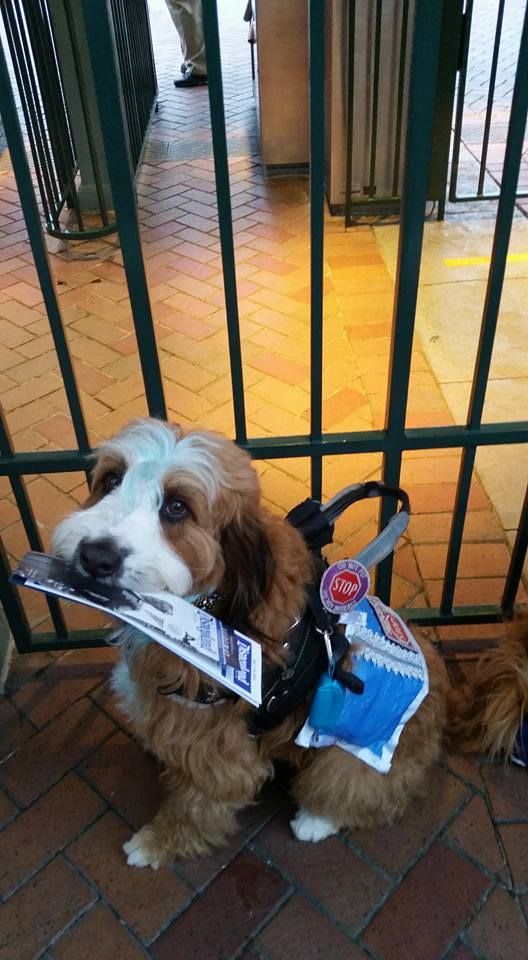
When a service dog retires, there’s always the question of where they will go. Many handlers keep their retired dogs as pets. When this isn’t possible, the dog is rehomed. Some handlers don’t have the funds or the space to care for a pet dog; some are in situations where they aren’t permitted a pet, even a retired service dog. If the dog came from a program, often she will be offered back to her original puppy raisers. There are also long waiting lists of people waiting to adopt these retired service dogs.
In Juno’s case, she’s in what I like to call joint custody. Kaline and I have our own apartment, which does not allow pets, so Juno officially lives with my parents. This is a win for everyone (with the possible exception of Kaline, who is filled with unrequited love for his big “sister”). 
Kaline and I still spend a lot of time hanging out with Juno.

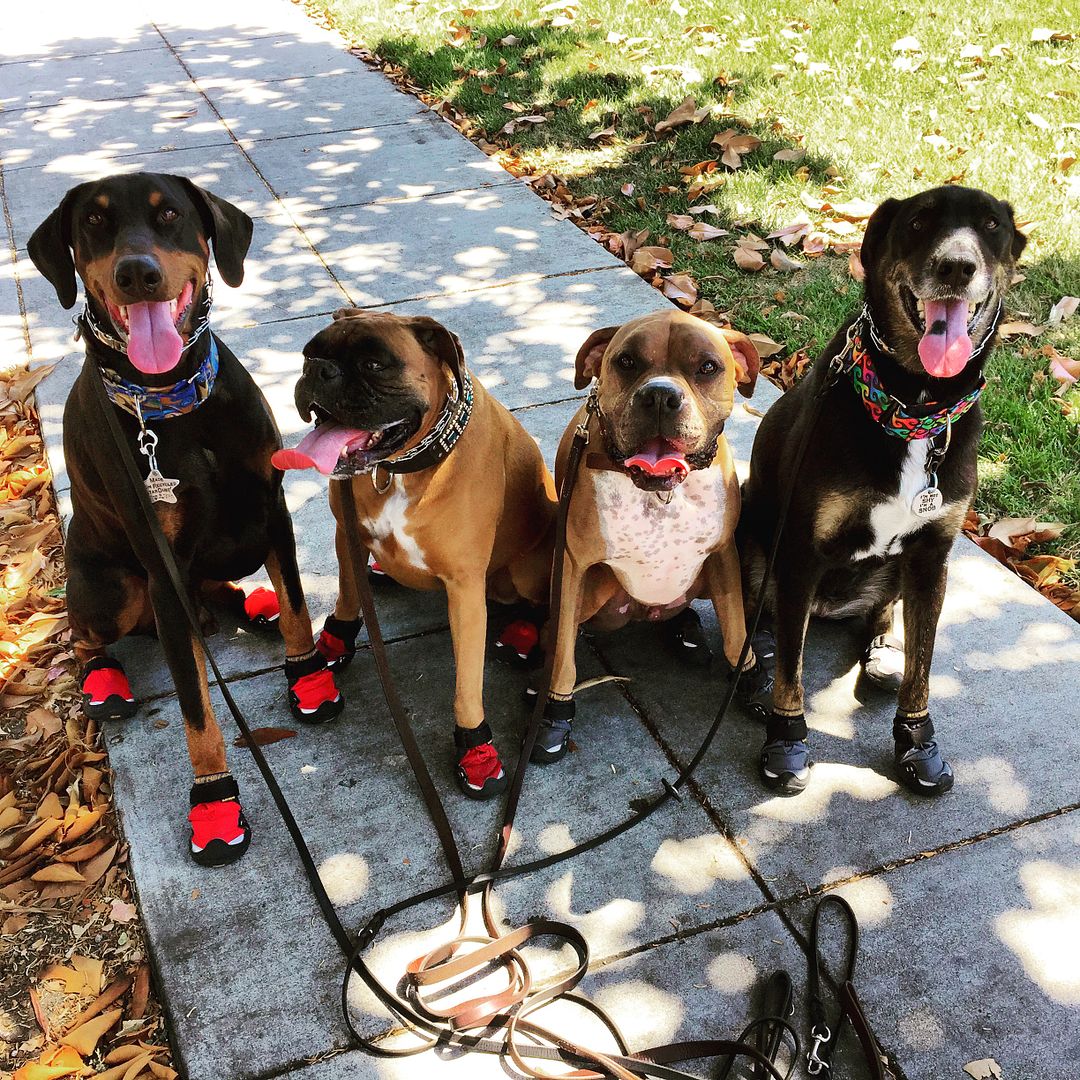
Juno is still with me nearly all day during the week, since she is my trusty sidekick for walking my packs of dogs. 
Juno, Kaline, and our Boxer packmates.
She also comes to my training job with me, unless it’s cold and/or wet. But she also gets a nice break every night from her loving but sometimes very annoying little “brother.”

Juno loves retirement. When Kaline and I head off for a trip, she gets to go have “spa time” with her Auntie Sonja and her devoted suitor, Sonja’s service dog Chief. Instead of working, she gets to hike off leash and go running on the beach. 
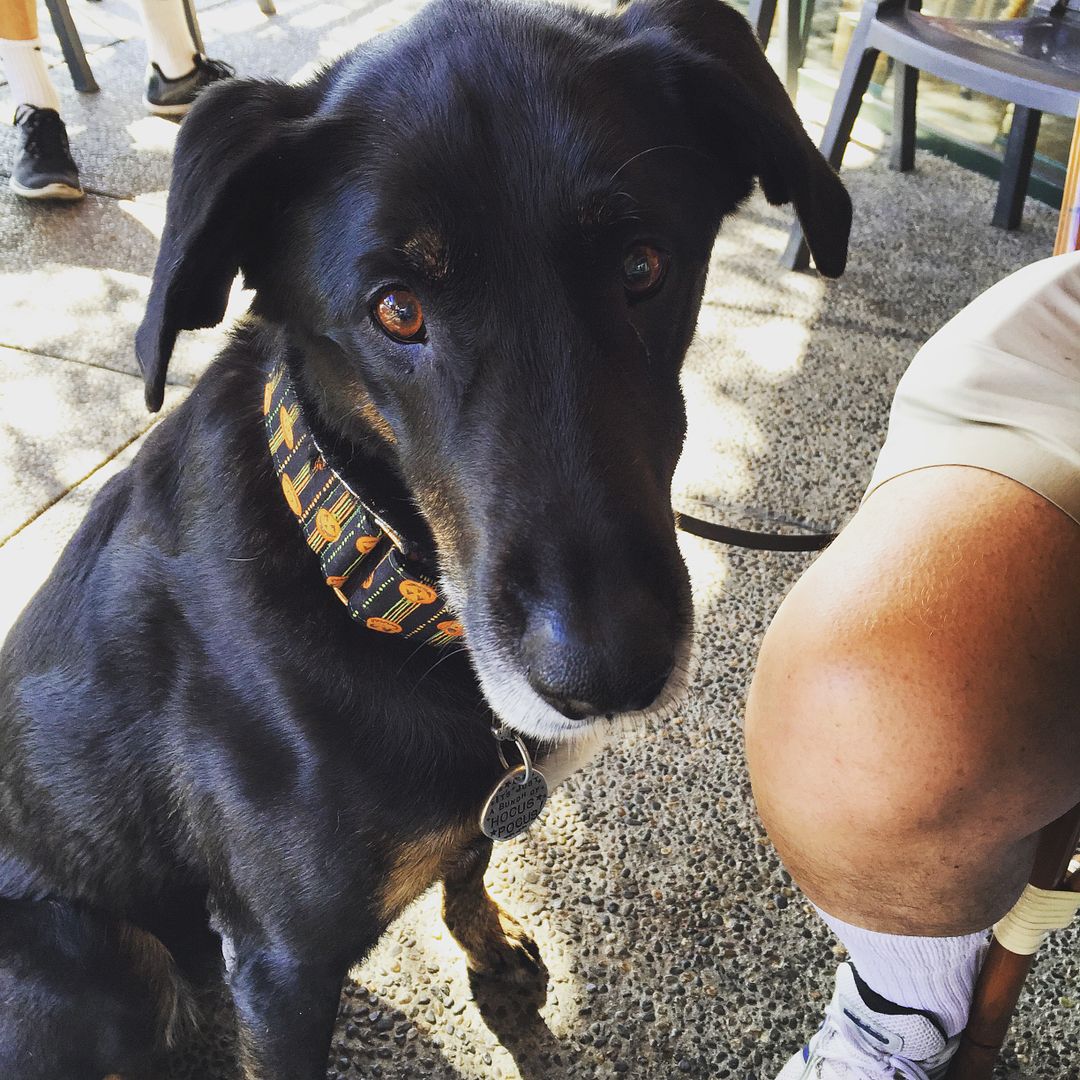
She also clearly enjoys not having to be quite so professional. Juno is still the queen and not interested in paying any attention to strangers who lack food offerings. 
The patented feed-me face.
But she loves making sad puppy eyes at all meals (it usually works), and being able to greet her human friends with wounded-bear sounds, kisses, and tail thwacks any time she sees them. After all Juno's hard work, it's great to see her getting to enjoy her retirement to the fullest.


Colt