Patrick, GUGP's 2015 Guide Dog Puppy

Patrick, GUGP's 2015 Guide Dog Puppy
GUGP Website

24 November 2015

A Greyt difference

Since becoming active in the service dog world through my daughter's needs, I've realized that I would benefit from a service dog.

Before we go too far, I'm an actively practicing registered nurse. I also have disabling conditions. I work 40-60 hours a week in a fast-paced field in nursing. I'm advancing my degree. I drive. I have a disabled child that I have raised alone since she was born. I cook, do laundry, clean, work, and go shopping. I am also a person with physical and psychological conditions that are disabling.

I decided that, after much weighing and measuring, once my daughter's service dog in training was nearly finished I would pursue the service dog route with my healthcare providers. I couldn't simply decide that I had disabling conditions on my own. Diagnosis does not necessarily indicate that you are disabled. 

Last year in March my bipolar disorder, severe depression, and PTSD were put into hyperdrive by several things that occurred within a very short period of time—the last one being an attempted armed robbery while working as a hospice nurse. I ended up in a day program for people who experience mental health issues to get things under control as quickly as possible. While I was there, I spoke to the certified mental health NP about the possibility of the benefits of obtaining a service dog candidate to train for myself. She agreed wholeheartedly that not only would I benefit, but it might be a necessity. 

I came loaded for bear when I presented the idea to her. A lot of practitioners have no clue that there is a difference between an emotional support animal and a task-trained service dog. I came to her office with printouts, a list of tasks I needed, etc. I was lucky that she was educated in this arena, and she had documented the areas of my life that were impaired by my diagnoses.

Next, I went about thinking about what type of dog would meet my needs, what were my current and probable future needs, did I really want to do the puppy thing yet again, etc. A wonderful friend of mine, Patti, trains retired greyhound racers to help people with disabilities. I was leery of a greyhound. They're so slight. I'm not. They seemed unintelligent, from the few I'd met. Could they actually be taught everything I'd need? Would one meet the ethical guidelines to assist me with mobility? Would it run away? Would it be timid? They look timid compared to the pit bull mixes I'm used to training. 

So, I took a leap of faith. I trusted Patti, literally, with my life. We chatted over this hound, the other hound,for months. This one's too small. This one looks too "pet-able". That one just seems too ... everything.

Then Robin Hood, a Saluki-Borzoi mix puppy, came along to the Greyt Hearts Service Dog program. He was bigger than most greyhounds as a puppy. He would grow to be a gentle giant. He was a gangly, elegant, poofy goof. I was hopeful, but didn't want to put all my eggs in one basket. I had had two prospects fall through in the last few months, and I couldn't take another heartbreak. Patti asked me, between the two she had picked for me, which did I want. Robin Hood, now named Ivan, was my tenative pick. Patti was going to get him started for me. I was worn out after training two service dogs for my daughter. I couldn't start from scratch again. 

I will never forget when Patti came to drop him off. It was like someone handed me a leash, and at the end of it was my life. My life that I had wanted back for so long. My life where I traveled to big cities, went to movies, shopped for groceries, went for walks, hung out at coffee shops, ate at restaraunts, felt safe at home, all without being in such a panic I became physically ill or feeling absolutely unsafe. It wasn't instantaneous, but it came after a couple months of learning each other. 

Ivan came home in July. In September, with great trepidation, I decided we were going to Boston. I was going to travel. It was a trial by fire. A trial he aced. He had never been to a larger city. He was still in training, but he met every new challenge like a champ. We went on the train all over Boston. He had never been on any mode of mass transit, but he was so steady and did his job so well you would have never known. We went to the museums, restaurants, the aquarium—everywhere I had always wanted to go. I hadn't traveled to a big city in at least five years. I couldn't. Even with a "service human," it was difficult and beyond uncomfortable. This trip was how I remembered my "real" life being. When I loved NYC. When I ate wherever I wanted to without requesting a corner booth, to protect my back. 

Not every day is a trip to Boston. Some days are mundane things. It's the grocery store trips where I don't feel like people are crowding me, because Ivan is providing a passive buffer between me and other shoppers. The trips through the checkout that used to be so anxiety inducing I'd have panic attacks, but aren't anymore because he's doing his job "watching my six." He will let me know if anyone comes close and block them from coming too close, triggering a panic.

It's him alerting to a rise in anxiety while I'm shopping so I can take a minute and do some breathing exercises to head it off from panic level.

It's coming home, and asking him to make sure there are no intruders in my house, so that I can enter and know that it is safe. It's the little things every day that he is trained to do that make my disabling conditions easier to deal with.
  
He is my rock. He is the reason I can leave the house and do things most people do without a second thought, but are impossible for me without him. He is the reason I can live some semblance of a normal, happy life again. Is it easy taking a service dog in public? No. The pointing, the invasive questions, the squealing because "he's so cute" are tough to deal with. Without his help, I can't do them. For me, it's worth the extra hassle.


R. Jones

17 November 2015

The Gift

I sometimes find it ironic that one of the biggest gifts I’ve ever received was given to me by complete strangers. I usually reserve the most valuable, time-consuming presents for my close family members, so the idea that someone would put such great effort into a gift for a stranger is, at times, baffling to me.   


The idea that someone would prepare such a gift 38 times is downright mind-boggling.


But that’s exactly what my dog, Roja’s, puppy raisers did. They raised 38 puppies prior to Roja. Of course, not all of those became guide dogs and not all of them were long-term raising situations, but from what they shared, they have seen a significant number of their pups graduate as guide dogs. In Roja’s case, they actually co-raised her with another family, due to work scheduling issues. The cooperation of two remarkable families resulted in the creation of a very adaptable, calm guide dog, which is exactly what I needed.


My raisers’ hours of work and play with Roja resulted in a  4-legged angel with a set of eyes that help me move smoothly through life. As if that gift weren’t enough, my raisers gave me other gifts on graduation day. They brought a toy they made for Roja, but more meaningful to me, they gave me the words I needed to hear that day. They told me that they could tell Roja was meant to be a guide dog from the time she was a puppy.


Before meeting them, I had been nervous that the interaction would be difficult, that maybe they’d be sobbing over the sadness of saying goodbye to her, as I had heard some classmates describe about their graduation day meeting with their previous dogs’ raisers. Such a reaction would have been understandable to me. I know that puppy raisers wake up in the middle of the night with their puppies in the early days, that they spend countless hours working with and training these pups that are constantly by their side and become part of their families. It wouldn’t have surprised me nor annoyed me in the least if there had been tears.


One of my classmates had told me that her first raisers had told her they had hoped the pup would never make it as a guide dog so that they could have adopted it instead. She felt bad taking their pup as her guide dog. Even this remark, as awkward as it sounds, is understandable to me. I could see how the sheer amount of time and effort spent raising a puppy could evoke such feelings. But I had also heard about raisers who gave incredible reassurance and encouragement to new guide dog users on graduation day.        


One classmate told me that his first puppy raiser’s parting words were: “She may be our puppy, but she’s your dog.” I appreciated hearing the distinction put in those words.


And I appreciated the words of encouragement from Roja’s raisers. I think after raising so many dogs, they had learned to detach themselves emotionally, and maybe since she was co-raised, they weren’t as attached. But they put a tremendous amount of time and effort and love into a puppy that they eventually gave up for a complete stranger. And then, as if that weren’t enough, they drove several hours to send Roja off with a proper farewell, and they offered that same stranger the gift of letting yet another puppy go graciously and with meaningful words.


They later sent me an email, telling me that they both felt that Roja seemed happy with me. They had no idea how much I doubted Roja’s and my bond at the beginning, so the idea that they would encourage me in that exact area  meant so much to me, especially since they had spent enough time with her as a puppy to assess whether she looked happy.

The interesting thing about receiving such a sizable gift from strangers is that there’s no suitable gift I can give in return that would be able to convey my gratitude. I gave Roja’s raisers framed pictures of Roja and myself, which seemed almost comical in its simplicity on graduation day, compared with the gift that would be leading me home. I can only hope that Roja’s raisers received an intrinsic gift as they watched Roja and me graduate. That watching a stranger gain newfound mobility, confidence and freedom as a result of their sacrifice made it somehow worth it for them. I have the sense that this must be true, or they wouldn’t have continued raising pups all these years. Even if it’s not an equal exchange, however, that’s the best part about gifts. When given genuinely, they are given without expectation, even to strangers.


Joy Thomas

10 November 2015

Travel with a service dog

The last time I wrote, I talked about flying with a service dog. Now it's time to talk about the actual trip!

A few weeks ago, my service dog Kaline and I headed to Michigan with my mom (retired girl Juno went for a "spa week" of frolicking on beaches with her Auntie Sonja). It's a tradition for us to go to Ann Arbor every fall, where we visit the Henry Ford and Greenfield Village to celebrate Hallowe'en, and attend the University of Michigan's fall musical.

When we landed in Michigan that Tuesday, our first objective was the terminal's service dog relief area. Kaline loves to do momentum pull, which involves some elements of guiding when there are crowds. The Detroit airport is one of his favorite venues. It's always a straight shot from our gate to the relief area, but with many delightful challenges in our way. It's always great fun to see him assess crowd shapes, the placement of clusters of people, and decide which path offers the least resistance to us. According to my mom, the people in our wake were pretty impressed.
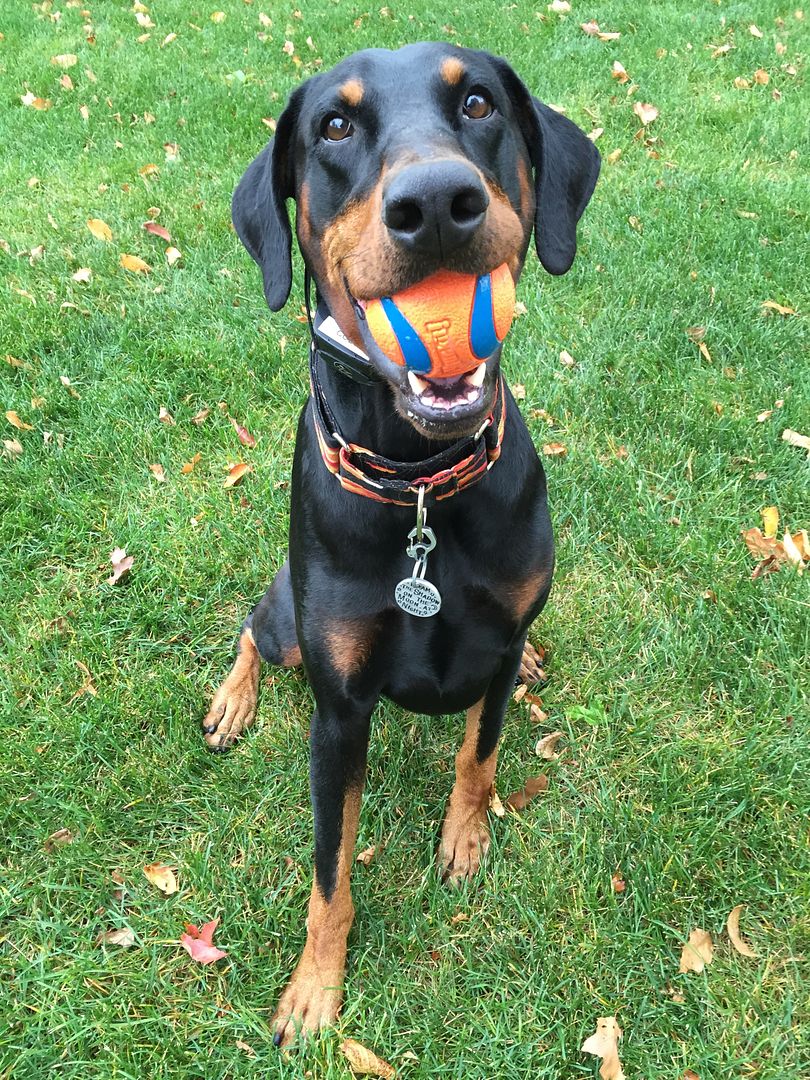
Our hotel in the fall is actually pet friendly, and has a long strip of lawn behind it for running a dog or playing fetch (plus unlimited free poop bags!). After unpacking, the first thing I did was have a game of Chuckit with Kaline out back. Trips are tiring for both of us—at home, he never spends as much time officially on duty as he does when we're traveling. The best way to keep him spunky and fresh, oddly, is by having at least one vigorous game of Chuckit every day. Service dogs really need their time to be ordinary, rambunctious, ridiculous dogs. Kaline runs like a maniac for his Chuckit balls!
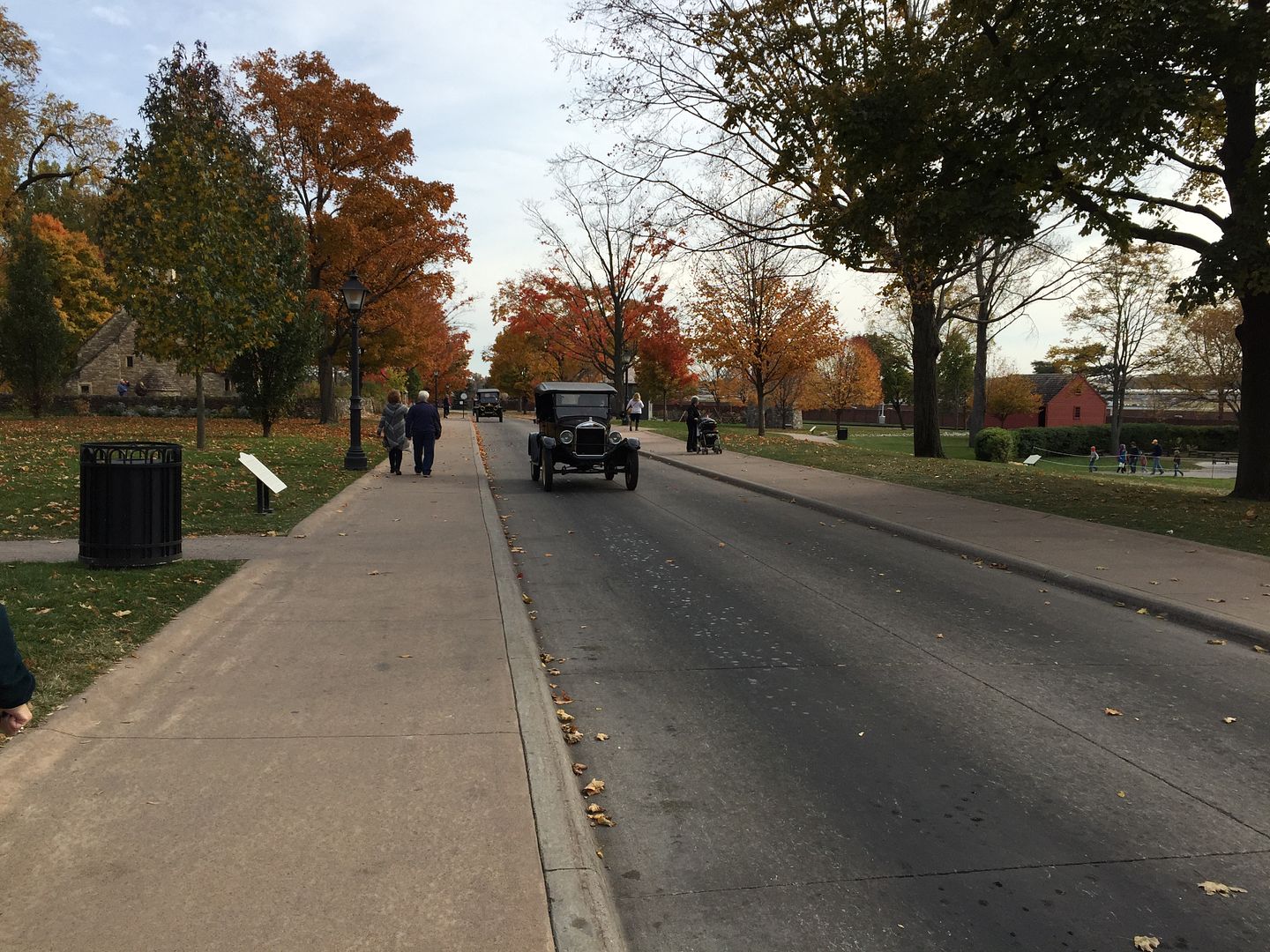
One of the best but most challenging parts of our fall trip is the time spent at Greenfield Village in Dearborn. The village is one of the foremost history attractions in the U.S., containing numerous historical buildings as well as replicas that Henry Ford collected from all over the country.
In the village are multiple horse-drawn omnibuses, Model T Fords, antique Ford buses, and steam locomotives. The locomotives are extremely loud, as they have to obey the state laws governing trains, even though they just go in a small loop. Therefore, their whistles have to be audible three miles away. Kaline has had to get acclimated to all of them, and since we are only there twice a year, it usually takes him a little while at the beginning to relax fully in the presence of all these things.
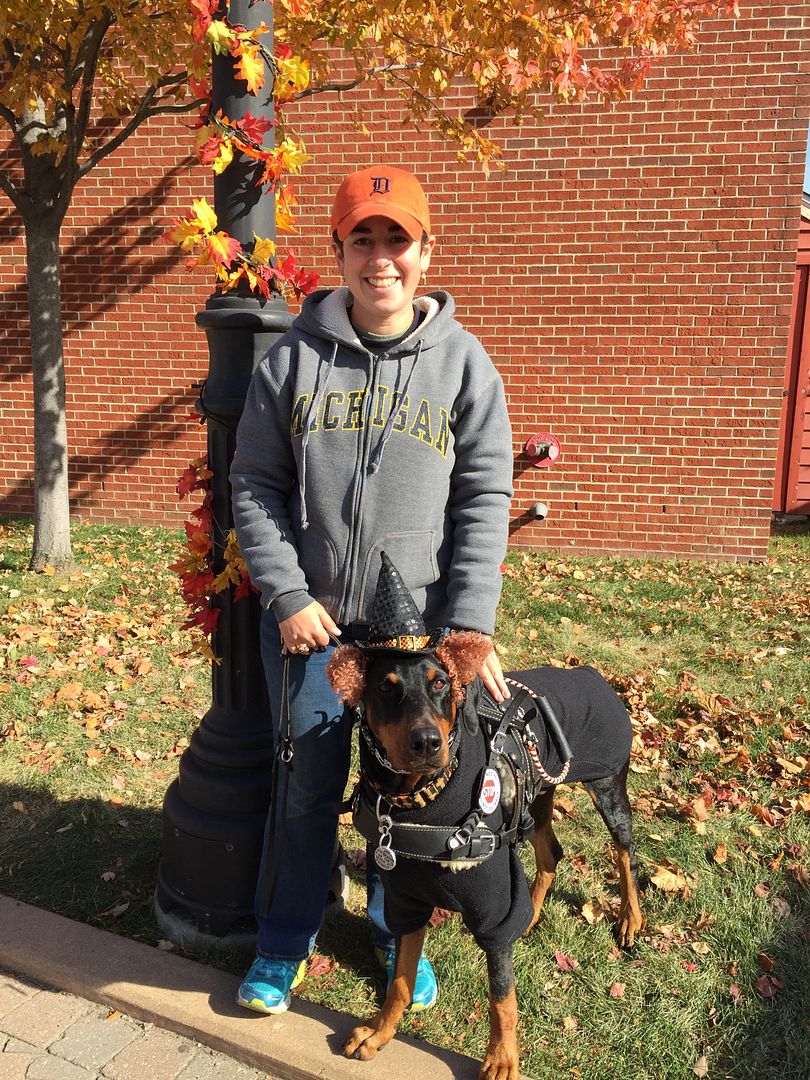
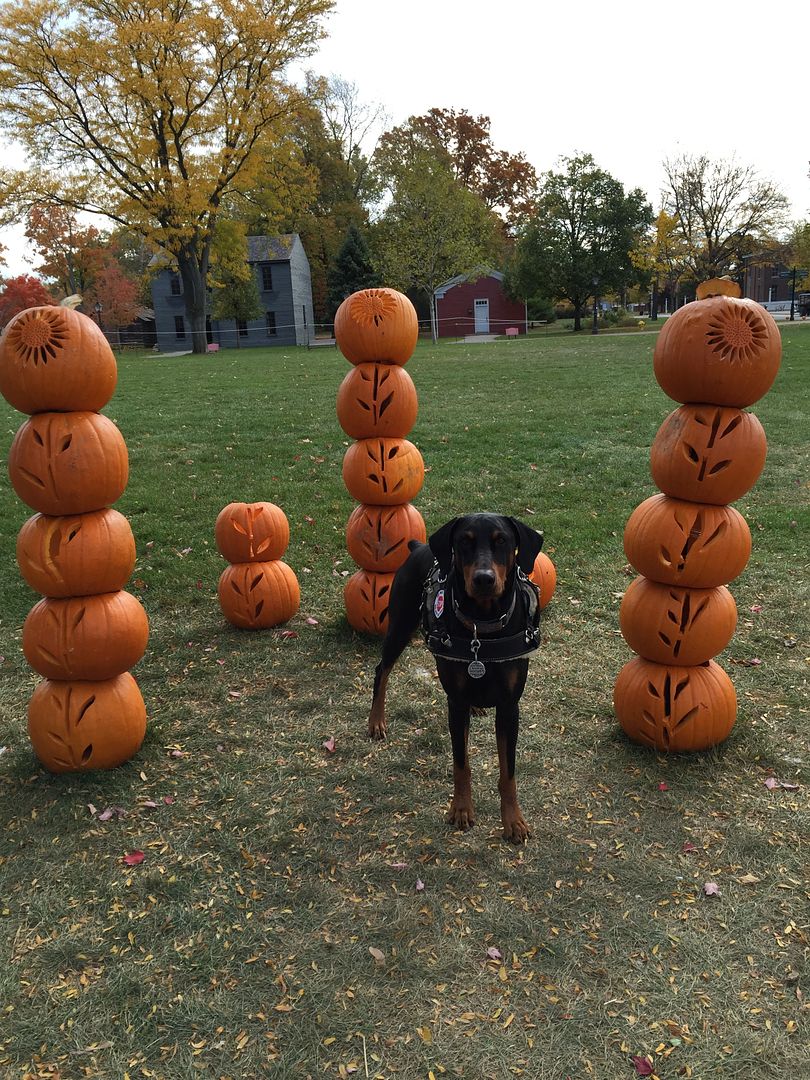
Showing our Hallowe'en spirit! Well, Kaline, anyway.
This was the first time he had no acclimation period! He's been going to the village since he was 16 months old, so maybe it's become old hat to him. It's lovely when we see some of the village presenters who remember him from his first trip—they can see how far he's come since then! Half the Model T drivers know him now; when we wait in line to ride them, the driver we're paired with inevitably lets out a joyful cry of "Kaline!" as we're about to get in.
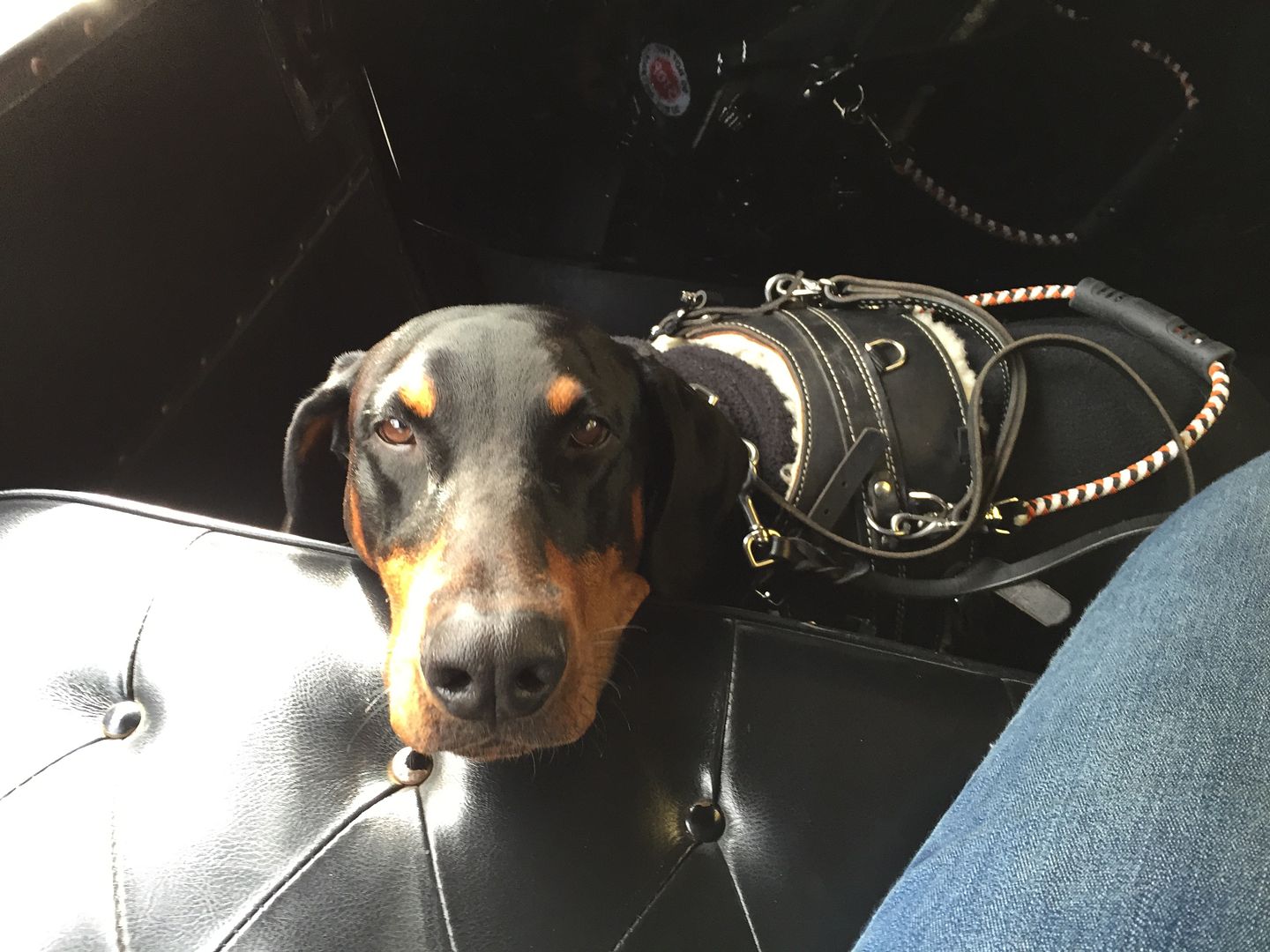
Kaline on the Model T.
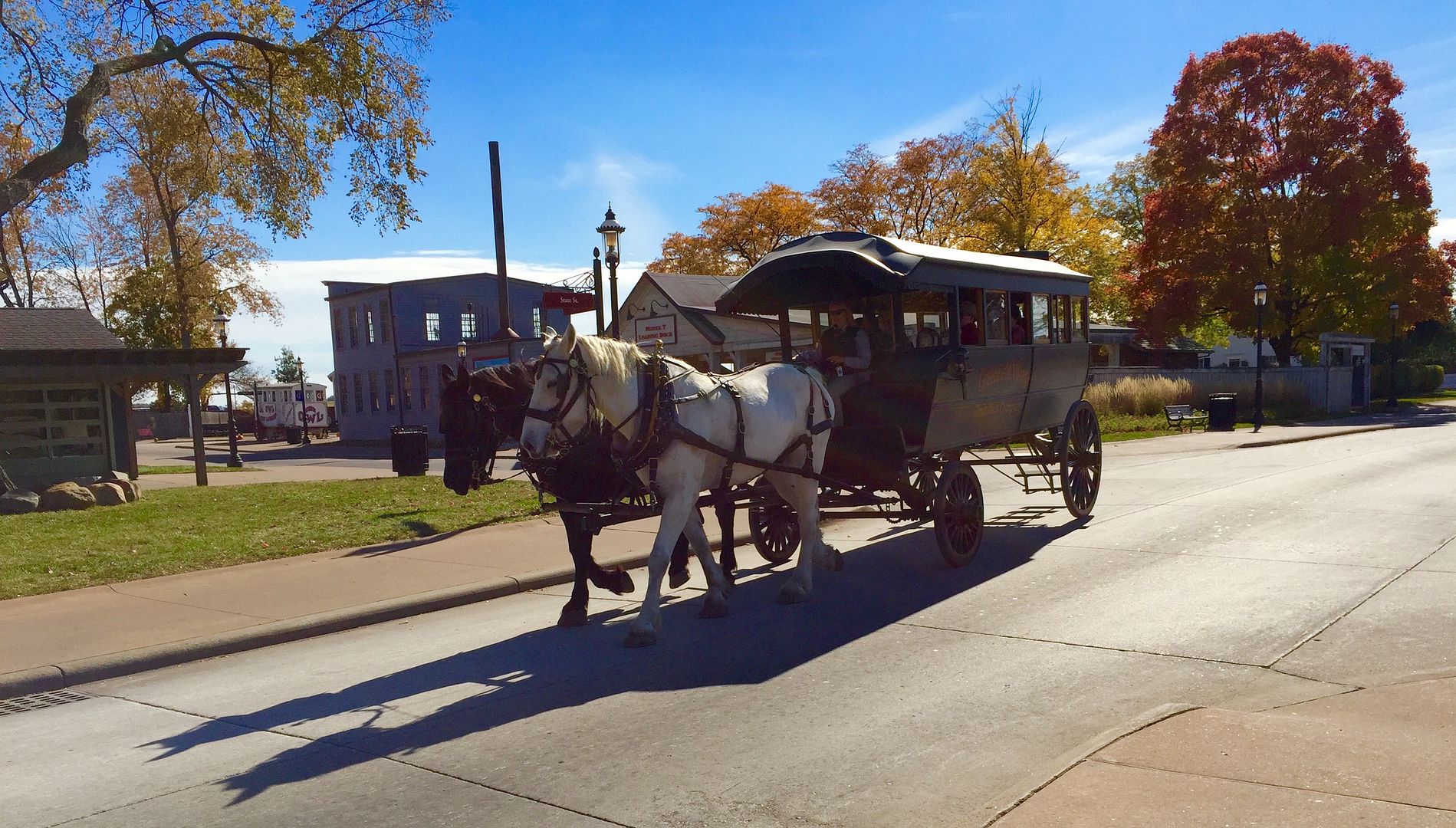
When we were the only ones on a particular horse-drawn omnibus, the driver let Kaline rest his chin on the window between the carriage and her driver's seat as she told us about her team, Wilbur and Orville. On the locomotive, he just objected to holding a down on the icy cold metal floor (can't really blame him). Kaline also enjoys riding the carousel.
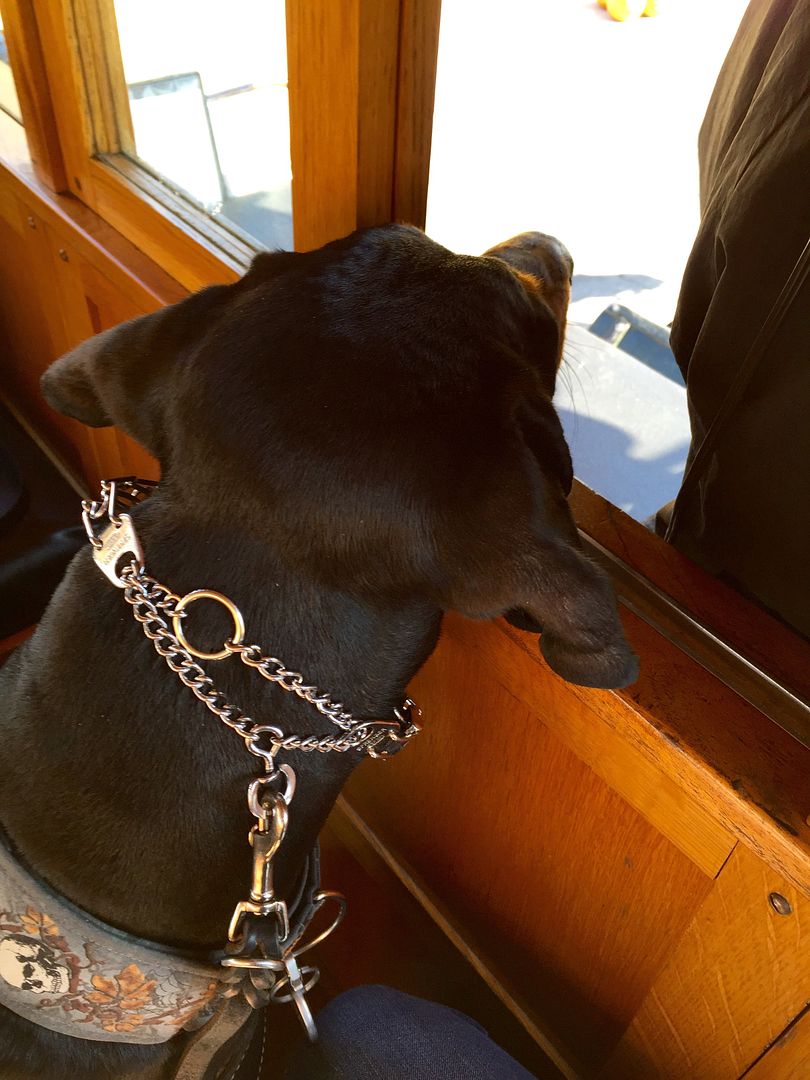
Kaline on the horse-drawn omnibus.
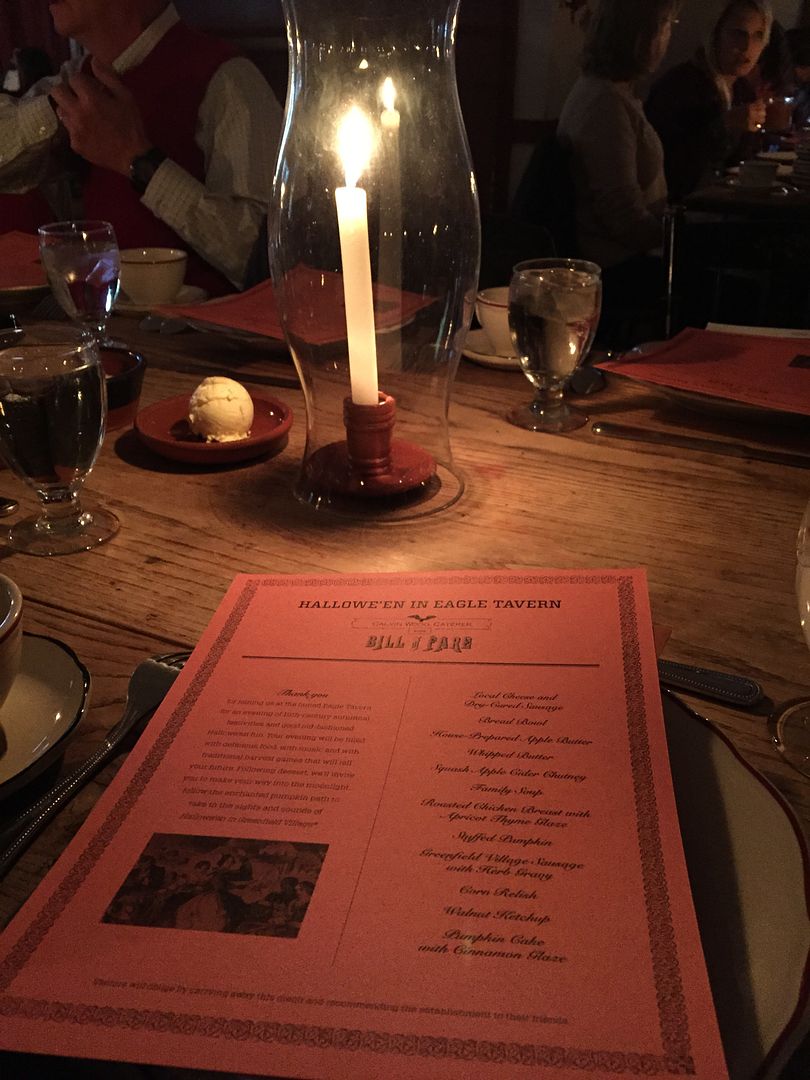
Another challenge of the village in the fall is our favorite special event, Hallowe'en Nights. We go to dinner in the packed Eagle Tavern with about 150 other guests—this year two of our tablemates were dressed as Sweeney Todd and Mrs. Lovett! It's dark, warm, and noisy—no electric lights—and a fiddler goes from table to table taking requests. Kaline was practically invisible, sleeping under the table until it was time to go out into the village.
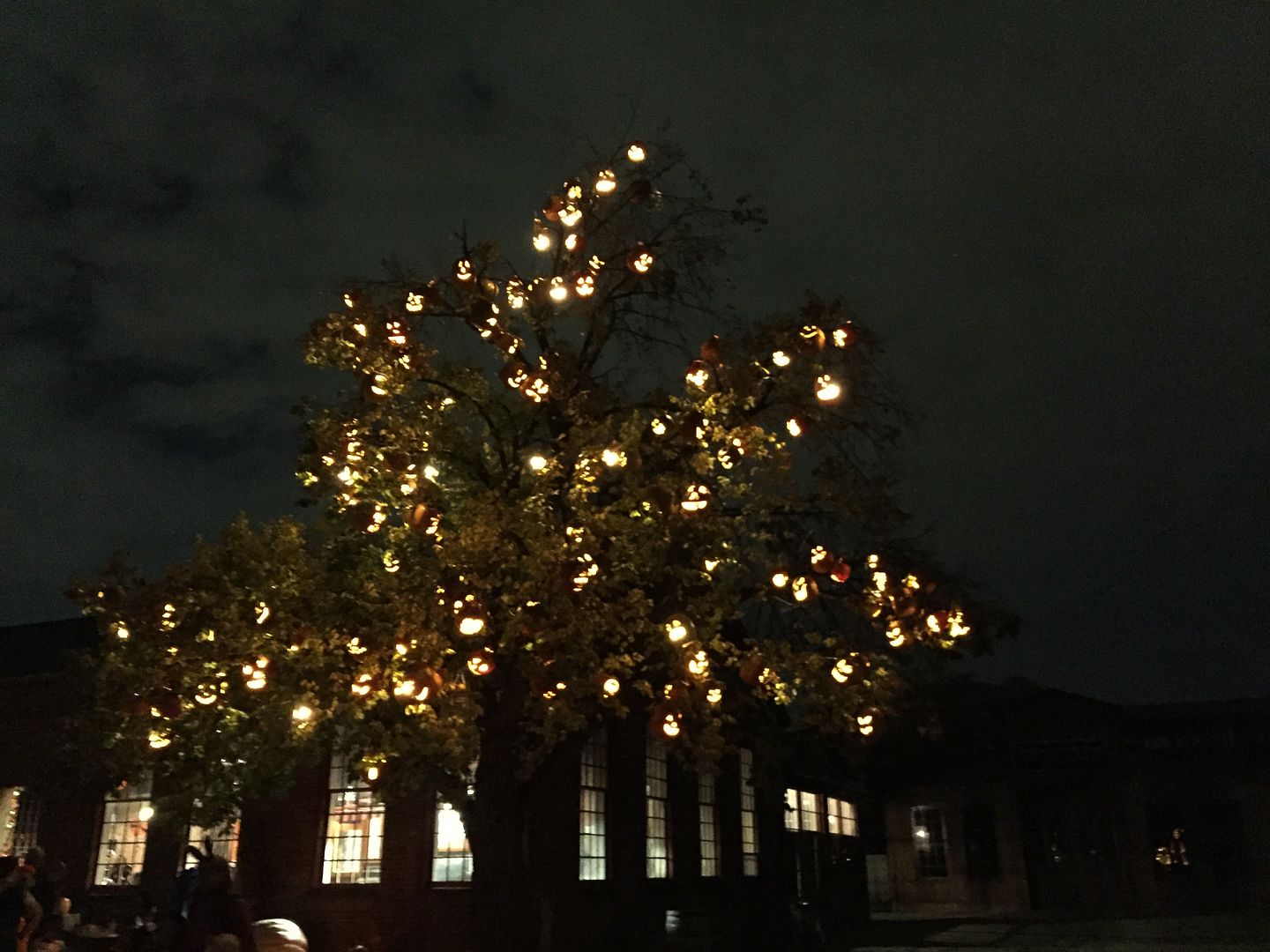
After dinner, we followed a jack-o-lantern-lit path all through the village. There are performances of Hallowe'en stories and songs. Most of the visitors come in costume, and at various points on the path, village presenters greet everyone dressed in elaborate vintage costumes.
It's a lot of moving through crowds in the dark—at one point we walked over a fog-filled, laser-lit covered bridge. There are buildings lit up to look like someone is raising a Frankenstein monster inside; the carousel runs backward to creepy music; and a pair of horses run up and down in a field to reenact the Legend of Sleepy Hollow. It's a lot to ask of a dog, asking them to focus with all that going on. Kaline just did his first one last year.
Kaline with some of the hundreds of hand-carved pumpkins.
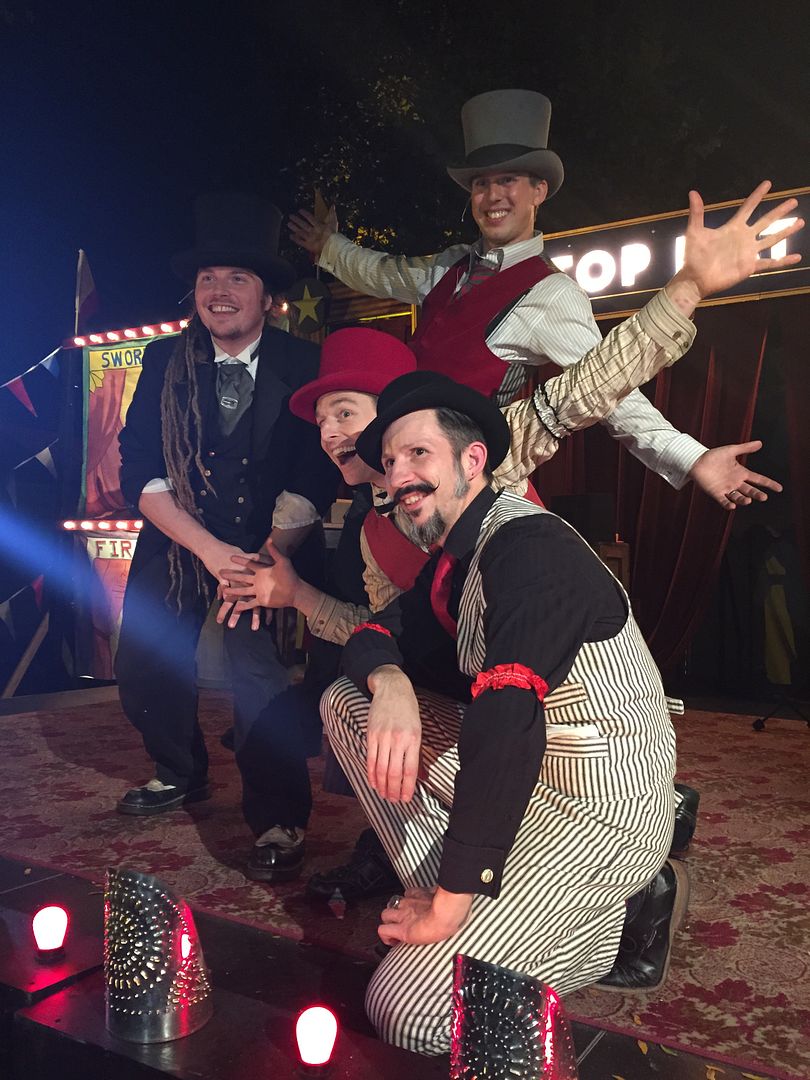
This year, he was totally unfazed by anything, except for one part in the excellent new Top Hat Sideshow where a performer was cracking a flaming whip. Suitable application of treats fixed that promptly. Kaline is quite willing to tolerate bizarre sights and strange loud noises if they mean he's going to get food. And while he doesn't need treats to perform his duties in normal locations, for events like Hallowe'en Nights I always make sure to take some high-value morsels with me. I like to think of it as hazard pay!
Kaline ably led me through all the crowds, ignoring all the costumed distractions. He was fantastic. We ended at the big restaurant, with Kaline passing out under a table while Mom and I shared some delicious mini-donuts and hot chocolate.
The next night was the fall musical, American Idiot, presented by the University of Michigan's amazing musical theatre department. If you've never seen it, it features songs from Green Day's album of the same name, at rock-concert volume. Earplugs for the human theatregoers were handed out at the door; for Kaline, I had purchased Mutt Muffs.
The ear protection for him was a rousing success—while the musical was blaring, I could feel Kaline twitching against my feet, so deeply asleep that he was having a fantastic dream.
It may be called a vacation, but it can actually be more exhausting than regular life, both for me and for Kaline. We are both under more stress than normal, and he is on duty far more than usual. He can go for twenty miles of pack walks and still want to do zoomies when he gets home. But after a full day of work—not just helping me, but maintaining his professionalism at all times—Kaline completely crashes.
Staying super focused in public is one of the hardest parts of being a service dog, sometimes even harder than learning the actual tasks. A good night of sleep restores him, though; it took me about a week after we got home to recover from our awesome and fun-filled vacation! Still, I can't wait to do it again.


Colt

03 November 2015

She is So Much More

We've been home a little more than a month, Megan and I. We've walked our neighborhood, gone to the doctor, been to the hospital, been grocery shopping, "stuff" shopping, and dress shopping for a fancy schmancy gala we will be helping with. We've been to the pumpkin patch and on walking trails and along the beautiful St. Croix River. We've been on an airplane, a hay rack ride, and trains, buses, and cars. We've packed a lot into a little bit of time so far.

When I tell people about her and our young partnership, I tell them that we don't walk together, we fly. Every time we go out, I am awestruck by our pace and by Megan's precision and near perfection. She is exceptional. We are a fast-flying pair and we're becoming stronger and more attuned to each other every day.

Thank you—every day, I think, "Thank you." When I safely cross at an intersection, or step up a curb without tripping, or find the stairs, or walk with grace, poise, and confidence with Megan by my side, I think, "Thank you."
She is so much more than a dog ...

She is so much more than a friend ...

She is so much more than a mobility tool ...

She is so much more than a gift ...

This dog—she is beautiful, impeccably trained, hard working, happy to snuggle, loving, protective, curious, and an incredible gift of the most precious sort imaginable. She gives me freedom, independence, confidence, assurance, and safety. She is so much more ... She is part of me, part of my family, and part of our community.

Thank you, Guide Dogs for the Blind, for both of these gifts: my retired guide, Picassa, and my new active guide, Megan. They are both so much more ... than I could have ever asked for.

Nicole Schultz-Kass

20 October 2015

A Service Dog in College

Greetings! My name is Sara, and I am a full-time college student studying biology. My owner-trained service dog, Velvet, is an Australian Shepherd. There are many educational posts about service dogs and public access, but that is only a small part of their daily activities they experience with their handler. I have seen various potential handlers and current handlers wondering how being a service dog handler works while in college. This sparked my idea to do a write-up about how an average day in college while accompanied by a service dog works for me.

Let’s start off with how I prepare for Velvet’s day with me.

Supplies: I have a bag filled with Velvet’s supplies. These supplies include a mat, a popup crate, a travel water bowl, boots, and a rain coat. We don’t use each of these supplies every day, but it’s good to be prepared.

Potty Breaks: I am fortunate in that I have a ten-minute break in between my back-to-back classes, and that all of my classes and laboratories are in the same building. When you are creating a class schedule, as a SD handler it is important to factor in time for your dog to be able to take a break and do their business. Especially for those on bigger campuses where you might have to go from one side of campus to the other in a mere ten-minute window.

Now on to our day!

Lectures

Currently, my lectures can last from 50 to 90 minutes depending on the days the class is scheduled. For this, Velvet has to lay quietly and not be a disturbance to the class. I also picked out a seat where she wouldn’t be obstructing an aisle as she cannot comfortably tuck under the desks in the classrooms. This is where the mat comes in handy, so she can lay beside my desk while I’m taking notes and participating in class.
Along with sitting through calm lectures, she also has to be calm during the more exciting lectures. One time my physics professor was throwing a ball around the classroom to various students while lecturing about free-fall objects.  This was a big test, but I had worked with Velvet on impulse control around various distractions. Even in “boring” lectures, you have to be prepared for anything!

Around Campus
Velvet at the coffee shop.
During my longer breaks in between lectures, I might go to the computer lab to work on coursework. In this case, Velvet will go into a tuck underneath the desk as to not take up additional room. If I don’t have anything to work on, I will go to the coffee shop and chat with friends over a frappe. I also have to consider that Velvet has been cooped up in lectures, and could use an off-duty break. This is especially important to remember if I have a lab that day, as that can last 3-4 hours. So often, I will take her for an off-duty walk around campus to let her stretch her legs and have some fun. After all, at the end of the day, she is a dog!

Laboratories

This is one topic that has different responses. To take your service dog to laboratories or not? In my experience thus far, it depends. For example, I do not take Velvet to my biochemistry lab due to the chemicals we are working with. I do not want to expose her to that, or disrupt that kind of environment by bringing in a dog. But for my physics lab, as long as we aren’t working with projectiles, I bring her. She is underneath the lab table on her mat, and I let her work on her Benebone for entertainment while my lab partner and I work on the experiment.
Along with my credit hour labs, I am also doing independent research in paleobotany. Part of my research includes making acetate peels of specimens, part of which involves having to etch the fossils in a tub of hydrofluoric acid. I am in a lab coat, rubber apron, rubber gloves and a face shield, so I obviously wouldn’t bring Velvet into this environment. My research setup is in a lab side room, so when I am working on my project, I have Velvet's popup crate set up in the main lab. The lab room she is set up in only hosts introductory level biology courses, so she is not exposed to chemicals there.
Overall, while we had to make some adjustments, we were still able to work around having a service dog in college. While it might seem daunting to have to not only adjust from “college life” to “college with a furry shadow life,” the benefits of the accommodation were worth it. My daily life has been enhanced with Velvet by my side as I go through my education.


Sara

06 October 2015

First flight

Flying with a service dog is a lot like traveling with a very obedient and helpful toddler. As long as you are well prepared, and anticipate pretty much any need that may arise, you'll be fine. You'll just be carrying a lot more stuff than usual, and most of it won't be yours. And you'll have a preoccupation with pottying that will be perplexing to anyone who has never traveled with a dog.
My service dog's gear always takes up at least one drawer in the hotel room.
That first flight though ... It can be a bit scary, especially if you've never flown with a service dog before. And even when you have, it can still be nerve-wracking to take your young, inexperienced partner on his or her first plane trip.
Experienced traveler Juno:
Unimpressed by all airplane-related things.
Juno, my first service dog, made her first flight when she was almost five years old. I was headed back to Ann Arbor, Michigan, so we flew Delta (the only airline that flies direct from San Francisco to Detroit). Delta is the only airline I've flown where I have never had a bad experience getting my tickets. Their disability hotline staff are impeccably well-versed in the Air Carrier Access Act (ACAA), which is the federal law covering service dog access on airplanes.

As ever, my girl was a pro, despite my nerves. At security, she got a pat down from TSA because I chose to call her through the metal detector wearing her service dog gear. Hilariously, when the first TSA agent discovered Juno was female, he immediately called for "female assist." (This has never happened with Kaline, my current—male—service dog, even if he's about to get a pat down from a female agent).
Juno just past security at SFO.
We got on the plane and Juno promptly curled up in the tiny bulkhead space at my feet (I have since learned to fly economy plus, where the dog usually has more room to stretch out under the seat in front) and went to sleep. Her powers of sleep and relaxation have always been fairly mind-blowing, but even so I couldn't quite believe that she slept through both the takeoff and the landing.
Juno on her first flight.
I always remove my dog's service dog gear
for the flight so s/he can fully relax.
Juno was also a very easy traveler because she has efficient relieving habits. You tell her to "get busy," and she does. Immediately. No. 1, No. 2, and done. She also seems to have an iron stomach (no matter what she eats, it almost never upsets her digestion) and an iron bladder. Her only requirement is that the pottying happen on something other than cement or asphalt.

I should note that airports legally must have a service dog relief area. However, that area does not have to be conveniently located or in any way appealing to dogs. San Francisco's area seems to be miles away from everything useful, and is slightly smelly and rather uncomfortable rocks dumped into a chain-link enclosed pen. They've tried to make it cute by having you follow little pawprints to get there, but after fifteen minutes of following said pawprints, you start to get a little annoyed.

Which brings me to one of the major perks of traveling with a male service dog who lifts his leg. Any vertical surface can be a potty spot! No need to wander about looking for grass, dirt, or gravel. Find a handy pole somewhere out of the way, and you're golden.

In that regard, Kaline has learned to do something Juno never had the opportunity to do: How to pee inside in the best service dog relief area ever. Just before Kaline's first flight, the Detroit airport put in a fabulous relief area inside security. The amount of anxiety this relieves can't really be overstated.

First of all, having to go through security twice due to needing a potty break is just a pain, especially if your disability affects your stamina and/or mobility. Trying to get out to the distant potty spot and then having to do security during a layover is even worse. Having a relief area inside security saves a handler innumerable amounts of stress and energy.

And you may have seen the story that made news of the service dog who had such a bad accident on a plane that they had to make an emergency landing ... That story features prominently in the nightmares of many handlers. The easier it is to potty your dog right before you fly, the better! The first time I asked Kaline to eliminate there, he looked at me like I was insane—"We don't PEE inside! What's the matter with you?" Now, when we get off the plane in Detroit, he books it straight to the area by Gate 34.
Can't beat the Detroit relief area.
Kaline's first flight was nerve-wracking in different ways from Juno's. With him, I had a good idea of what to expect at the airport and on the plane. I was able to prepare him more specifically for the ordeal. We practiced the stand for examination endlessly, since he is a far more stranger-social dog than Juno and would likely try to lick the TSA agent to death if allowed. He learned to curl up in a little ball at my feet and ride in the passenger foot-space of the car, getting comfortable in a small space and becoming accustomed to the rumbling feeling, as well as occasional "turbulence" if my dad was the driver.
Baby Kaline in the passenger foot space of my car.
We even did a practice run through security with my friend Sonja, whose service dog Chief is Kaline's best buddy. Practice runs are far more to settle any handler nerves than to settle the dog's. Kaline was completely fine, and once I saw him do it without the pressure of a flight to catch, I was able to be much more relaxed during the real thing!
Kaline waiting to board his first flight.
Kaline was only sixteen months old when he did his first flight. It worked out that both my parents were going on the trip, so we took up a whole row on the plane. This turned out to be really good, because Kaline did not sleep through takeoff or landing. I had armed myself with high value treats, expecting this to happen, so he got rewards all during the scary parts in addition to being cuddled by the whole family.
Kaline on his first flight, once the excitement of takeoff had ended.
Being a diva Doberman, Kaline was also more high maintenance in flight than Juno because he believes any temperature under 60 degrees to be extreme cold. Our last several flights have been so warm as to be nearly uncomfortable, but back then all the planes were very chilly. Where Juno just curled up on a thin mat and conked out, in "cold" Kaline requires: a thick Ruffwear pad to insulate him from the plane's cold floor, his Ruffwear Cloudchaser, his fleecy pajamas, and sometimes a Delta blankie from a kind flight attendant.

Though Kaline did well in the air, his apprehension during takeoff and landing was a bit worrying to me. However, with every flight he took, that diminished. Today, Kaline is a pretty experienced flyer and is unimpressed by all the strangeness of air travel.

All he needs is a comfy headrest, and he's good to go!


Colt


29 September 2015

Patrick is growing!

Hi everybody! Sorry if my last blog was a little sad, I promise this one won’t be. Patrick has been with us for two and half months now, and boy has he grown! I can’t believe it—he is as tall as I am now! None of the other puppies I have helped raise have grown this fast.
He is doing pretty well, but can still be an annoying little brother at times. He is always moving! If Patrick wore pants, I would say he acts like he has ants in his pants. I thought that I had a lot of energy, but Patrick even wears me out sometimes. When he does finally tire out he likes to lay really close to me. He’s actually pretty sweet when he is tired.
Patrick is learning a lot. He finally knows to go potty outside like me and Ozzy, which is nice. I don’t like potty inside the house—it makes Mommy upset. He also know how to walk with us much better now, but sometimes likes to hold either my leash or his own leash in his mouth as we walk.
He can still be very loud at times, especially if another dog barks or if he sees another dog, Mommy is spending a lot of time trying to help him with that.

Patrick has also earned a little more freedom in the house and he is constantly trying to get someone to play with him. He likes to take toys to Mom or Dad and drop them at their feet or in their laps and stare at them.
He will also bring toys to me and ask to play tug. I love playing tug! But don’t tell that to Patrick. I like to be cool and say, “ I guess I will play with you—if no one else will.” I don’t want him to know that I actually like playing with him, it may go to his head. Sometimes I let him win ... just to be nice. I do worry though that he is going to get so big that I won’t be able to win if I want to. Ozzy is also starting to play with him a little and Patrick likes to try to play keep away with toys with him. Patrick is pretty smart and tries to outwit Ozzy, but Ozzy is pretty smart too.

Now that Patrick is getting a little bigger, Mom and Dad have been taking him out on his own more often. I don't like this as much. I don’t like being left out. But Mom has made a little special time for me too. We recently went to the pet store, just the two of us. She let me see all the little animals there, which was fun. I tried to convince her to let me get a pet rat because they were so cool to watch, but no luck.
I did guilt her into buying me a new toy and a special treat, hehehe. I have great sad puppy eyes. I learned this trick from Eli—he was the master of the sad puppy dog eyes. When we would go to the store when he was still with us, the people at the checkout would just keep giving him treats! His eyes had special powers on people, I’m good, but not Eli good.
Ricki attempts to channel Eli in order to get a bite of that yummy sandwich.
Oh my Dawg! I almost forgot to tell you about Sebastian! Mommy brought home a super tiny kitty last week. We had a naming contest and Sebastian was the winning name. l really wanted his name to be Koda, just like the bear I met at Disneyland.
I was a little frightened of him at first, but he was calm and nice. Anyway, I love kittens! They are really fun to lick and clean. Ozzy really likes him a lot too, I think he misses his kitty, Fidget.
I’m trying to be as helpful as possible with Sebastian because Mom’s pretty busy with so many other things. The first week we had him Mom had to get up in the middle of the night to feed him and I would always get up with her to see if she needed any help. Ozzy just kept sleeping and wasn’t very helpful. He prefers to just play with him rather than help with the hard stuff.
Patrick is very interested in our older kitties and wasn’t sure what to make of Sebastian when he first arrived. I think Patrick thought Sebastian was a toy at first and tried to grab him from Mommy’s hand. Mom and I have taken some time to show Patrick how to be calm around a baby kitten.
I have to say I’m really proud of Patrick. He actually took the time to slow down and listen to what we were trying to teach him. He can now sit quietly next to Mommy and me while Sebastian gets fed. Anyway that’s all the update that I have for now. I think I hear Sebastian crying so I better go help Mommy get him fed and clean.
Wags and kisses,
Ricki