Patrick, GUGP's 2015 Guide Dog Puppy

Patrick, GUGP's 2015 Guide Dog Puppy
GUGP Website
Showing posts with label new puppy. Show all posts

25 August 2015

Guest Post: Owner-training my own service dog

Training a dog for service dog work is an interesting undertaking, no matter how you look at it. Vincent is my first service dog, and after researching several programs and doing a bit of pro-and-con comparisons in my head, I ended up deciding to look into a breeder and do the job myself.

Oh, boy.

I did all the research, of course. Which breeds would be best suited for me, different training techniques, different training tools … I thought I was prepared. When I picked up my nine-and-a-half-week-old ball of fluff, I had all but convinced myself that I could tackle just about any obstacle thrown my way. I had the support of other trainers, of course, and other handlers who had been in my position. When I brought Vincent home, I was so excited. He was going to be the most amazing dog ever and everything was going to be fabulous and I was going to have so much energy. Then when it was all over, I’d have this wonderful dog ready to go out into the world and help me grab it all by the horns.
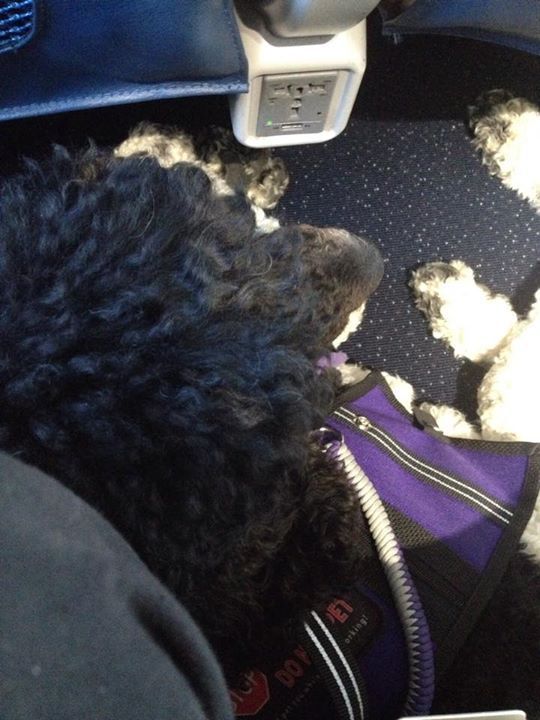
Vincent traveling on an airplane.
Let me explain the reality of raising and training your own service dog from puppyhood. It’s not quite as I thought it would be. I enjoy sports references, so instead, think of it as though you’re about to go twelve rounds with Evander Holyfield. And then, for just a moment, imagine that you’re in that ring, you’ve got no boxing gloves, and you’ve never, in fact, thrown a punch in your entire life. Now you’ve got to figure out how to survive those twelve rounds. Holyfield is faster than you are, and he can throw a pretty good punch, too.

This is kind of what it’s like to raise and train your own service dog.

Round one isn’t too bad. You and your opponent are just getting to know each other. You’re just starting to figure out what works with him. Should you duck, or lunge? In dog training world, we’ll call this the basics stage. Before you start working with a puppy, you need to get to know that puppy. You need to figure out what sort of things work for that dog, and which sort of things don’t. There’s a myth in the training world that all techniques work the same on all dogs. This is a fallacy. Every dog is different, just like people, and understanding that will help you to understand that sometimes you have to approach things a little differently with dog B than you did with dog A. So, you’re getting to know your dog. You can recognize his ‘I have to potty’ face. You have realized that he’s more motivated by his toys than his treats. You have noticed when he’s more alert, more attentive.

And now, it’s time to dance. You throw the first punch. You might even throw a few really good ones, and you’re in the ring, and your feet are moving as though you’re possessed by Muhammad Ali, and you’re doing a pretty good job. You are gaining some headway, and you begin to think that twelve rounds might not be too bad.

By round three though, you’re starting to lose some steam. We’ll call this the ‘oh my goodness, my dog is growing up’ stage of the training process. When a puppy is first learning, everything is great. They seem to catch on easily. You might even try to rush things. I know I did at one point.

“Well, my pup knows sit, stay, and down, so we can move on to this now! Wow, he’s doing so great! This is the most amazing thing ever! I didn’t know I was a dog training guru!”

Think again.

By the time Vincent was about six months old, he had been house-trained and knew most of his basics. I thought these basics were pretty solid. He listened well. We had bonded. We were the best of friends. This would be the stage of the fight just after you’ve gained some ground against Holyfield. You’re feeling pretty good about yourself, and for a moment, just a small sliver of time, you let your guard down. Holyfield sees his opening and cold-cocks you right in the face.

Vincent was being a bit … rebellious. All of a sudden my gorgeous, well-trained puppy was unrecognizable. He was barking at other dogs, running around and hopping on things and on people. He seemed to have forgotten how to sit, as though he simply couldn’t get his legs to complete the motion. I felt as though the wind had been knocked out of me. 

This is the not-so-glamorous side of raising and training your own service dogs. There are lots of ups and downs. Fear stages. Rebellious stages. Training hiccups. There are going to be several times when you’re going to doubt yourself during these times. I don’t know how many times I sat in my living room during times like these, head in my hands as I played over every day of the past several months in Vincent’s life and wondered if I had gone wrong, and where, and how to fix it if I had.

But the thing is, one punch doesn’t necessarily lose you the fight. Sure, your head is spinning a little bit, and the world looks like some blurry melting pot of colors and unrecognizable shapes. It takes you a minute to shake it off and make the world right itself again. You might need a bit of a break and a little pep talk from your cheering squad. In times like these with Vincent, I often turned to my friends, and to trainers and other service dog handlers in the community. In doing so, I learned something that turned out to be very valuable: That I was not alone. That other handler’s dogs went through fear stages. That other handlers’ dogs had chewed their favorite pair of shoes despite seven months of never showing interest in those things at all. And most importantly, that other trainers and other handlers had doubted themselves. Even those that were vastly more experienced than I was.

So, now you’ve had a bit of water, and the world has stopped spinning, and your cheering squad is screaming your name, and it’s time for another round with Holyfield. The little break helped you refuel a little bit, and your fans have definitely boosted your ego a bit, too. The bell rings, and you’ve already taken one hit, so you go back out there to face Holyfield knowing what that fist to the face feels like. You can anticipate it next time. You can work around it. You might even be able to throw a few more punches of your own.

I’m going to be honest. Vincent went through several of these stages. He had a lot of problems that at the time seemed like mountains I would never be able to scale. There were times I was sure that I had failed him, and in doing so, had failed myself, and that he would never be able to make it as a service dog.

The truth of the matter is the plain and simple fact that owner-training and raising your own service dog prospect is hard work. It’s an emotional roller-coaster with lots of ups and downs. The truth of the matter is that no matter how hard you work, no matter how much time you put in or how much you think you’ve analyzed everything, some dogs, most dogs simply aren’t cut out for service work, and you still may fail. I thought I would.

However, if you learn to roll with the metaphorical punches, it can be a very rewarding thing to do. Vincent did succeed. He’s getting ready to “graduate.” And the truth of the matter is, even though I still sometimes feel like I’ve spent twelve rounds in a boxing ring and gotten the stuffing knocked out of me, at the end of the day, I’m still standing, and there is nothing that I have ever been more proud of in my entire life than the seemingly insurmountable task that Vincent and I have tackled together.
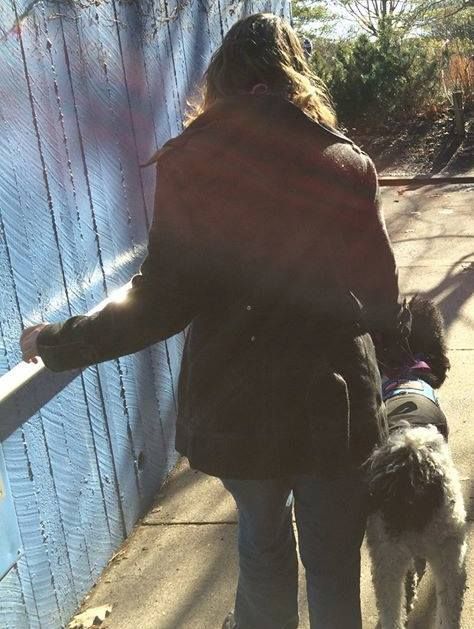


Submitted by Kayla Hoyet


Have a service dog or puppy raising story you'd like to share? Send it to us! We will be featuring posts by guest authors on a regular basis.

18 August 2015

Finding Growing Up Guide Pup

Sometimes, YouTube knows what's best for you.

In August of 2011, I was owner-training my first service dog, Juno. Issues that had been simmering for years had finally developed into a full-blown disability. My doctors supported my plan to train my four-year-old Doberman mix to help me. To help myself, I constantly watched various training and service dog videos on YouTube.

Soon, every time I opened the page, this big shades-of-green pawprint logo would dominate the "suggested channels" section. I ignored it for weeks (bad decision). Finally, I clicked on Growing Up Guide Pup's channel.

For the next several days, I was glued to my computer and my phone. I had to know what each week held for adorable little Ricki. I loved seeing her adventures, especially when she got to tag along on an outing with working guide dog Bamboo. You wouldn't believe how few good videos of working guides are out there. I adopted Juno when she was 18 months old, so seeing a puppy being raised from day one as a service dog candidate was fascinating. I was sad when Ricki was career changed, but glad that she came home to Amie and Matt.

Training with Juno continued apace, and by September—nine months after beginning focused service dog training—she had graduated. Our partnership was unbelievable. She was unflappably professional, and we rarely had a miscommunication.

Then in February of 2012, I found out that Juno had Sudden Acquired Retinal Degenerative Syndrome, or SARDS. Basically, it meant that unless she responded to an experimental treatment, she would rapidly go blind. Of course, I retired her from work—and my world seemed to shrink instantly to a confining bubble. I began contacting the Doberman breeders I'd already researched on the assumption that I wouldn't be getting a puppy until summer 2013.

Soon, I knew that barring a lack of male puppies, I would be getting my new service dog prospect in June. I commenced binge-watching Growing Up Guide Pup again, this time looking at it with new eyes. In a few months I'd have a tiny little puppy just like that, and if I failed at raising him, two years later I'd still be without a service dog. I tried to absorb every extra bit of knowledge, even going so far as to download the Guide Dogs for the Blind Puppy Raiser Manual to see what tips I could glean from it. (The potty training section: Pure gold.)

At the end of February, I was walking a pack of dogs along Alameda de las Pulgas. I saw another group of dogs heading toward us, and was about to cross the street to give them more space when I suddenly had to take a second look. One of those dogs looked really familiar ...

In super cool and very dignified fashion, I blurted, "Is that RICKI?!" Then I recognized Eli next to her, and realized that Matt was walking them. I practically died—I may have a few hero-worship issues. I babbled to Matt about how I had watched Ricki's whole season within a few days—sometimes while walking the dogs—and he seemed almost as excited that I was such a fan of the show.

Despite my little performance, I became friends with Amie and Matt. Juno responded very well to the experimental treatment and regained her vision, taking the pressure off the mind-blowingly adorable puppy who arrived right on schedule in June—Kaline.

Thanks to Amie and Matt, Juno and I got to accompany a guide dog puppy group to a San Jose Giants game. Later, I brought Juno and little Kaline to meet Amie, Matt, and Pilaf at a local Mutt Strut. And Kaline, now three years old, grew into a confident and capable service dog, following in Juno's pawprints.

Having been such an ardent fan of the show, I was elated when Matt and Amie asked me to get more involved with Growing Up Guide Pup in preparation for Patrick's arrival. I love advocating for service dogs and educating people on the amazing things these dogs can do, from guiding blind handlers to alerting to impending seizures to stopping panic attacks.

I can't wait to see Patrick grow up!

Colt

28 July 2015

Ricki's Welcome

I’m so excited—this is my first official blog! Let me introduce myself. My name is Ricki and I was the very first star of Growing Up Guide Pup. But I have had a new job since I decided that I would rather chase squirrels than be a guide dog. I am a mentor dog to all the new puppies that come into our house, no matter how annoying those puppies can sometimes be.

We just brought home a new puppy last week and he is going to be the next co-star of Growing Up Guide Pup, after me of course. We took a very long drive to get him because he came from a different Guide Dog school than I did. We turned the trip into a little vacation and it was so much fun.

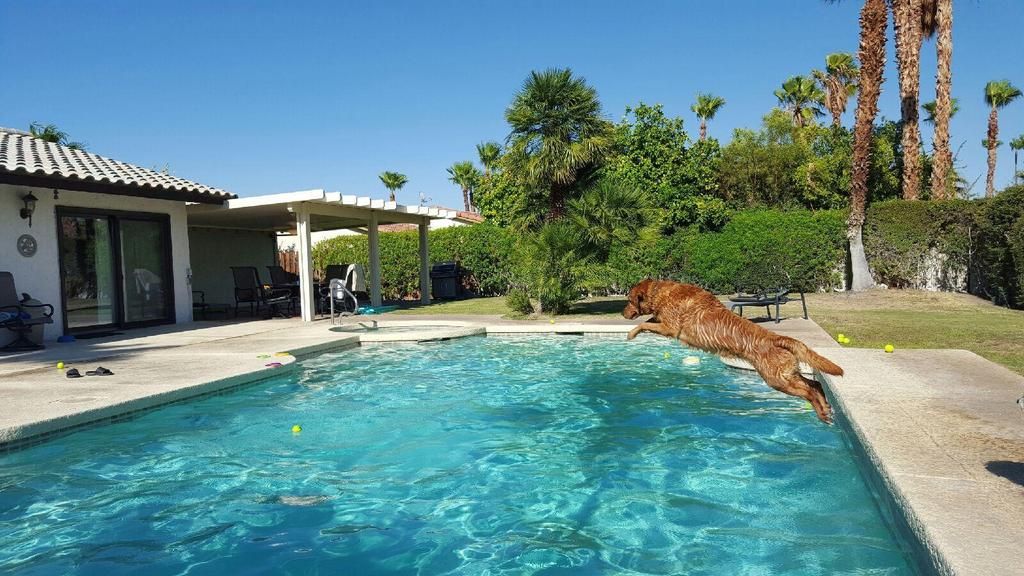
After many long hours of driving, we arrived at this amazing house that had a fenced-in backyard and a pool! I love to swim, especially jumping in the water after tennis balls. My little brother Ozzy doesn’t like it as much as I do, but he did give it a try. It was really hot where we were, so swimming every day was a great way to stay cool.


On the third day of our trip, my parents arrived back at the house after being away for a little bit with our new temporary little brother. His name is Patrick and he is a little German Shepherd. He hopes to be a guide dog one day. Back when I was a puppy I thought I wanted to be a guide dog too, but I also like to chase squirrels and I was told that I could not do both. Be a guide dog and chase squirrels, that is. So I chose to chase squirrels—best decision ever!

Anyway, back to Patrick (sorry, dog brains get distracted easily sometimes). So far, he’s a good puppy, but boy, can he be loud sometimes. He doesn’t like his crate too much. He told me it’s because he has a hard time seeing us in it and that he doesn’t like to be alone. I’m not much for the crate either and my mom and dad say that I used to cry a lot in the crate too when I was a puppy. I would try to deny it, but there is video evidence to back it up.

Patrick likes to think that he is older than he is and tries to be in charge with some of our dog friends, but so far he seems to understand that Ozzy and I are the big brother and sister and he listens well to us. He has been really good at not pulling on my ears or tail like previous puppies I have helped raise, so I like that about him. He is a very slow eater and that makes Ozzy and me a little annoyed. Seriously, if you don’t want your food we are happy to help you finish it. Patrick is also really good about not stealing our toys. A puppy that comes up to you when you are enjoying a really good chew and tries to take your toy from you is not my favorite thing.


So far, Patrick is doing well with us. Ozzy may think a little differently than me though—he makes the puppies wait awhile before he will start playing with them. But as for me, I don’t mind him too much. That’s about it for now as I just heard the letters F-E-T-C-H come out of Daddy’s mouth and I don’t want to miss out on that! I will keep you posted on how my new little brother is doing soon.

Wags and kisses,
Ricki